Chapter 27Carrier Protein Structure and Recognition in Peptide Biosynthesis
In this chapter, we describe carrier protein structure and recognition in polyketide and nonribosomal peptide biosynthesis [1, 2, 3]. This chapter builds on the earlier lectures on protein flexibility, and motivates, by a specific empirical example, the concepts of conformational change (switch) in proteins, and recognition at protein-protein interfaces. The purpose is to ground the algorithmic discussion by reference to specific systems, and to learn more about NRPS.
Carrier Proteins
Carrier proteins in polyketide synthase (PKS) and nonribosomal peptide synthetase (NRPS) systems play an important role in synthesis of polyketides and nonribosomal peptides, respectively (figure 27.1). Carrier proteins are relatively small in size (80–100 amino acids; 8–10 kDa) compared to other catalytic domains in a synthase system. The key role of carrier proteins is to serve as an attachment site for monomers (acyl, aminoacyl, or aryl compounds), and intermediates during the sequential synthetic reactions, shuttling intermediates between catalytic modules during the synthesis. Both monomers and intermediates are attached to a carrier protein at a thiol group of the phosphopantetheine cofactor that is covalently attached to a carrier protein. Since there are three kinds of possible building blocks for these two enzyme systems, carrier proteins are categorized into groups accordingly: acyl carrier proteins (ACPs), peptidyl carrier proteins (PCPs), and aryl carrier proteins (ArCPs). Basic reaction steps are shared among different systems. These sequential reaction steps include activation of a monomer, and condensation between an activated monomer and a growing chain.
The PKS and NRPS systems are responsible for syntheses of a vast number of secondary metabolites. Such variability comes from varieties of building blocks, and additional modification steps in each elongation round. Even though final compounds, monomers, and catalytic members of the systems can differ to a great extent, there are some similarities among carrier proteins of different systems. Specifically, many carrier proteins have a similar general fold motif, and hence are characterized into a superfamily. Figure 27.2a (plate 31) shows this prototypical four-helix bundle structure of carrier proteins.
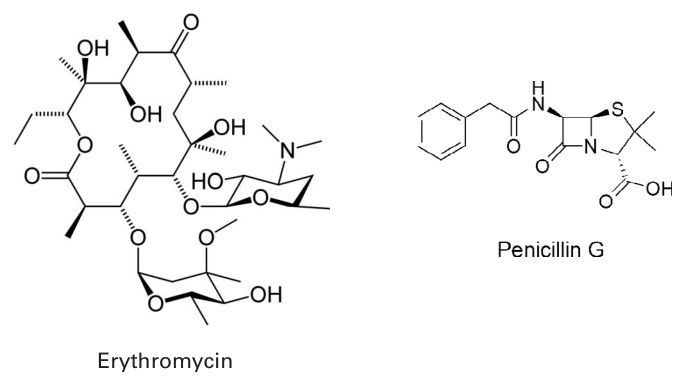
Figure 27.1 Two examples of a polyketide compound (erythromycin) and a nonribosomal peptide (penicillin).
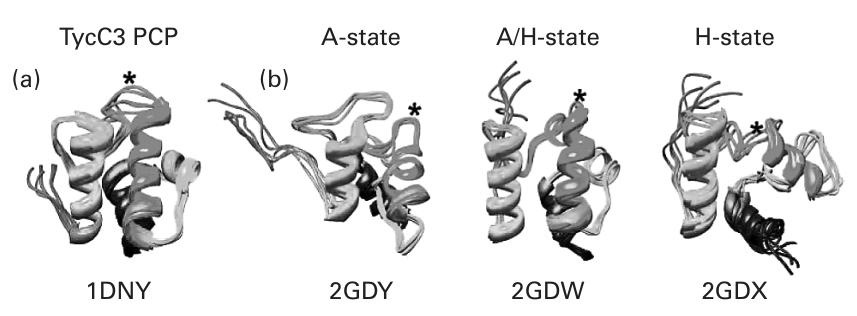
Figure 27.2 (plate 31) Structural mobility in a PCP: distinct conformations of the third module of tyrocidine synthetase-TycC3-PCP [4]. (a) Canonical structure of TycC3-PCP reported by [5]. (b) Three distinct conformations reported by Koglin et al. [3]: 2GDY for an Apo state (no cofactor attached), 2GDX for a Holo (cofactor attached) state, and 2GDW for an Apo/Holo state. Note that the structure of the A/H state is similar to the previously determined structure [1]. Reprinted with permission. Copyright 2006 American Chemical Society.
The structure portrayed in figure 27.2a (plate 31) is not the only conformation of this carrier protein, TycC3. NMR studies have shown that some carrier proteins in PKS or NRPS systems have multiple distinct conformations, and dynamic changes among conformations modulate protein interactions during the synthesis. Proper and specific protein-protein interactions (PPIs) between carrier proteins and other catalytic domains are essential for sequential reactions to occur. However, the carrier proteins are small compared to other catalytic proteins that they interact with, and movements of the phosphopentatheine arm are not in a sufficient range for interactions. This is where conformational mobility of carrier proteins comes into play, modulating interactions during the well-timed sequential synthetic reactions.
Combinatorial mutagenesis studies on some PKS/NRPS systems have revealed that the interacting surface on some carrier proteins is localized. Only a few key residues are responsible for interacting with a catalytic domain, and the key residues are distinct and specific for interactions with different catalytic domains in these systems. These results give an insight into possibilities to create a carrier protein with a noncognate interaction, and hence a possible novel final compound. However, we still need to know more about whether these principles hold true in other systems, and to have better understanding of protein-protein recognition and interactions between carrier proteins and other catalytic domains for this engineering purpose.
Dötsch and coworkers [3] showed how NMR studies revealed three distinct conformations, encoding a conformational switch, for a carrier protein. These switches modulate PPIs in NRPS. The study [3] demonstrates the power of NMR to elucidate the connection between dynamics and biological protein function.
References
- [1] J. R. Lai, A. Koglin, and C. T. Walsh. Carrier protein structure and recognition in polyketide and nonribosomal peptide biosynthesis. Biochemistry 45;50(2006 Dec 19):14869–14879.
- [2] J. Lai, M. A. Fischbach, D. Liu, and C. T. Walsh. A protein interaction surface in nonribosomal peptide synthesis mapped by combinatorial mutagenesis and selection. PNAS 103;11(2006):5314–5319.
- [3] A. Koglin, M. R. Mofid, F. Lohr, B. Schafer, V. V. Rogov, M. Blum, et al. Conformational switches modulate protein interactions in peptide antibiotic synthetases. Science 312(2006):273–276.
- [4] J. R. Lai, M. A. Fischbach, D. R. Liu, and C. T. Walsh, Localized protein interaction surfaces on the EntB carrier protein revealed by combinatorial mutagenesis and selection. Journal of American Chemical Society 128(2006):11002–11003.
- [5] T. Weber, R. Baumgartner, C. Renner, M. A. Marahiel, and T. A. Holak. Solution structure of PCP, a prototype for the peptidyl carrier domains of modular peptide synthetases. Structure 8(2000):407–418.