Chapter 30Side-Chain and Backbone Flexibility in Protein Core Design
Having discussed protein design and protein flexibility in several chapters, we now consider another way that researchers have combined these two algorithmic and modeling themes. In this chapter, we discuss soft repacking of cores (SoftROC) [1], an optimization technique that combines genetic algorithms (GA) and Monte Carlo (MC) procedures with Metropolis sampling and simulated annealing. This technique is applied to protein core structure prediction with flexibility for both the backbone dihedral angles (DAs) and the core side-chain rotamers.
This chapter builds on, and complements, our earlier discussion of provable, DEE-based algorithms for protein design with backbone flexibility (section 12.6 of chapter 12).
Protein Modeling with Fixed or Flexible Backbone
Many protein modeling algorithms are based on the assumption that the backbone structure is given and fixed. A few of these methods have achieved success by experimental confirmations [2, 3, 4]. Despite the reduced complexity and the nontrivial task of constructing or selecting an appropriate force field for that backbone, these methods have certain limitations. Most important, stable hydrophobic core structures with significant backbone relaxation have been found in crystallographic studies [5, 6, 7]. These structures are disallowed under the fixed backbone assumption. Further, these algorithms are usually unable to contribute in de novo protein design because apparently no precise starting backbone is available.
An earlier work [8] employing backbone flexibility targeted coiled-coil core motifs. The method uses the symmetric geometry of such structures to alleviate the increase in complexity introduced from additional backbone parameters, and impressive success was achieved in both prediction and design. Another study [9] approximated backbone flexibility by systematically generating multiple backbone variants and then feeding them into a fixed-backbone algorithm. This method successfully designed a series of novel variants that have similar properties to those of the wild-type protein. The limitation of both methods is that the generalizability still remains unclear. Thus, the authors of SoftROC provide a possibly more general solution by introducing simultaneous optimization on backbone and core side-chains, and solving it with a combination of fast non-deterministic algorithms. The algorithms are heuristic, and are not provable, but they provide an interesting study in design with flexibility. For provable algorithms for protein design with side-chain and backbone flexibility, see section 12.6 (chapter 12).
SoftROC
The SoftROC algorithm is based on torsional modeling, which modifies dihedral angles (DAs) instead of Cartesian coordinates. It comprises three steps: (1) generating initial backbone models; (2) finding a locally optimal model using genetic algorithm; and (3) refining the model with a specialized Monte Carlo sampling.
First Step: Initializing Backbone Population
First, the backbone structure of each member in the initial population is generated by randomly choosing and angles within , and values within , of those from the template protein. Then, to avoid error propagation throughout the entire amino acid chain, an initial Monte Carlo (MC) optimization on the folding energy defined by the Amber force field [10] is applied.
The core side-chain identities and DAs are generated by randomly choosing a rotamer from a rotamer library [11], and then choosing each DA to be within of that from the rotamer. For noncore side-chains within the core sequence, these values are fixed to be values from the template protein. For all the other side-chains, only the fixed DAs of and from the template are included.
Second Step: Optimization with Genetic Algorithm
The genetic algorithm (GA) is a series of evolutions (iterations) on a population with predefined stopping criteria. In each evolution, every member in the population is evaluated by a fitness function. Then, some pairs of members (usually the fitter ones) reproduce offspring via recombination, that is, exchanging values between each pair. The offspring are again evaluated, and the total population is subject to selection, where only the fitter members survive. Finally, the resulting population is subject to random mutations to maintain diversity. An illustration of GA is shown in figure 30.1 (plate 33).
In a typical run of SoftROC, a population of 200 initial torsional models is fed into the GA algorithm, where the population evolves during 300 evolutions. In each evolution, SoftROC performs the following variant of GA procedures:
Fitness Evaluation The fitness function is defined as the normalized Boltzmann probability, whose temperature parameter decays linearly from 10,000 K to 100 K (also known as simulated annealing) to avoid early convergence to local optima.
Stochastic Selection Each model is allowed to reproduce offspring proportional to the fitness function. It is stochastic in that every model has a chance to reproduce offspring, and none of the parent models, whether fit or not, is kept in the next evolution.
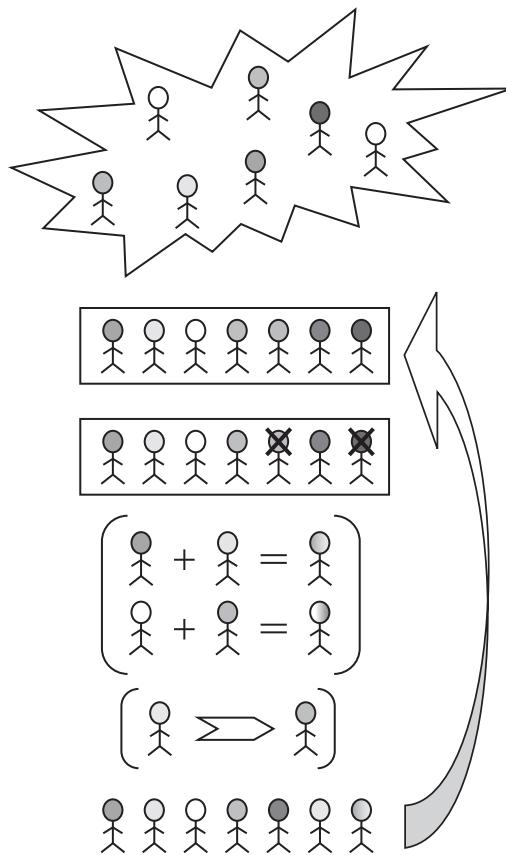
Figure 30.1 (plate 33) Genetic algorithm with a snapshot of one evolution. In this example seven members comprise the initial population. In the selection phase, two members are found unfit and will be replaced. In the recombination phase (also known as crossover), two member pairs are chosen to reproduce two offspring with combined characteristics from their parents. Finally, in the mutation phase, the pink member is picked and modified to be pinker.
Uniform Recombination Each model pairs with 200 randomly selected other models. Only one of the two recombined offspring is kept, and its values come from either parent randomly and uniformly. From the property of normalized probability, the number of offspring sums up to 200, which means the population size remains invariant over evolutions.
Mutation Each new model is subject to random changes of three types: (1) A 3% chance to change rotamer classes and/or side-chain identities within a range; (2) a 10% chance to change side-chain DAs within a range; and (3) a 0.5% chance to change backbone DAs within a range. A special restriction after 280 iterations disallows rotamer class change and allows only a range of backbone DA changes.
The model in the final population with the lowest energy serves as the input to the ensuing MC refinement.
Third Step: Refining the Model with Monte Carlo Sampling
Monte Carlo with Metropolis sampling is an iterative stochastic optimization approach. In the iteration, a sample is obtained by a random movement from according to a proposed probability distribution . This movement is accepted as with probability , where is defined as
If is not accepted, is set to .
In SoftROC, is the Boltzmann probability, whose temperature parameter decays linearly from to . is a mixture of unchanging and uniform changing within a range. For each side-chain DA, the changing probability is 10% and changes are restricted within range. For each backbone DA, the changing probability is 2%, within a range. Rotamer class changes are disallowed throughout the MC process.
Final Model
SoftROC performs 20 runs of the aforementioned steps. After a first set of ten runs, the rotamer library is trimmed by omitting those classes not included in any of the ten models. The same trimming is performed after an additional five runs. The last five runs are then performed with the trimmed library. The model with the lowest energy among the 20 runs is selected as the final model.
Issues on Energy Calculations
In the SoftROC paper, the authors first apply the conventional AMBER force-field [10] potential with OPLS (Optimized Potential for Liquid Simulations) [14] to calculate the energy terms used in Boltzmann probabilities and the objective functions in both GA and MC optimizations. However, they found that the backbone deviation becomes very large when allowing backbone flexibility. Therefore, they try to solve this problem by augmenting/replacing the AMBER/OPLS potential in backbone energy calculation with another estimation called PLG (Preservation of Local Geometry). In SoftROC, the PLG potential is included with a weight of 2.0 relative to the other energy terms calculated via AMBER/OPLS potentials.
PLG Definition Basically, PLG approximates the sum of local root mean square deviations (RMSDs) from template substructures. A sliding window of size 5 is maintained along the target residues. For each atom in each window, the distances between it and the other four atoms are evaluated and compared with those in the corresponding window along the template residues. The differences in distances are then summed up for all five atoms to yield one value, and the square root of this value is taken and summed over all sliding windows to yield the PLG estimation.
In principle, there is no reason not to employ the conventional AMBER/OPLS potentials; using PLG instead, seems like forcing the predicted backbone local structures close to the template. The backbone deviation problem might be due to the recombination and/or selection strategies used in SoftROC. In the uniform recombination phase in SoftROC, the backbone DAs for each residue are chosen randomly from one of the two different models. Such choices yield an interweave that is likely to possess higher potential than any parent. Also, in the stochastic selection phase, all parents are eliminated despite the possibility that they could be of lower energy than some offspring. From these observations, applying other GA variants, such as one-or two-point recombination and selection on both parents and offspring, might be viable to reduce backbone deviations without introducing PLG.
Results: Comparison to ROC Variants
ROC Settings
ROC (repacking of cores) [3] is a prototype of SoftROC and is written by the same authors. ROC assumes a fixed backbone and includes only the GA step of SoftROC. The authors compare the performance of SoftROC with three settings of ROC: ROC with an existing library [11], ROC with the library expansion including all rotamers with DA differences, and ROC with a library expansion including all rotamers with DA differences at increments. The last setting is considered to allow full flexibility of side-chains, and it is also used in the GA and MC algorithms in SoftROC.
Note that the running time of each run of ROC/SoftROC varies from 1 minute to 6 hours (table 30.1). The expanded rotamer library might contribute the most to the increase of running time.
Experiments on 434 cro
The wild-type crystal structure of 434 cro [12] is used as the template for all methods. The SoftROC paper reports the plots of calculated energies against the melting temperatures , along with the correlations between them. Low correlations are seen in the results of ROC with rigid rotamer library () and SoftROC with AMBER/OPLS backbone potentials ().
Table 30.1 Averaged running time for SoftROC and three ROC variants
| Method | ROC, Rigid lib. | ROC, lib. | ROC, lib. | SoftROC, lib. |
|---|---|---|---|---|
| Hour(s) for 1 run |
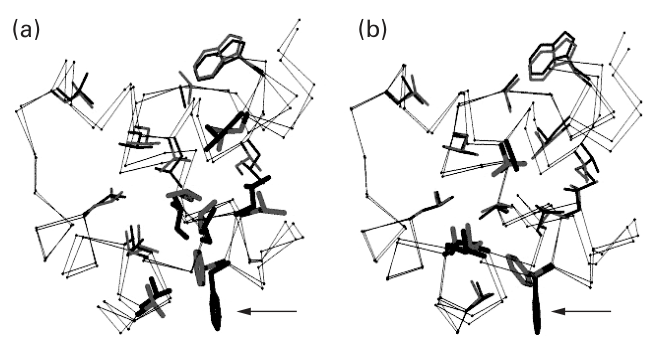
Figure 30.2 (plate 34) Modeling of cro-rep. Structures are displayed as traces with hydrophobic core side-chains. (a) The crystal structures of 434 cro (black) against 434 cro-rep (red). The arrow shows the major difference at Phe44. (b) ROC (black) and SoftROC (red) predictions based on the cro-rep template. While ROC predicts a cro-like orientation of Phe44, SoftROC predicts a core structure more similar to that of cro-rep. [1] Reprinted with permission from Elsevier.
The correlations for ROC with partial and full rotamer flexibility are much higher ( and , respectively). SoftROC with PLG backbone energies yields moderate correlations (). From the plots, it is hard to tell whether any method stands out because the variations from different runs are very high, except those of ROC with a rigid library.
The structures for many 434 cro variants have not yet been determined, and therefore it is difficult to compare predictions. Thus, the SoftROC paper compares the computational models of cro-rep, a known variant in which the native core of 434 cro is replaced with that of 434 repressor. According to figure 30.2 (plate 34), while ROC with full rotamer flexibility failed to change Phe44 from cro-like to cro-rep-like, SoftROC predicted the change as well as several other cro-rep side-chains.
Experiments on T4 Lysozyme
The wild-type crystal structure 2LZM [13] and eight of its variants (I-VIII, in decreasing stability order) were used as the template for all methods. The plots of predicted and experimental stabilities still have high variances, which provide little information for performance comparisons. Therefore, the SoftROC paper proposes another metric called prediction penalties, which is the sum of the number of atoms misplaced by each DA incorrectly predicted by at least . The authors chose this metric because it should normalize the effect of incorrect side-chain predictions on residues of different sizes. The plot of the penalties against the actual RMSD between wild-type and the eight variants is shown in figure 30.3, which indicates that ROC with full rotamer flexibility performs better than SoftROC only for some of the stabler variants. A further examination in the SoftROC paper shows that only SoftROC predicts the orientations of Leu129 and Trp153 in variant II, where the latter residue is bigger than the corresponding wild-type residue, and therefore a major change in the structure is expected.
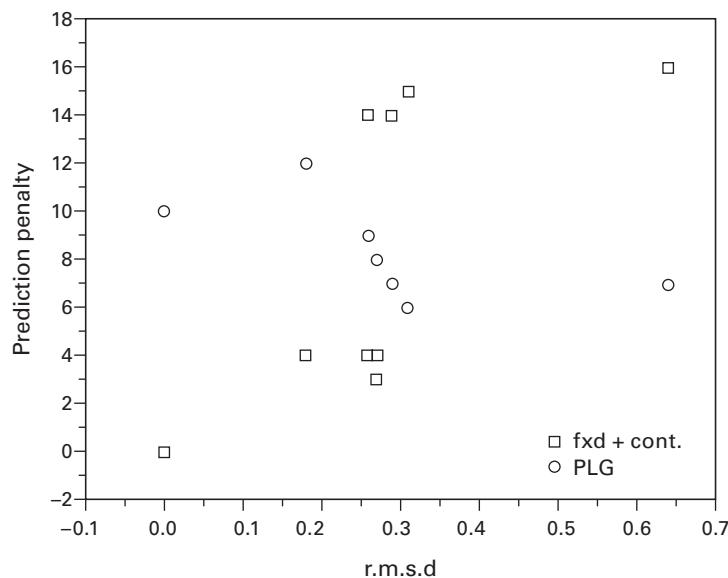
Figure 30.3 Side-chain prediction penalties for T4 lysozyme and variants. A penalty of zero implies a very good prediction. Open circles denote penalties for SoftROC predictions, and open squares denote penalties for ROC predictions [1].
Note
Figure 30.1 (plate 33) source unknows. All attempts have been made to find the rightsholder. If you have information, please contact the author or publisher.
References
- [1] J. R. Desjarlais and T. M. Handel. Side-chain and backbone flexibility in protein core design. Journal of Molecular Biology 290(1999): 305–318.
- [2] B. I. Dahiyat and S. L. Mayo. Protein design automation. Protein Science 5(1996): 895–903.
- [3] J. R. Desjarlais and T. M. Handel. De novo design of the hydrophobic cores of proteins. Protein Science 4(1995): 2006–2018.
- [4] J. H. Hurley, W. A. Baase, and B. W. Matthews. Design and structural analysis of alternative hydrophobic core packing arrangements in bacteriophage T4 lysozyme. Journal of Molecular Biology 224(1992): 1143–1159.
- [5] E. P. Baldwin, O. Hajiseyedjavadi, W. A. Baase, and B. W. Matthews. The role of backbone flexibility in the accommodation of variants that repack the core of T4 lysozyme. Science 262(1993): 1715–1718.
- [6] A. E. Eriksson, W. A. Baase, X. J. Zhang, D. W. Heinz, M. Blaber, E. P. Baldwin, and B. W. Matthews. Response of a protein structure to cavity-creating mutations and its relation to the hydrophobic effect. Science 255(1992): 178–183.
- [7] W. A. Lim, A. Hodel, R. T. Sauer, and F. M. Richards. The crystal structure of a mutant protein with altered but improved hydrophobic core packing. Proceedings of the National Academy of Sciences (USA) 91(1994): 423–427.
[8] P. B. Harbury, B. Tidor, and P. S. Kim. Repacking protein cores with backbone freedom: Structure prediction for coiled coils. Proceedings of the National Academy of Sciences (USA) 92(1995): 8408–8412.
[9] A. Su and S. L. Mayo. Coupling backbone flexibility and amino acid sequence selection in protein design. Protein Science 6(1997): 1701–1707.
[10] S. J. Weiner, P. A. Kollman, D. A. Case, U. C. Singh, C. Ghio, G. Alagona, et al. A new force-field for molecular mechanical simulation of nucleic acids and proteins. Journal of the American Chemical Society 106(1984): 765–784.
[11] P. Tuffery, C. Etchebest, S. Hazout, and R. Lavery. A new approach to the rapid determination of protein side-chain conformations. Journal of Biomolecular Structure & Dynamics 8(1991): 1267–1289.
[12] A. Mondragon, C. Wolberger, and S. C. Harrison. Structure of phage 434 Cro protein at 2.35A resolution. Journal of Molecular Biology 205(1991): 179–188.
[13] L. H. Weaver and B. W. Matthews. Structure of bacteriophage T4 lysozyme refined at 1.7A resolution. Journal of Molecular Biology 193(1987): 189–199.
[14] W. L. Jorgensen and J. Tirado-Rives. The OPLS potential functions for proteins. Energy minimizations for crystals of cyclic peptides and crambin. Journal of the American Chemical Society 110(1988): 1657–1666.