Chapter 34MARS: An Algorithm for Backbone Resonance Assignment
In this chapter, we describe MARS, an algorithm for backbone resonance assignment of proteins, and its extension for backbone assignment of proteins with known structure using residual dipolar couplings (RDCs) [1, 2].
MARS—Backbone Assignment of Proteins
Backbone Resonance Assignment
Backbone resonance assignment is a prerequisite for structure determination of proteins by NMR. In assignment process, the chemical shifts , , , of residue and , of residue are generally assembled into arrays called pseudoresidues (PRs), and each PR is associated with a single , root.
Many previous backbone resonance assignment approaches can be grouped into two categories: The first group comprises optimization algorithms that try to minimize a global pseudoenergy function, or in other words to maximize a global “goodness of fit”; the second is based on best-first search strategies. Each approach has disadvantages: The optimization algorithms can be trapped into local minima, and the best-first search strategies are prone to propagation of errors made in the initial phases of the assignment process. In contrast, MARS heuristically and stochastically attempts to simultaneously optimize the local and global quality of assignment to minimize propagation of initial assignment errors and to extract reliable assignments.
Method
One common implementation of resonance assignment of -labeled proteins comprises five steps: (1) identify and filter peaks, and reference resonances across different spectra; (2) group resonances into PRs; (3) identify the amino acid type of PRs; (4) find and link sequential PRs into segments; (5) map PR segment onto the primary sequence. MARS does not perform the first two steps. Jung and Zweckstetter [1] recommend using some other analysis software, such as FELIX, AURELIA, XEASY, SPARKY, and NMRView, for peak picking and referencing of multiple NMR spectra. In order to avoid an unreasonable high number of PRs and to improve reliability, they [1] suggest partially discarding ambiguous peaks and reinserting suspicious peaks in later iterations when inspecting PRs.
The input data of MARS are as follows: (1) the primary sequence of protein; (2) secondary structure predicted from the software PSIPRED; (3) the ASCII text file of defining assignment parameters; (4) observed intra-and interresidual chemical shifts grouped into PRs. In addition, sequential information from HNCO/HN(CA)CO and - NOESY spectra and the amino acid type for a PR can also be included in MARS assignment.
The assignment procedure, as shown in figure 34.1, consists of four steps:
- Establishing sequential connectivity Initially, each PR is assumed to be connected to every other PR and only connectivities not in agreement with experimental intra-and interresidual chemical shifts are removed. In this step, all matching shifts are equally accepted, that is, there is no preference for the “best match” to avoid a bias from insignificant chemical shift differences. Moreover, PRs are not classified according to the number of chemical shifts they contain or the intensity of their corresponding NMR resonances. Therefore, PRs strongly affected by chemical exchange or by the presence of a paramagnetic ion can be fully utilized.
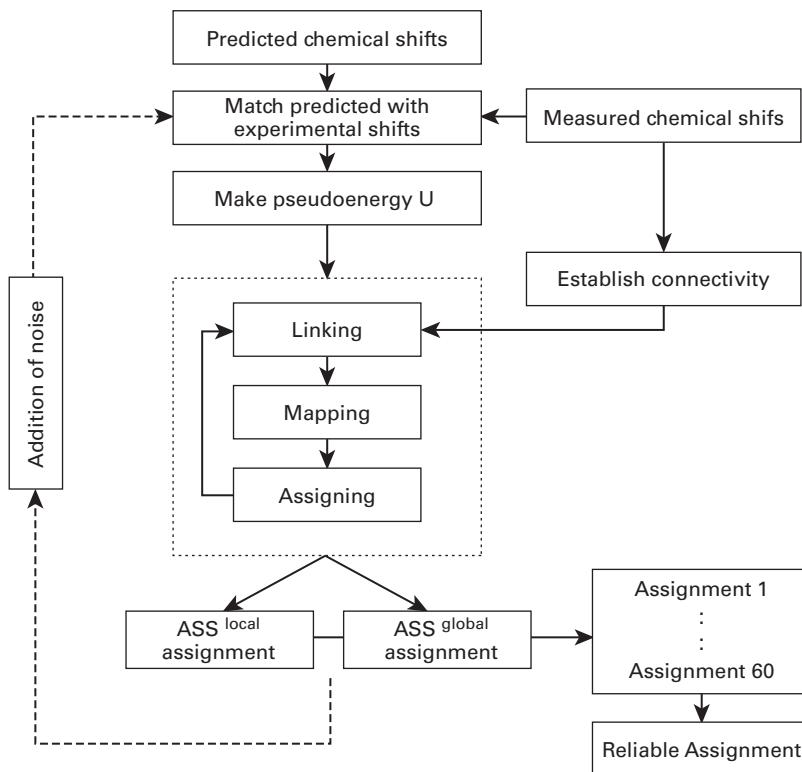
Figure 34.1 Overview of the MARS assignment procedure [1].
- Calculating pseudoenergy Pseudoenergy (i.e., a scoring function) is calculated by comparing the experimental and chemical shifts with values that were obtained for each residue from a statistical analysis of chemical shifts deposited in the BMRB [3]. In MARS, this process is further improved by using chemical shift distributions that are corrected for neighbor residue effects [4] and the type of secondary structure of each PR predicted from the secondary structure prediction program PSIPRED [5]. MARS calculates for all experimentally observed PRs the deviation of their experimental chemical shifts from predicted values according to
where is the measured chemical shift to type of PR , is the predicted chemical shift of type of residue , and is the variance of the statistical chemical shift distribution that is used for calculating . By ranking all residues according to their chemical shift deviation with respect to PR , MARS calculates a pseudoenergy for each PR . Note that this scoring function does not rely directly on chemical shift deviation. This is claimed to make MARS robust against unusual chemical shifts, because the exact fit of calculated to experimental chemical shifts is not as important as the overall quality of the chemical shift fit.
- Exhaustive search for sequential connectivity and mapping The PRs are initially assigned randomly to the protein sequence. In order to refine the assignment, MARS randomly selects a starting PR, and searches in the forward direction of the primary sequence for all PR segments of length five that can be assembled based on the available connectivity information. Then, MARS exhaustively maps all these segments on the protein sequence, and selects a best-fit segment by calculating a scoring according to
To validate , MARS repeats the same procedure but from the last position of and in the backward direction of the primary sequence. If the calculated segment , then the assignment is updated according to this resulting segment. The assignment is further refined by exhaustive search for best-fit segments of length 4, 3, and 2.
- Identifying reliable assignments The algorithm results in a final optimization assignment mainly derived by the local fit of fragments. In addition, pseudoenergy values , which qualitatively describe the mapping of a single residue to PR , have been changed during the process. Thus, a global assignment can be extracted from the refined . This global assignment is compared with the local assignment and only consistent assignments are retained.
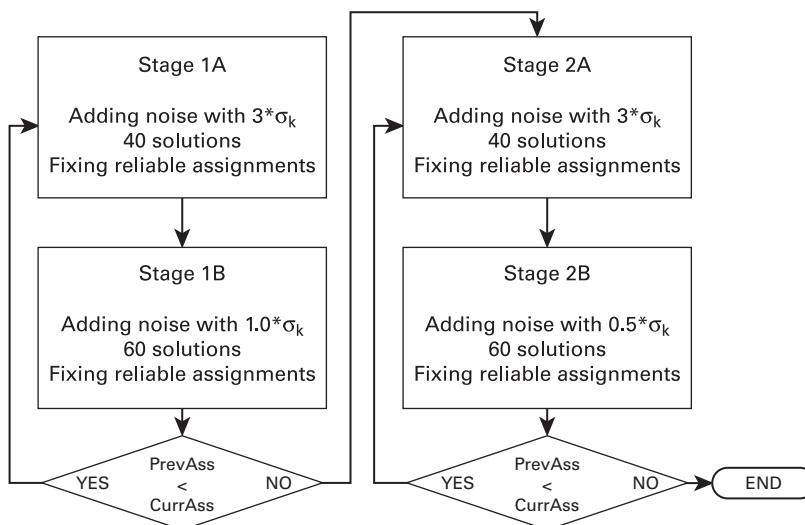
Figure 34.2
Empirically optimized scheme for avoiding errors due to inaccuracies in predicted chemical shifts in MARS [1].
A major factor influencing the assignment is the quality of chemical shifts predicted from the primary sequence. To overcome this problem, MARS repeats the complete assignment many times and adds some noise into assignment procedure to make the resulting assignment more robust (figure 34.2).
Results and Discussion
MARS was tested using either real data or chemical shifts deposited in the BMRB, on 14 proteins (table 34.1) ranging in size from 71-residue Z domain of Staphylococcal protein A to 723-residue malate synthase G (MSG). For small proteins, using connectivity information, the assignment accuracy of MARS is nearly 100%. In case that only chemical shift information is available, the assignment accuracy of MARS remains at a high level and all reliable assignments reported by MARS are correct. The test results also indicate that MARS could compute reliable assignments for big proteins like the 723-residue MSG and for proteins with incomplete chemical shift data. MARS is claimed to be useful for proteins with very high degeneracy such as partially or fully unfolded proteins and proteins with missing or erroneous chemical shift data.
Backbone Assignment with Known Structure Using RDCs
In this section, an extension of MARS is discussed, in which resonance assignment was enhanced when experimental RDCs are matched to values back-calculated from a known three-dimensional (3D) structure.
Table 34.1 Proteins and data quality used for testing MARS [1]
| Protein | BMRB code | # of residues | # of PRO/GLY | (%) a |
(%) a |
(%) a |
(%) a |
|---|---|---|---|---|---|---|---|
| Malate synthase G | 5471 | 723 | 31/51 | 95/95 | 94/94 | 94/95 | — |
| Maltose-binding protein | 4354 | 370 | 21/29 | 96/96 | 95/96 | — | — |
| Rous sarcoma virus capsid | 4384 | 262 | 23/20 | 92/92 | 89/91 | 92/93 | — |
| Human carbonic anhydrase I | 4022 | 260 | 17/16 | 100/100 | 100/100 | 95/96 | — |
| N-terminal domain of enzyme I (EIN) | 4106 | 259 | 4/15 | 96/97 | 96/97 | — | — |
| E-cadherin domains II and III | 4457 | 227 | 14/12 | 78/63 | 78/63 | — | — |
| Human prion protein | 4402 | 210 | 15/43 | 98/97 | 98/97 | — | — |
| Superoxide dismutase | 4341 | 192 | 8/14 | 64/64 | 62/63 | 48/61 | — |
| Calmodulin/M13 complex | 547 | 148 | 2/11 | 99/99 | — | 99/99 | — |
| Profilin | 4082 | 139 | 4/16 | 99/99 | 100/98 | — | — |
| E. coli EmrE | 4136 | 110 | 5/12 | 86/84 | 57/60 | 73/77 | — |
| Human ubiquitin | — | 76 | 3/6 | 100/100 | 100/100 | — | — |
| Z domain | — | 71 | 3/0 | 90/96 | 51/82 | — | 89/100 |
| Tirl 10 | — | 110 | 12/15 | 100/100 | 100/100 | 100/100 | — |
aPercentage of available chemical shifts of a given type.
Method
When dipolar couplings are to be used in assignment, a PDB file of a known 3D structure or homology model of the protein as well as the resolution of that structure are supplied as input to MARS. To include RDCs in the process of mapping PR segments onto the protein sequence, MARS calculates for all experimentally observed PRs the deviation of their experimental RDCs and chemical shifts from predicted values according to
where is a weighting factor measuring the different reliability of calculated chemical shifts and RDCs. Empirical optimization resulted in , thereby downscaling the contribution of RDCs. In addition, the RDC normalization constant is adjusted according to the resolution as , or can also be set to a fixed value of 0.21 for ranging from 1.4 to 2.4 Å without strongly affecting the assignment result.
When the internuclear vectors are distributed reasonably uniformly in orientation (chapter 6), the magnitude and rhombicity of a molecular alignment tensor can be obtained without assignment from a histogram of experimental RDCs [6].
In MARS, four different methods are available to extract the orientation of the alignment tensor: (1) shape and charge/shape prediction of molecular alignment tensors; (2) SVD (after an initial assignment step using only chemical shifts); (3) exhaustive back-calculation; (4) a grid search to optimize the fit of experimental chemical shifts and RDCs to values predicted from the 3D structure.
In order to improve the accuracy of assignment, two complete MARS assignment runs are performed for RDC-enhanced assignment. The first run is to back-calculate the dipolar couplings from the 3D structure using the approximate alignment tensor, and the second run is to refine the alignment tensor. The test results suggest that with this two-step procedure the final assignment score obtained by MARS is almost independent from the method that was chosen to get a first estimate of the alignment tensor.
Furthermore, some additional noise is added to the assignment procedure of RDCs and chemical shifts to improve the reliability of the assignment results. This procedure is different from adding noise to chemical shifts; however, the amount of noise added to back-calculated RDCs is kept fixed at a large amount of five times to avoid wrong assignments.
Results and Discussion
The RDC-enhanced assignment was applied to three proteins: 76-residue ubiquitin, 259-residue N-terminal domain of enzyme I of the phosphoenolpyruvate (EIN), and 370-residue two-domain maltose-binding protein (MBP). In order to evaluate how much information is required for successful assignment, tests were performed using different data, such as assignment without sequential connectivity information using only dipolar coupling/chemical shift matching, assignment with
Table 34.2 RDC-enhanced assignment of ubiquitin and MBP for varying amounts of data [1]
(a) RDC-enhanced assignment of ubiquitin
| RDCs | Chemical Shifts for Linking | Chemical Shifts for Matching | Assignment Score (%) IUBQ Total correct | Wrong reliable | IAAR Total correct | Reliable | Wrong reliable | |
|---|---|---|---|---|---|---|---|---|
| Without sequential connectivity information | ||||||||
| — | — | 36.1 | 19.5 | 56.6 | 36.1 | 19.5 | 5.6 | |
| — | 47.2 | 16.7 | 1.4 | 38.9 | 9.7 | 1.4 | ||
| — | 76.4 | 44.4 | 0.0 | 68.1 | 33.4 | 2.8 | ||
| — | 91.7 | 55.6 | 0.0 | 83.3 | 50.0 | 0.0 | ||
| With sequential connectivity information | ||||||||
| — | 80.6 | 25.0 | 0.0 | 80.6 | 25.0 | 0.0 | ||
| 93.1 | 51.4 | 0.0 | 97.2 | 37.5 | 0.0 | |||
| 100.0 | 90.3 | 0.0 | 100.0 | 73.6 | 0.0 | |||
| 100.0 | 100.0 | 0.0 | 100.0 | 100.0 | 0.0 |
- RDC-enhanced assignment of 370-residue MBP
| RDCs | Chemical Shifts for Linking | Chemical Shifts for Mapping | Missing Chemical Shifts (%) | Assignment Score | Reliable | Wrong reliable | |
|---|---|---|---|---|---|---|---|
| % Total correct | Reliable | ||||||
| — | 4 | 95.8 | 87.2 | 0.0 | 0.0 | ||
| 4 | 98.5 | 94.6 | 0.0 | 0.0 | |||
| 4 | 98.5 | 93.4 | 0.0 | 0.0 | |||
| 4 | 99.1 | 94.6 | 0.0 | 0.0 | |||
| — | 20 | 82.7 | 44.2 | 0.7 | 0.7 | ||
| 20 | 88.8 | 51.4 | 0.0 | 0.0 | |||
| 20 | 95.0 | 58.0 | 0.4 | 0.4 | |||
| 20 | 94.3 | 62.6 | 0.0 | 0.0 |
denotes a - RDC.
only sequential connectivity information, and assignment using chemical shifts. The effect of including one, two, or three types of RDCs was also tested. As shown in table 34.2, in case of a small protein, such as ubiquitin, MARS performed assignment of more than 90% of backbone resonances without the need for sequential connectivity information if 3 RDCs per residue are available; for bigger proteins such as MBP, the combination of sequential connectivity information with RDC-matching enables more residues to be assigned reliably and backbone assignment to be more robust against missing data.
In conclusion, the RDC-enhanced assignment method with known structure is applicable to both small and big proteins. In particular, the RDC-enhanced assignment is useful for large proteins where chemical shift data are often missing or for a substantial portion of residues the chemical shift degeneracy is too high to allow unambiguous assignment, or chemical shift and sequential connectivity only provide a few reliable assignments.
References
- [1] Y. S. Jung, and M. Zweckstetter. MARS — robust automatic backbone assignment of proteins. Journal of Biomolecular NMR. 30;1 (2004 Sep): 11–23.
- [2] Z. S. Jung, and M. Zweckstetter. Backbone assignment of proteins with known structure using residual dipolar couplings. Journal of Biomolecular NMR. 30;1 (2004 Sep): 25–35.
- [3] J. F. Doreleijers, S. Mading, D. Maziuk, K. Sojourner, L. Yin, J. Zhu, et al. BioMagResBank database with sets of experimental NMR constraints corresponding to the structures of over 1400 biomolecules deposited in the Protein Data Bank. Journal of Biomolecular NMR, 26 (2003 October): 139–46.
- [4] Y. J. Wang, and O. Jardetzky. Investigation of the neighboring residue effects on protein chemical shifts. Journal of the American Chemical Society. 124;47 (2002 Nov 27): 14075–14084.
- [5] L. J. McGuffin, K. Bryson, and D. T. Jones. The PSIPRED protein structure prediction server. Bioinformatics 16 (2000): 404–405.
- [6] G. M. Clore, A. M. Gronenborn, and A. Bax. A robust method for determining the magnitude of the fully asymmetric alignment tensor of oriented macromolecules in the absence of structural information. Journal of Magnetic Resonance 133 (1998): 216–221.