Chapter 48Molecular Replacement and NCS in X-ray Crystallography
This chapter presents the application of normal-mode analysis (NMA) in molecular replacement (MR) and crystallographic refinement [1]. We also discuss examples of NCS-constrained exhaustive search using oligomeric models [2], building on chapter 47.
Background
The Phase Problem
X-ray crystallography is one of the most important approaches for solving structures of biological molecules at nearly atomic resolution. In an X-ray crystallography experiment, the X-ray beam is scattered mainly by the electrons of atoms, forming a diffraction pattern on the collection screen that records the intensity of diffraction (figure 48.1, plate 51). In effect, the diffraction pattern experimentally contains only the magnitudes (the Fourier moduli) of the complex structure factors that correspond to the Fourier transform of the electron density map of the crystal.
If the magnitudes can be supplied with phases, an inverse Fourier transform would allow us to reconstruct the electron density map in the crystal, from which we can obtain rich three-dimensional (3D) structural information about the molecule. Unfortunately, the phase information is exactly the missing piece in an X-ray crystallography experiment, and its reconstruction hence becomes a very famous problem known as the “phase problem.”
Molecular Replacement
Since early 1930s many methods have been developed for solving the phase problem. Among these are Fourier refinement, the Patterson map, heavy atoms, direct methods, and more recently, molecular replacement [5]. Based on the assumption that similarity in amino acid sequence may imply similarity in 3D structure, molecular replacement (MR) is essentially a trial-and-error approach for solving crystal structures for which there is a known, homologous structural model through which initial estimates of phases for the unknown structure could be obtained [3].
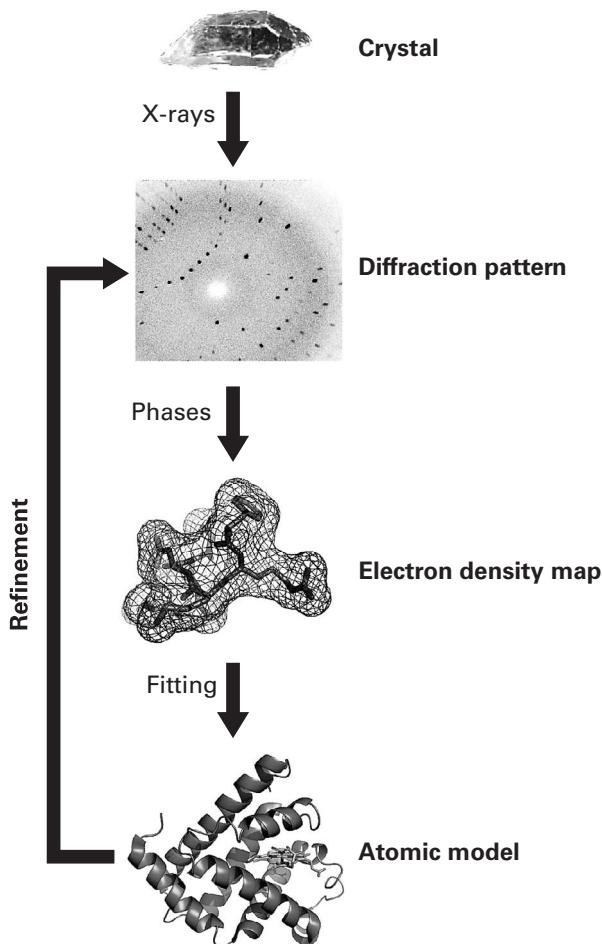
Figure 48.1 (plate 51)
Schematic diagram for X-ray crystallography in structure determination [6].
NMA in Molecular Replacement
Objectives
The algorithm in Delarue [1] aims to address the following problems:
- Conformational sampling to optimize the success rate of molecular replacement.
- Refinement of a model against X-ray or cryo-EM data in the presence of large-amplitude structural changes.
- Multicopy refinement and an all-in-one-go weight refinement approach for MR.
Normal Modes and Elastic Network Models (ENM)
Normal modes are eigenvectors of the Hessian matrix of the free energy:
where the Tirion potential energy is of the form
under the Elastic Network Model (ENM) assumptions (see chapter 21). Here, is distance between atoms and it has an upper threshold of around , and is its equilibrium value. If the system is at equilibrium and the potential energy is purely harmonic, then the motion of each atom is a linear combination of normal modes
where is the frequency associated with eigenvector , is the amplitude constant, and is some phase shift. Note that at a given temperature, the lowest-frequency modes are those that are most likely to reproduce large amplitude movements. An easy way to understand this qualitatively is by analogy to a simple energy function for harmonic oscillators:
where is the frequency of oscillation, is the mass and is the amplitude. Since each normal mode is assigned the same energy , it follows that the amplitude of movement along a lower frequency normal mode will be greater than those with higher frequencies. Supporting evidence includes the observation that on average known structural transitions can be reasonably described with two modes that tend to be among the lowest frequency modes, and results from comparing predicted and measured crystallographic factors.
How Many Normal Modes Do We Need to Represent the Full Transition? The full structural transition can only be described by the complete set of normal modes. However, it has been observed that usually the 10–20 lowest normal modes can describe 90%–95% of the structural transitions.
How to Select Biologically Relevant Modes? Two approaches are available:
- Select modes that are robust in slightly different ENMs.
- Tune the links between atoms in ENMs by multiple sequence alignment.
NMA Application in MR In X-ray crystallography, NMA has been used to generate model variants by systematically varying the amplitude of a given normal mode in a given range. While 1D and 2D exhaustive scans of a given mode are possible, higher dimensions of scanning are computationally prohibitive. One way around this is a randomized approach. Sampling conformational flexibility within a given RMSD range is made possible by generating random linear combinations of a limited set of modes:
where is the initial model, is randomly generated, and is the size of set. Given this formulation, the structure factors (see section 40.1.1) corresponding to the models deformed by equation (48.1) can be written as
where is the coordinates in reciprocal space expressed in Miller indices, is the total number of atoms perturbed and is the scattering factor of atom . Then the usual Pearson correlation coefficient can be computed, and ’s and appropriate coordinates that maximize are identified. Note that this refinement is made after rotation and translation search in MR, in place of the rigid body refinement program.
An alternative to this approach is to simultaneously refine multiple models, linked in one term by adding adjustable weights to each model. Attempts are made to avoid overfitting by fixing models and only varying their weights, and mean-field optimization of weights is then performed using Pearson correlation as a score, starting from uniformly assigned weights. It has been observed that the procedure converges with a dominating weight for the true expected solution for the test example. However, more comprehensive study is needed to analyze the scope and robustness of this approach in refinement.
Summary
In conclusion, normal mode analysis is a powerful tool to generate structural variants that would increase the chance of success in MR. It has the advantage that it can be refined directly by X-ray data and could potentially be made more efficient by a weight refinement regime. However, the weight refinement regime has only succeeded in refinement for a few test cases, and more systematic tests will be needed to assess its applicability.
NCS-Constrained Exhaustive Search Using Oligomeric Models
The presence of noncrystallographic symmetry (NCS) can be helpful for phasing using molecular replacement (MR). The orientation of NCS axes may be identified by the self-rotation function
(SRF), whereas the orientations of each copy of the model are identified by the cross-rotation function (CRF) (see chapter 47). Since the cross-rotation function uses only a fraction of the Patterson vectors, its efficiency can be limited.
When the directions of NCS can be derived accurately and oligomeric homologs of the unknown structure are available, the cross-rotation step of MR can be omitted. Functions are developed to build oligomers from monomers and to orient them properly, that is, in agreement with SRF. The oligomers are subsequently used in translation search. Such oligomer models may reduce the dimension of search space, making subsequent exhaustive search using the translation function a plausible option. However, this approach is applicable only in rare or ideal circumstances when protein quaternary structure is proven to be conserved by analysis of multiple homologs, when the unknown protein has a similar oligomeric structure, and when the cross-rotation function step causes problem with the conventional MR.
Methods
The technical procedure in Isupov and Lebedev [2] includes:
- Orientations of the NCS axes are defined from SRF.
- Reference oligomer axes are aligned with the NCS axes.
- A list of allowed oligomer orientations relative to the reference orientation is created for subsequent translation function (TF) trials.
- Visual inspection and case by case manual analysis.
Examples
Three examples are given in Isupov and Lebedev [2], whose structures were solved following the procedure outlined in section 48.3.1:
- Oxygenating component of 3,6-diketocamphane monooxygenase from Pseudomonas putida.
- Anti-TRAP from Bacillus licheniformis.
- Thioredoxin peroxidase B from human erythrocytes.
In the third example, the internal organization of the oligomer is varied, requiring generation of a new model for each translation search.
References
[1] Marc Delarue. Dealing with structural variability in molecular replacement and crystallographic refinement through normal-mode analysis. Acta Crystallographica. Section D, Biological Crystallography 64;1 (2008 Jan):40–48. Epub 2007.
[2] M. N. Isupov and A. A. Lebedev. NCS-constrained exhaustive search using oligomeric models. Acta Crystallographica. Section D, Biological Crystallography D64 (2008):90–98 [doi:10.1107/S0907444907053802].
[3] P. Evans and A. McCoy. An introduction to molecular replacement. Acta Crystallographica. Section D, Biological Crystallography D64 (2008):1–10.
[4] Lilien RH, Bailey-Kellogg C, Anderson AC, Donald BR. A Subgroup Algorithm to Identify Cross-Rotation Peaks Consistent with Non-Crystallographic Symmetry. Acta Crystallographica. Section D, Biological Crystallography D60 (2004):1057–1067.
[5] David Sayre. X-ray crystallography: The past and present of the phase problem. Structural Chemistry 13;1 (February 2002): 81–96.
[6] Article on X-ray crystallography. Wikipedia. Accessed: 2010. URL: http://www.wikipedia.org.