Assignment 1.1: Representing molecules
Your answers are saved in this browser. Check them against the downloaded answer key, or open the explanation when you are ready.
Lecture 1.1
Transcript
HAZEL SIVE: Welcome to lecture 1 of Getting Up
to Speed in Biology.
This lecture is called "Molecules of Life."
And today, we're going to cover two big topics.
The first topic are the bonds build molecules,
and the second are the macromolecules themselves.
So let's take a moment here.
Next time, we'll talk a lot about cells.
But today, we're just going to make the statement
that the building blocks of life are cells.
So life is made of cells.
We can think about them as building blocks.
They're little building blocks.
In humans, a cell has about a 10-micrometer diameter.
They are filled with molecules--
well, they are made of.
And I'll tell you about the molecules as we go along.
And they are a bag of chemical reactions.
So that's our background.
That's the framework that we're going to start with today.
Let's go to our first big topic of the day--
bonds build molecules.
And let me give you a little disclaimer
about this lecture and the other parts of Getting Up
to Speed in Biology.
I want you to have heard of something.
I want you to be able to go into a good introductory biology
course at MIT or elsewhere, and I
want you to have heard of what I'm going to say.
You're not going to know all of it.
You're not going to know it in depth.
But you should be somewhat familiar
so that you can go and then do well
in your introductory biology course.
So bonds build molecules, and a bond holds molecules together.
So a bond holds molecules together
because bonding is due to attraction between atoms.
Bonding is due to attraction between atoms.
We'll talk about the kinds of bonds in a moment.
In life, there are certain key elements that
come up over and over again.
And there are really six of them.
The big one is carbon, then oxygen, nitrogen, phosphorous,
and sulfur.
And I guess that's five and not six.
So there are some others we can add,
but those are really the five big ones.
You're going to need the concept here of valency.
Valency refers to how many bonds an atom can make.
So valency equals the number of bonds an atom can make.
It is a really key concept in biology.
And then finally, when we think about bonds building molecules,
we need to be able to somehow represent molecules
in an easy-to-deal-with way.
And this is where we are going to start.
We're going to start with representing molecules.
So let's look at representing molecules.
I'm showing you here five different schematics
of the same molecule.
The molecule is butanol.
It's called 1-butanol, a particular form
of butanol which is an alcohol.
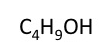
The chemical formula is written on the top--
4 carbons, 9 hydrogens, and an oxygen
and another hydrogen, which is kind of written separately
because the OH is a unit.
It's a hydroxyl group.
And you may remember this from some chemistry
which you have taken before.
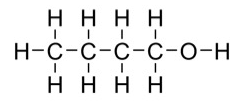
You can write out the structure of butanol
as I've shown it there with the carbons in the line,
every carbon written out, every hydrogen written out.
And that's called the full structure.
All the atoms in the bonds are shown.
But that is difficult. It's a nuisance
to write out every structure of every molecule.
And so there's a shorthand that we use.
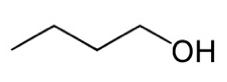
And this is the bond line structure
shown where you can see that instead of the carbons,
there is a broken line.
There is a zigzag line.
And the carbons are at the corners
or at the ends of every line.
So if you look at the lines, you can
see that there would be a carbon right at the end,
and then the next place, the next place, the next place.
And that would count up to four carbons.
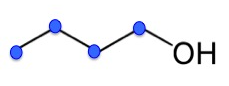
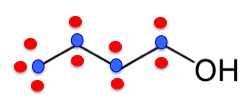
We can show that to cement this by putting a blue dot for each
of the carbons.
And then we can put red dots for each of the hydrogens.
And you can figure out from this where
the hydrogen atoms lie because of this concept of valency.
Carbon has a valency of four.
Every carbon atom can make four bonds.
This is the reason that it is a pivotal atom in life--
because it can make lots of bonds,
and you can get long chains of carbons added together.
And so you can see that the hydrogens
are surrounding the carbons.
And so you've got an explanation there of the bond line
structure as you go down this slide.
Let's take a pause now, and you can go and practice
representing molecules and figuring out
that you know how to go from the chemical formula
to the full structure to the bond line, bond angle formula.
Reference Summary
Chemical Formula
Each C, H, and O atom is counted. For example...
Full structure
All atoms and bonds are shown. For example...
Line-angle structure
Below is butane. Carbons are at the corners or ends, and hydrogens are not shown.
The locations of the carbons are shown below with blue dots.
Now, the locations of the hydrogens are shown below with red dots.
Because C has a valency of FOUR (meaning that each C makes four bonds), you can figure out location of H atoms.
Exercise 1 (Acetic Acid)
Exercise 2 (Serine)
MIT OpenCourseWare / MIT Open Learning Library. Hazel Sive and Diviya Ray. Adapted for local study under Creative Commons Attribution–NonCommercial–ShareAlike 4.0. License terms.