← Unit 1

Assignment 1.2: Polar and non-polar molecules

Your answers are saved in this browser. Check them against the downloaded answer key, or open the explanation when you are ready.

Lecture 1.2

Transcript

HAZEL SIVE: Another key concept that we will discuss

is electronegativity.

Electronegativity refers to the attraction

of an atom for electrons.

And in biology, we need to distinguish

two kinds of molecules that are different based

on their electronegativity.

And I'm going to abbreviate electronegativity

for the rest of this board as en.

And the types of molecules that we need to discuss

are called polar, where polar molecules

have an unequal electronegativity, unequal en.

And these molecules are always hydrophobic

or tend to be hydrophobic based on having one charged

portion of the molecule.

The other type, the opposite, are non-polar molecules

where there is equal electronegativity.

And these tend to be hydrophobic.

OK.

Let's look at some polar molecules.

Whether a molecule is polar or not polar

depends on two things, whether it

has got polar bonds where the electrons are unequally

distributed.

And it also depends on the geometry of the molecule.

But we won't deal too much about that.

I've put it in for completeness' sake.

So here is water.

And you can see that there is--

I've drawn an unequal electron distribution.

This is called a dipole.

And the dipole is because the oxygen of the water

is very electronegative.

It pulls the electrons towards it

and it depletes the electrons somewhat from the hydrogens

that it is bonded to.

So you get a molecule where the oxygen

is somewhat negative because of its high electronegativity.

And the hydrogens are somewhat positive because of their lower

electronegativity.

And this is indicated by those deltas.

Delta minus means that the atom is

more negative than an atom that's indicated delta plus.

So delta negative is the oxygen. Delta plus is the hydrogen.

The geometry of the molecule also

is such that these dipoles don't cancel out.

And so you get overall a molecule that is polar overall.

Here are two examples.

One is polar and one is not polar.

The top example is propane, which has the chemical formula,

as you can see, C3H8.

It is just carbons and hydrogens.

And carbons and hydrogens, neither of which

are particularly electronegative atoms,

neither have a tendency to pull electrons more than the other

and so the bonds and the molecule are overall non-polar.

There is an equal distribution of electrons

throughout the molecule.

On the other hand, isopropanol, you can see,

has got a hydroxyl group added to it.

And there is that oxygen which is highly electronegative.

It will be pulling electrons away

from the carbons and the carbon and the hydrogens.

And therefore you get a partial negative charge

or a more negative character in the hydroxyl

and the oxygen part of the molecule.

And this molecule is polar.

And you can get a hint as to whether a molecule is polar

or not by whether or not it has an electronegative atom

like oxygen that is associated with it.

And now we're going to take a pause.

And you are going to do an assignment

to practice whether or not you can recognize

polar and non-polar molecules.

Reference Summary

Polarity

Polarity is dependent on
- Polar bonds
- Geometry of the molecule


Dipoles

An unequal electron distribution is called a dipole.
Dipoles are often shown by a T-arrow or a δ. The dipoles are shown on the figure in red. The overall dipoles (which are a vector sum of the individual dipoles) are shown in blue.
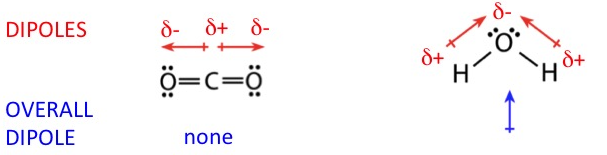
This image shoes two molecules, carbon dioxide C(=O)=O and water [H]O[H]. The dipoles and overal dipole of each molecule are drawn. For carbon dioxide, the C is labelled with a delta plus symbol to indicate a partial positive charge and the O atoms are labelled with delta minus symbols to indicate partial negative charges. There are two arrows shown to represent the dipoles. The non-arrowhead end of the arrow is crossed, similar to a plus sign. Each arrow starts at the C and points towards one of the O atoms. There is no overall dipole of carbon dioxide because the dipoles are equal in magnitude and opposite in direction. For water, the O is labelled with a delta minus symbol, and the two H atoms are labelled with delta positive symbols. Similar to carbon dixoide, water has two arrows with crossed tails. Each arrow starts at one of the H atoms and points towards the O atom. The H atoms are shown as bent downwards on the left and right sides of the O atom. Therefore, overall dipole is in the up direction.

For CO2...

The C=O bond is POLAR since O is more electronegative than C (attracts electrons more), BUT the vector sum of the dipoles is equal to zero, so CO2 is NON-POLAR overall.

For H2O...

The O-H bond is POLAR since O is more electronegative than H. The vector sum of dipoles is NOT equal to zero, so H2O is POLAR overall.


Example: Propane v. Propanol
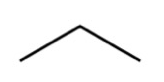
This image is of propane: CCC

This is propane.
Chemical formula: C3H8
Bonds: NON-POLAR, since C and H share electrons equally
Molecule: NON-POLAR
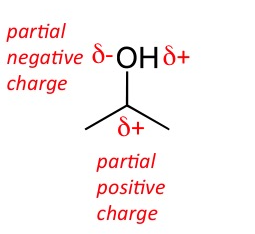

This image is of propanol: CCCO. The O is labelled with a delta minus to indicate that it has a partial negative charge symbol. The C and H that are attached to this O atom are each labelled with a delta plus symbol to indicate that they each have partial positive charges.

This is propanol.
Chemical formula: C3H7OH or C3H8O
Bonds: C-O and O-H bonds are POLAR, since O is more electronegative (attracts electrons more) than C or H
Molecule: POLAR, the dipole vectors do not cancel out.

Exercise 1 (Butane v. Butanol)

Let us now examine the molecules butane...
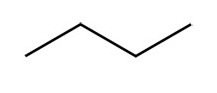
This image is of butane: CCCC

...and butanol.

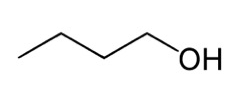
This image is of butanol: CCCCO

Butane: Chemical Formula

Give the chemical formula of butane, shown above. (Enter answers as an integer.)

How many C's?


How many H's?


How many O's?

Show answer and explanation
  1. 10
  2. 4
  3. 0

Explanation

The correct formula is C4H10.

Butane: Polarity

Does butane have any dipoles?

Is butane POLAR or NON-POLAR?

Show answer and explanation
  1. Non-polar
  2. No

Explanation

All of butane's bonds and the molecule itself are NON-POLAR since C and H share electrons equally. Therefore, butane does not have any dipoles.

Butanol: Chemical Formula

Give the chemical formula of butanol, also shown above. (Enter answers as an integer.)

How many C's?

How many H's?

How many O's?

Show answer and explanation
  1. 1
  2. 4
  3. 10

Explanation

The correct formula is C4H10O.

Butanol: Polarity

Does butanol have any dipoles?

Is butanol POLAR or NON-POLAR?

Show answer and explanation
  1. Yes
  2. Polar

Explanation

The molecule butanol is POLAR.
Butanol has a dipole since oxygen (O) is more electronegative than carbon (C) or hydrogen (H).

Butanol: Polar Group

Clicking on the image will place the circle on the image at the cursor location.
Click on the image of butanol below to place the circle over butanol's polar group (the one with unequal charge distribution).

Click to select a position on the diagram
Show answer and explanation
    The outlined area marks the answer

    Explanation

    Remember that C-C and C-H bonds are nonpolar, while O-H and O-C bonds are polar, so the hydroxyl group (-OH) is the polar group.

    Butanol: Dipoles

    Describe the dipoles (δ) and each of their charges for the butanol molecule below. To do so, use the dropdown options to indicate the dipole (δ+ and δ-) for the corresponding region of the dipoles.

    Butanol.

    • the C adjacent to the -OH group:
    • the O in the -OH group:
    • the H in the -OH group:
    Show answer and explanation
    1. δ-
    2. δ+
    3. δ+

    Explanation:

    Dipoles have partially positive () and partially negative (δ-) atom(s) to denote the direction and strength of the dipole. In this case, the oxygen (O) shares electrons unequally with the adjacent carbon (C) and hydrogen (H). Since oxygen is electronegative, it possesses a partially negative (δ-) charge, while the adjacent carbon and hydrogen possess partially positive (δ+) charges.

    Exercise 2 (Benzoic Acid)

    Now let us examine benzoic acid.
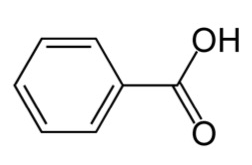
    This image is of benzoic acid: C1=CC=C(C=C1)C(=O)O

    Benzoic Acid: Bond Polarity

    Show answer and explanation
    1. Yes

    Explanation:

    To identify if benzoic acid has any polar bonds, look for highly electronegative atoms (like oxygen) covalently bonded to less electronegative atoms (like carbon and hydrogen). Since benzoic acid has a C=O bond, C-O bond, and O-H bond and these three bonds are polar, then benzoic acid has polar bonds.

    Benzoic Acid: Dipoles

    If benzoic acid has polar bonds, label the dipoles (δ) and the charge on each. To do so, drag and drop the δ+ and δ- icons within the appropriate square target zones below. (Note: you may not need all of the target zones.)

    If benzoic acid does NOT have polar bonds, drag and drop the "No Dipole" icon within the rectangular target zone that is located in the top left corner.

    Choose a numbered location for each label. Leave unused labels as “Not placed.”

    The line angle diagram for the molecule benzoic acid.123456
    Show reference answer

    This archived key gives example locations for repeated labels. It does not show a complete placement.

    • δ+: location 5
    • No Dipole: not placed
    • δ-: location 4

    Benzoic Acid: Molecule Polarity

    Would you predict that benzoic acid is a polar molecule?

    Show answer and explanation
    1. Yes

    Explanation:

    The prior questions showed that benzoic acid has (a) polar bonds and (b) dipoles, so it is a polar molecule!

    Exercise 3 (Lysine)

    Let us look at one more: Lysine.
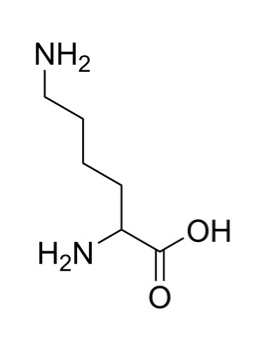
    This image is of lysine: [NH2]C(CCCC[NH3+])C([OH])=O

    Lysine: Polar and Non-polar Groups

    On the image below, label whether the group within each box is a polar or non-polar group by dragging and dropping the "P" and "NP" icons within the appropriate boxes.
    P = Polar group
    NP = Non-polar group

    Choose a numbered location for each label. Leave unused labels as “Not placed.”

    A line angle diagram of the amino acid molecule lysine.123456
    Show reference answer

    This archived key gives example locations for repeated labels. It does not show a complete placement.

    • NP: location 3
    • P: location 6

    Lysine: Molecule Polarity

    Would you predict that lysine is a polar molecule?

    Show answer and explanation
    1. Yes

    Explanation:

    Lysine has polar bonds and polar groups, so it is a polar molecule!

    MIT OpenCourseWare / MIT Open Learning Library. Hazel Sive and Diviya Ray. Adapted for local study under Creative Commons Attribution–NonCommercial–ShareAlike 4.0. License terms.