Assignment 1.3: Types of bonds
Your answers are saved in this browser. Check them against the downloaded answer key, or open the explanation when you are ready.
Lecture 1.3
Transcript
HAZEL SIVE: Let's talk about bond types.
And I'm going to distinguish four, two of which
are going to be a kind of a joint class.
There are ionic bonds, covalent, hydrogen.
And I'll tell you that hydrogen bonds are very big in biology.
You may not be familiar with those at all,
and you need to be.
And then I'm going to put together
van der Waals and non-polar or hydrophobic bonds
in one class, although strictly speaking,
that's not quite fair.
From strongest to weakest, the ionic and covalent bonds,
and this bottom class are the weakest, with hydrogen
somewhere in the middle.
Let's take a look at some of these chemical bonds
and see what we can say about them.
OK, so I've summarized for you here the notion
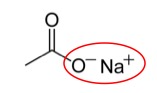
that ionic bonds are attractions between atoms that involve
oppositely charged ions.
And so in this molecule that I've shown you here,
there is a negatively charged part and a positively charged
part, and they are attracted to one another very strongly,
and that holds the molecule together.
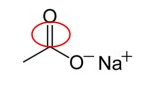
In a covalent bond, the electrons
are shared by two atoms, and this contrasts, again,
with the ionic bond, where electrons
move to one part of the molecule or to another part
of the molecule, or to a completely different molecule,
and the added--
the molecule is held together with the electron
split completely away from one of the atoms.
In a covalent bond, in contrast, the electrons
are shared by two atoms.
And I've circled there a bond between a carbon and an oxygen.
It's actually two bonds.
That's why there are two lines.
And those are two covalent bonds.
The hydrogen bond is one, as I mentioned, that is key to life.
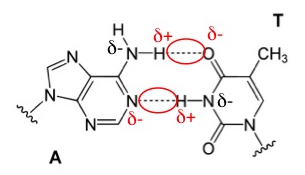
Hydrogen does not have high electronegativity.
It's electropositive, if you like,
and so it often has a partial positive charge.
This allows it to be attracted to an electronegative atom,
which will have a partial negative charge.
These two differential dipoles, the positive
and the negative dipole, will then
hold together two different molecules
and form a bond between them.
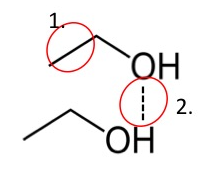
The hydrogen bond is shown by a dotted line.
It is not a covalent bond.
It is an electrostatic bond.
And it always involves hydrogen, hence, the name.
If you look at molecules in biology,
and you're not sure what kind of bond
it is, if you see hydrogen, and then
you see some kind of electronegative atom,
like oxygen or nitrogen, you can be fairly sure
that you are looking at a hydrogen bond.
And as we'll explore a bit more, and you'll
explore in further biology courses,
hydrogen bonds are unbelievably important in biology.
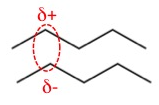
And then this last class of non-polar and van der Waals
bonds or forces occur between non-polar molecules
where in at least one form, there
may be very transient dipoles between different molecules
that holds the molecules together
as a transient positive and a transient negative dipole.
And now, I'd like you to predict the bond.
Go to your next assignment and see
if you can predict the bond based on the characteristics
that I've just given you.
Reference Summary
Ionic Bond
An ionic bond is an electrostatic interaction between oppositely charged ions (atoms that have lost/gained 1 or more electrons).
Strong interaction
Covalent Bond
A covalent bond consists of one or more pairs of electrons are shared by two atoms.
Strong interaction
Hydrogen Bond
A hydrogen bond forms between polar molecules where an H has a partial positive charge (induced by an electronegative atom) and is therefore attracted to a different electronegative atom.
Medium-strong interaction
Non-polar/van der Waals Bond
This type of bond is between nonpolar molecules, with transient unequal charge distribution (dipoles).
Weak interaction
Exercise 1 (Ethanol)
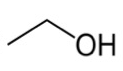
Ethanol (single molecule shown above) can form interactions with other ethanol molecules as shown below.
Exercise 2 (Amino Acids)
MIT OpenCourseWare / MIT Open Learning Library. Hazel Sive and Diviya Ray. Adapted for local study under Creative Commons Attribution–NonCommercial–ShareAlike 4.0. License terms.