Assignment 1.4: Recognizing macromolecules
Your answers are saved in this browser. Check them against the downloaded answer key, or open the explanation when you are ready.
Lecture 1.4
Transcript
HAZEL SIVE: At this point during our lecture,
you should understand that bonds construct molecules.
You should have had some practice
with representing molecules and should
be able to draw a line-angle diagram
or know where the carbons and the hydrogens
are on a line-angle diagram.
You should be able to recognize polar and nonpolar molecules.
And you should know something about recognizing
different types of bonds.
So let's move on to the second big topic today, which
are the macromolecules.
Macro means big.
And macromolecules just mean big molecules which
are found prevalently in cells.
There are four major classes of macromolecules in cells
that we will go through.
They are the lipids, the carbohydrates,
the nucleic acids, and the proteins.
And we'll go through each of the classes now.
They are often polymers.
That is, they are some kind of joining together
of a monomer, which we sometimes write as an M.
And a polymer would be M to the n or n monomer units
joined together to make the polymer.
Good.
Our first class of macromolecules
that we're going to discuss are the lipids.
Lipids do a whole bunch of things.
They make up the cell membranes that keep cells intact.
They do things like insulate seals.
They are part of the whole signaling circuitry aspect
of cellular function.
And they are also the way that energy
is stored in our bodies in a very large extent.
Lipids have certain key characteristics
that you should know.
They are always nonpolar or largely nonpolar.
That means they're hydrophobic.
They don't mix with water.
As you know, oil or lipid and water don't mix.
They may be partly polar in which case
they get a special name.
And they are called amphipathic.
And those are interesting because the polar part
of the lipid can interact with water.
And the nonpolar part will not interact with water.
They can be long chains although not usually
polymers in the strict sense.
Or they can be small.
But they have as their key characteristic this nonpolar
aspect.
And that's the one you want to focus on if you're
trying to identify a lipid.
Here are some diagrams of lipids.
You know now from representing molecules
that all of those zigzag portions of these molecules
are hydrocarbon chains.
And you can see that many of these lipids
have got lots of hydrocarbon, just hydrocarbon,
no other molecules.
But you can see also that some of them--
and I've circled the bottom one in blue--
has a polar portion with lots of oxygens and nitrogens
as well as the nonpolar portion that makes it a lipid.
You can see some of these lipids are small.
For example, at the top, there's cholesterol.
That is a very important part of the cell membrane.
And that has a particular kind of structure, lots, again,
of carbons and hydrogens.
And that structure is called a steroid ring structure.
And so those are your lipids.
Let us move on now to carbohydrates.
The next major class of macromolecules
are the carbohydrates.
These do lots of cool things.
They are what gives you your blood type.
But they also are a way that energy is taken in.
They're a quick form of energy.
Runners when they're about to run a marathon
will have carbohydrates right before because that
is available energy.
They do things like build the cell
walls of plants and the exoskeletons of insects
that protect them.
And as we'll talk about in a little bit,
they are an essential part of the genes of the DNA.
Carbohydrates can be recognized by their basic chemical formula
CH2O.
And if you're trying to recognize whether it's
a carbohydrate, you can count up the carbons, the hydrogens,
and the oxygens.
And you should be able to tell.
For carbohydrates, we can usually identify the monomer.
The monomer, the M, would be the monosaccharides.
These are sugars.
And these will form long chains that give rise
to the polymers, which are often starch, glycogen,
or, in plants, cellulose.
And these monomers are joined together
by a special covalent bond that's
called a glycosidic bond COC.
Here's a diagram of glucose.
This is called a chair diagram.
And you can see something about the actual 3D
structure of glucose.
The dark parts of the molecule are coming out
of the screen towards you.
And the light parts are going back.
So it's not a flat molecule.
It's actually got some 3D structure to it.
On the bottom of the slide, you can
see amylopectin, which is a form of starch where the glucose
monomers are joined together by the glycosidic bonds
that I have circled.
And that's a carbohydrate for you.
The monomers of carbohydrates, or even the polymers,
can exist in isomeric form.
For example, these are the different forms of glucose.
An isomer is just a slight rearrangement
of the overall structure of the molecule.
So glucose can be allotted a chain, an open chain.
It can be a cyclic molecule in one form or another form, alpha
or beta forms.
And each of those, each of the different forms,
can be used to build polymers of carbohydrates.
Good.
So let us move on now to the next class of macromolecules.
And this class I would say is the reason
that we're having this conversation today.
Nucleic acids and understanding what they are
and how they function broke open the field of molecular biology.
And molecular biology is the common language of biology
that transcends all the different fields of biology.
And it's because of nucleic acids
that we have molecular biology.
So let's talk a little about what
these important nucleic acids are.
They are the things that make the genes.
If you think about a gene which you've undoubtedly heard of,
it is made of the macromolecular class of nucleic acids.
Nucleic acids are also required for energy.
They are involved in the synthesis
of other types of macromolecules we'll
talk about in a moment, the proteins.
And they are the things that-- because this is what genes do--
that carry the hereditary information from cell to cell
from parent to child.
Nucleic acids are made up of nucleotides.
The nucleotide would be the monomer.
The polymer is either DNA or RNA.
The structure of the nucleotide is stereotypical.
And you should know the names of the components.
So the nucleotide structure is comprised of a sugar,
a phosphate, and a base.
And we write it really as phosphate, sugar, and base.
I'll show you the chemical structure in a moment.
And we can abbreviate this as PSB.
The sugar is a five-carbon sugar called ribose
or it might be or deoxyribose.
And the bases are adenine, guanine, cytosine,
and thymine--
A, G, C, or T.
Now, let's make a little notation here on the side.
There are two kinds of nucleic acid--
DNA or RNA.
In DNA, these are the basis.
In RNA, the T is replaced by something called uracil.
Otherwise, the bases are the same.
And so in RNA, there is U and not
T. And a notation about the sugar--
in DNA, the sugar is deoxyribose.
And in RNA, the sugar is ribose.
Let's look at a slide to give you
a better sense of nucleic acid's structure.
Here's a diagram of a nucleotide.
This is a particular nucleotide.
Doesn't matter what right now.
You can see the phosphate group highly electronegative
there, phosphate with four oxygens
covalently bonded to one of the sugar carbons.
It's called a 5 prime carbon and will become important
in a little moment.
And those other 4 prime, 3 prime, 2 prime, and 1 prime
are the carbons of the sugar.
And you can see that there are a couple of hydroxyls here.
That 3 prime hydroxyl is really important.
And we'll talk more about it in a moment.
And then the other part there is the base, which
is joined to one of the carbons of the sugar, the 1
prime carbon of the sugar.
Here are the bases of the nucleic acid--
adenine, guanine, cytosine, thymine.
And you can see at the top uracil, which
is really similar to thymine except it is lacking
this methyl group right here.
The bases can be divided into two separate types
of structure.
On the left of the slide are the purines,
which have got two carbon rings.
And on the right are the pyrimidines,
which have just got one carbon ring.
Good.
We're going to come back to nucleic acids in a moment
when I tell you something special about them.
But in the meantime, I want to talk about the last major class
of macromolecules.
And those are the proteins.
All of these classes of macromolecules
are really interesting and unbelievably important.
And there is no life without any of the four classes
that I'm telling you about.
The proteins are particularly cool.
They do everything.
The only thing that they don't quite do
is to carry hereditary information from cell
to cell from parent to child.
They participate in that.
But they are not actually the information
that is transmitted through the genes.
Proteins, however-- and you can see on this slide--
contribute to the structure of the cell.
They are involved as enzymes, which
are the catalysts of the cell.
We'll talk a bit about in another lecture.
They give you a whole body structure.
They are the reason that you are standing up.
It is because of the structure of the proteins and the things
that they build.
And really, anything you can think about in life,
the proteins are involved in.
Proteins are made up of a monomer called
an amino acid or an amino acid.
This would be the monomer.
In the nucleic acids, there are four different types
of bases, four different types that
can contribute to the nucleotides in the amino acids
or amino acids.
There are about 20 different amino acids that
are essential for human life.
And there are lots more that are found in other places in life.
But there are 20 common ones that we can think about.
A protein is an amino acid polymer.
And it can be little proteins and big proteins.
In just the same way, as we'll discuss,
there can be small nucleic acid polymers and large nucleic acid
polymers.
The structure of the amino acid is
built around something called the alpha carbon.
And I'll draw the chemical formula
because it's the easiest way to think about it.
If this is the alpha carbon, it has on one
end a carboxyl group.
Has on the other end an amino group and a hydrogen, and then
there is this thing called R.
R is a side group.
And it's the side group that gives the amino acid
its character.
R can be polar or nonpolar.
It can be charged or uncharged.
And the R is really what gives the amino acids their name.
We can think about the amino acids,
or we can write the amino acids in three different ways.
We can write, for example, the full name of the amino acid,
for example, valine.
Or we can abbreviate it Val, three letters,
or we can use the one letter code V.
Here's a diagram of an amino acid with the R group
as I told you about.
And you can see that the charges on the amino
and the carboxyl groups can be differentially distributed
to the way that I've drawn them on the board.
And here are the structures of the whole set
of common amino acids.
You don't need to know each of these.
But you should be able to look at these particular structures
and say, oh, this looks like it would be a charged amino acid
or an uncharged.
This would be polar or not polar.
So let's review a moment recognizing macromolecules
and how you would tell these four classes apart
because that's one of the things I'd like
you to get out of this class.
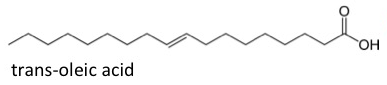
The lipids-- look for something nonpolar, hydrophobic,
lots of hydrocarbon.
May have a little polar bit, but really most of it
should be nonpolar hydrocarbon.
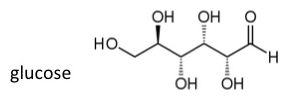
The carbohydrates-- look for the CH2O formula.
And they are always polar because they've
got a lot of oxygen groups and hydroxyl groups
there, which are polar groups.
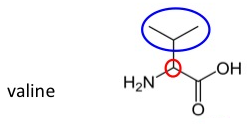
Proteins-- look for the alpha carbon.
I've ringed it here.
And you should find next to the alpha carbon
there should be an amino group.
On the other side, there should be a carboxyl group,
and then there should be something else sticking out,
which would be your R group, your side group.
And finally, the nucleic acids--
complicated.
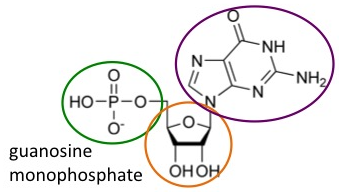
The way to start is look for a phosphate group.
If you can find a phosphate group, it may be an amino acid.
If you can find a phosphate group attached to a sugar,
and you know sugars have got CH2O formulas,
then you are on the right track.
And then if you see something that's
got a bunch of nitrogens and some oxygens
and either one or two rings attached to it,
that's probably the base.
You can make these assignations.
You can recognize these macromolecules
using a set of rules, using a set of ways to recognize them.
And I would like you now to go to your next assignment
where you're going to do some practice of recognizing
macromolecules.
Reference Summary
Lipids
Lipids are non-polar and hydrophobic.
Carbohydrates
Carbohydrates follow the formula CH2O and are polar.
Proteins
Proteins are made up of amino acid monomers, which consist of an α-carbon (circled in red) bound to an NH2 group, a COOH group, and a side chain, or R group, (circled in blue). The R group can be polar or non-polar
Nucleic Acids
Nucleic acids are built from nucleotide monomers, which consist of a phosphate group (circled in green), a sugar (circled in orange), and a base (circled in purple). Nucleotides are polar.
Exercise 1 (Macromolecule identification)
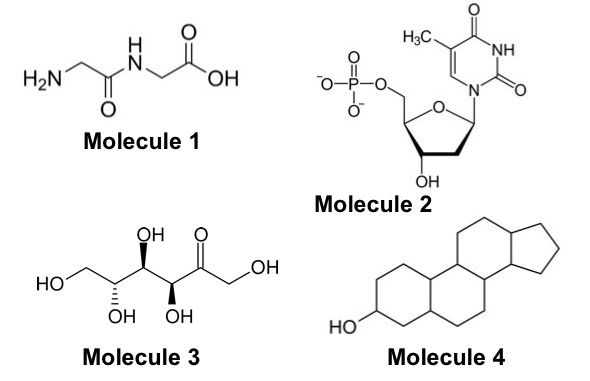
The following questions center around Molecules 1-4, shown here.
Exercise 2 (Amino Acids)
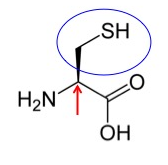
The molecule above is the amino acid cysteine (CYS).
The α-carbon is indicated with the red arrow.
The R-group is circled in blue. (Remember, the R-group is the side chain of the α-C.)
MIT OpenCourseWare / MIT Open Learning Library. Hazel Sive and Diviya Ray. Adapted for local study under Creative Commons Attribution–NonCommercial–ShareAlike 4.0. License terms.