Assignment 1.5: Nucleic acid polarity
Your answers are saved in this browser. Check them against the downloaded answer key, or open the explanation when you are ready.
Lecture 1.5
Transcript
HAZEL SIVE: The last thing I want
to tell you about in this class is probably the coolest.
And that is that macromolecules carry information.
And they carry information because they
have got different ends and because they
have got direction.
And if you think about it, all languages
have got some kind of start and stop signals to them.
And there is some direction associated with them.
And the language of life is exactly the same.
So let us write down that macromolecules
may have order and polarity.
The polarity would give some kind of direction.
And these two attributes together
comprise information that can be used by the cell.
The two classes of macromolecules
that do this par excellence are the nucleic acids
and the proteins.
And so we're going to talk about both of those--
nucleic acids and proteins.
The nucleic acids as I said carry the information
of hereditary.
The proteins carry the information
of just about everything else.
So these two classes are what we'll discuss
over the next few minutes.
In order to do that, we need to come back and consider
the nucleic acid polymer.
The nucleic acid polymer has two different ends.
It has got a so-called 5 prime and a so-called 3 prime end.
And you can see that if I draw you
a very rough schematic of how a nucleic acid
polymer is put together.
I'm going to write 5 prime.
And next to it, I'm going to put P for phosphate.
The phosphate is covalently bonded to a sugar abbreviated
S which is covalently bonded to another phosphate,
another sugar, another phosphate,
another sugar in my schematic, and then I'm
going to write 3 prime.
And sticking off from the sugar, I'm
going to write the bases base 1, base 2, and base 3.
So let's look at what I've drawn here.
PS refers to a covalently-joined sugar phosphate backbone.
It's the thing that holds the nucleic acid polymer together.
The bonds that join the sugar and the phosphate
have a special name.
They're called phosphodiester bonds.
And they join the phosphate to one of the hydroxyl groups
on the sugar.
Let's think now going back to that polymer.
You can see I've written 5 prime and 3 prime.
At one end of the polymer--
this has to do with polarity.
At one end of the polymer, there's a 5 prime end.
And the other end, there's a 3 prime end.
Those are two different ends.
They're chemically different.
And the cell can distinguish them from one another.
And that gives you part of the information
coding in nucleic acids.
So the 5 prime end is the phosphate
that's joined to the 5 prime carbon on the sugar.
And the 3 prime end is the 3 prime hydroxyl group
that, again, is on the sugar.
The second thing that you need to know
is that this polarity is superimposed
with the bases and the sequence of the bases along the polymer.
So base 1 is near to this 5 prime end,
then base 2 and base 3.
So there is base order along the polymer.
And then the last thing that you should know
is that a new base will add onto this 3 prime end.
So this base 3 was the last one that was added to the polymer.
And when a new one comes along to extend the polymer,
it will add to that 3 prime end.
So the 3 prime is the last base added.
And the next base adds to the 3 prime hydroxyl group
on the sugar.
Let's take a look at a slide to help us there.
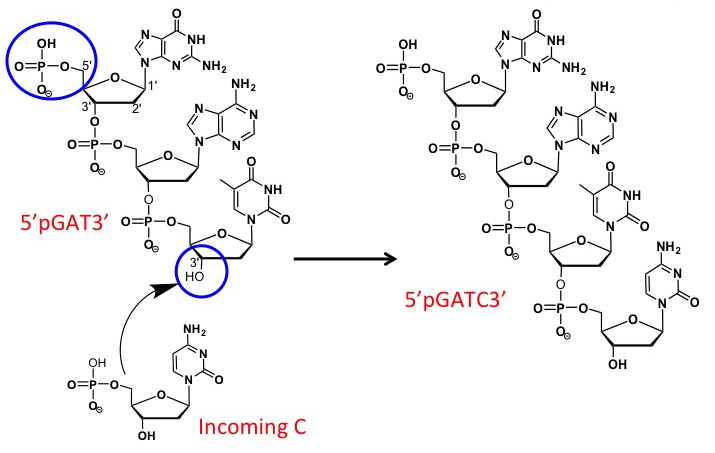
This is a fragment of a DNA polymer.
And there is the 5 prime phosphate and the 3
prime hydroxyl circled in blue on either ends of the polymer.
And I've also circled this complex phosphodiester
bond that holds the sugar and the phosphate together.
And the bases are kind of separate.
They're hanging off the sugar phosphate backbone.
If we look at a schematic of this,
I've drawn you the sugar phosphate backbone, the base
order, the first nucleotide, the last nucleotide,
the free phosphate group at the 5 prime end,
and the free hydroxyl group on the last nucleotide.
The direction of polymerization is from 5 prime to 3 prime
because you always add onto the 3 prime end.
But when we write the sequence of the bases on nucleic acid,
we don't write the sugar phosphate backbone.
We just take that as a given.
What's really important are the base order, B1 to B6
in my diagram--
I've put a real example there--
and the 5 prime and the 3 prime ends.
And you always, always, always write those 5 prime
and those 3 prime ends.
Doesn't matter if you've been working with nucleic acids
for 30 years.
You always have to write 5 prime 3 prime and the base order
between.
There is no exception ever, ever, ever.
It's one of the most important things I can tell you.
The order of the bases relative to this 5 prime and 3 prime
is the information in nucleic acid.
It's what the genes are.
It makes you who you are because of these two
attributes of nucleic acid.
The polarity, the 5 prime and the 3 prime end,
shows the first to last nucleotide added
and the direction in which to read the information.
We will have more to say about this.
But what I want you to do now is to go to this exercise
and practice your nucleic acid polarity
skills that use these pointers and these rules
that I've just given you.
Reference Summary
Anatomy of a nucleic acid
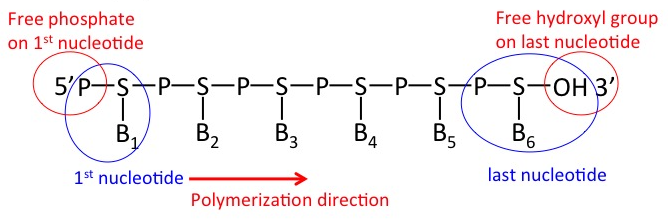
Above is a diagram of a nucleic acid polymer.
Recall that each nucleotide is composed of a sugar, phosphate and base.
S = Sugar
P = Phosphate
B= Base.
The strand is polymerized from the 5' end to the 3' end. The nucleotide at the 5' end has a free phosphate and the nucleotide at the 3' end has a free 3'OH group on its sugar.
Nomenclature
S-P backbone is not written, just the bases and the polarity of the strand.
ALWAYS write 5’ and 3’ on each nucleic acid strand!
In other words, written nucleic acids take the following form:
5'B1B2B3B4B5B63'
For example:
5'GAATCC3'
Polarity of Synthesis
Nucleic acids are made from 5’P to 3’OH. This means that the –3’OH end is the growing end, i.e. receives the incoming nucleotide, as shown below.
Base order = INFORMATION
Polarity = 5’ and 3’ ends show first to last nucleotide added and confer a direction to read information
Exercise 1 (Labeling and Building Nucleic Acids)
Exercise 2 (Interpreting Nucleic Acids)
MIT OpenCourseWare / MIT Open Learning Library. Hazel Sive and Diviya Ray. Adapted for local study under Creative Commons Attribution–NonCommercial–ShareAlike 4.0. License terms.