Assignment 1.6: Protein polarity
Your answers are saved in this browser. Check them against the downloaded answer key, or open the explanation when you are ready.
Lecture 1.6
Transcript
HAZEL SIVE: I want to extend this notion of information
into the proteins.
So proteins, you remember, are the polymer of amino acids,
and they have quite a lot of similarities
in their notion of information coding
than the nucleic acids do.
They have a kind of a backbone, and then they
have information that is associated with the backbone.
When we write proteins, we designate N or an NH2
or amino as one end of the protein molecule.
And then we write amino acid one joined to amino acid
two, amino acid three.
And then we have C or COOH or carboxy,
and that would be at the other end.
The amino acids are joined together
by a peptide bond, covalent bonds, between the amino group
and the carboxyl group of the amino acids,
and this NC bond will form a kind of a backbone,
similar to the nucleic acids.
Not the same at all, but the notion
is similar, as I'll show you in a moment.
The amino acid order is relative to the two
ends of the molecule.
So there is polarity to proteins that
is based on the amino and carboxy ends,
and is also based on the amino acid order.
And we can draw a parallel, again,
to nucleic acid structure.
The carboxy amino acid is the last added,
and the next one will add on to the carboxy end
so that the carboxy end has the last amino acid added,
and the next adds to this carboxy end.
A little compressed down there, but let's go to the slide.
The first thing I want to show you
is that proteins have got two different ends, an amino end
and a carboxy end, with the amino acids arrayed
between those.
And then if we look at the protein polymer, two
different amino acids here, glycine and alamine,
circle the alpha carbon on these, joined together
to make a peptide bond, which I've circled in blue,
and leaving a free amino end on the first amino acid
of the polymer and a free carboxyl end
on the last amino acid.
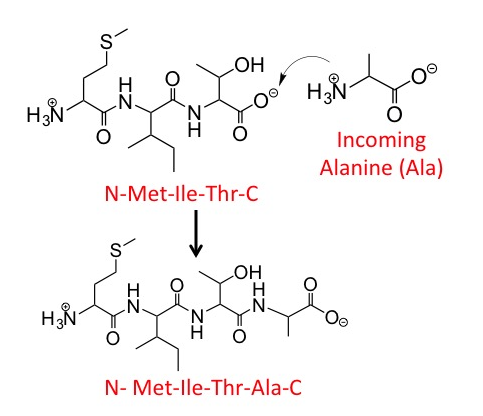
And if a new one were to add-- this
is just a dipeptide, this very tiny protein.
If the next amino acid were to add,
it would add where I've arrowed the incoming next amino acid.
When we write proteins, we write with the three or the one
letter amino acid code.
We always, and this has another parallel to nucleic acids--
we always write the amino end and the carboxy end.
We never get too old to write the amino acid
and the carboxy end onto a protein.
So here I've got a couple of example peptides,
little tiny proteins, with their amino and carboxy ends
indicated.
And here, again, the direction of polarization.
The order of the amino acids is the information.
The polarity of the amino acid chain, the N and the C ends,
shows the first to the last amino acid added
and the direction to read the information.
If we compare the proteins and the nucleic acids,
there is an order of monomers that
can be read in a defined direction,
and that defined direction is the information.
In the nucleic acids it's the order
of the nucleotides from five prime to three prime.
In the proteins, it's the order of amino acids
from the free amino to the free carboxy terminus.
And so for your last assignment, I'd
like you to go and practice looking at protein polarity
and how you write this and which is
the first and the last amino acid.
Reference Summary
Anatomy of an amino acid polymer
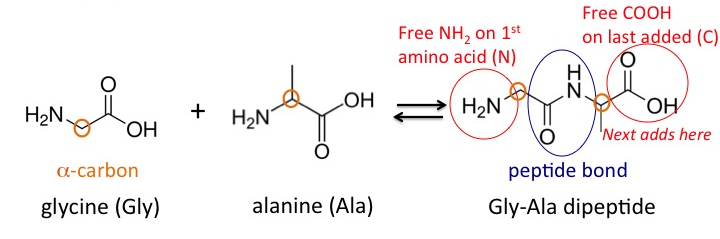
The diagram above shows the synthesis of a dipeptide from two amino acid monomers.
The alpha-carbons have been circled in orange.
The peptide bond that forms upon synthesis is circled in blue.
The polypeptide is polymerized from the N end to the C end. The amino acid at the N end has a free NH2 group and the amino acid at the C end has a free COOH group.
Nomenclature
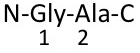
Proteins are written with three or one letter amino acid code from N to C.
ALWAYS write N and C on each protein!
For example:
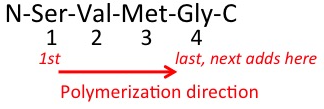
OR, from the diagram above:
Polarity of Synthesis
A polypeptide chain is synthesized from N to C. Therefore, the –C end is the growing end (for addition of next amino acid).
Amino acid order = INFORMATION
Polarity = N and C ends show first to last amino acid added
Exercise 1 (Labeling and Building Proteins)
MIT OpenCourseWare / MIT Open Learning Library. Hazel Sive and Diviya Ray. Adapted for local study under Creative Commons Attribution–NonCommercial–ShareAlike 4.0. License terms.