Assignment 2.1: Condensation and hydrolysis
Your answers are saved in this browser. Check them against the downloaded answer key, or open the explanation when you are ready.
Lecture 2.1
Transcript
HAZEL SIVE: Welcome back to Getting Up to Speed in Biology.
I hope your first class was helpful
and that you have started to know
the names of certain biological terms
and understand certain biological concepts that
were unfamiliar before.
Today, we're going to move on to the next topic I'd
like to cover with you in lecture 2--
the cell and how it works.
And again, there are going to be a lot of class exercises
or a lot of exercises that you can
do to make sure that you have the concepts
and are able to use them as we've talked about them.
What I'd like to do today is three things.
I first am going to talk about cellular chemistry
and some key concepts there.
Then we'll talk about organization of the cell,
and then we'll talk about cell division.
So let's move right in to the question of cellular chemistry.
Here are our three topics for the day.
And let's talk about, to begin, this notion
of cellular chemistry.
The cell, as I mentioned yesterday
in the previous meeting, is full of chemical reactions.
It is a bag of chemical reactions.
And the sum of all chemical reactions in the cell
is called metabolism.
So metabolism is all of the chemical reactions in a cell.
There are two major types of chemical reactions
that you should know.
There are catabolic reactions which break down molecules.
For example, if you have some kind of polymer--
here's a monomer joined to another monomer.
If you add water to that polymer,
you will get out two separate monomers, each
with their own hydroxyl group.
This is a catabolic reaction.
And it is also, because you're adding water,
called a hydrolysis reaction.
The flip of this is an anabolic reaction
where you build up molecules.
And these release water in general as they
are being performed, and they are
called condensation reactions.
For example, two monomers, each with a hydroxyl group,
will then give rise to a polymer, MOM,
with the release of water.
These two types of chemical reactions
are really pivotal to how the cell functions.
Let's take a look at a couple of slides.
This first one introduces me to--
and introduces you-- to the notion
of the cell as a factory.
This beautiful painting lays for us
a kind of framework of thinking about the cell
as a production process, a production plant where
things are made, they're broken down, they're made again.
And so I want you to bear that in mind
as we talk more about the cell and its chemistry.
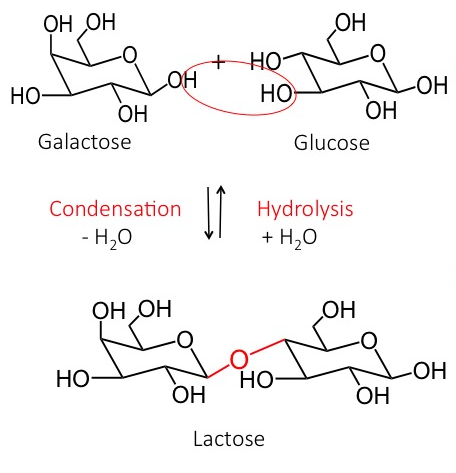
Here are a couple of diagrams of real condensation
and hydrolysis reactions.
As the slide points out, both of these
involve formation and breakdown of covalent bonds,
some of those very strong bonds we spoke about previously.
And you can see that this single reaction, which is either
the production of the disaccharide lactose
or its breakdown into its component monosaccharides,
can go in both directions.
In one direction, it's a condensation reaction
as lactose is being made.
And in the other, it's a hydrolysis reaction
as the disaccharide is being broken down
into its component parts.
So this really exemplifies what you
need to know about condensation and hydrolysis reactions.
The idea is that when you build up molecules,
you generally need energy to do so.
And when you break down molecules,
energy is generally released.
We're going to see that that's not entirely true in a moment,
but it's a reasonable first approximation.
So I'd like you now to take a look at this first exercise
and practice figuring out if it's
a condensation or a hydrolysis reaction.
Reference Summary
Anabolism v. Catabolism
Anabolism is a form of metabolism that consumes energy and by which covalent bonds are formed.
Catabolism is a form of metabolism that produces energy and by which covalent bonds are broken.
Condensation Reactions
A condensation reaction is one that forms covalent bonds and produces water as a product. These reactions are anabolic.
A-OH + H-B → A-B + H2O
(This reaction is also included in the figure at end.)
Hydrolysis Reactions
Hydrolysis reactions break covalent bonds by consuming a water molecule and dividing its atoms between separate molecules. These reactions are catabolic.
A-B + H2O → A-OH + H-B
(This reaction is also included in the figure below.)
Exercise 1 (Gly-Ala Dipeptide)
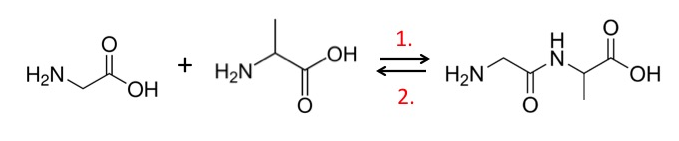
The following questions concern the formation of the Gly-Ala dipeptide, which is depicted below.
Exercise 2 (Glucose Pathways)
MIT OpenCourseWare / MIT Open Learning Library. Hazel Sive and Diviya Ray. Adapted for local study under Creative Commons Attribution–NonCommercial–ShareAlike 4.0. License terms.