Assignment 2.2: Free energy and reaction kinetics
Your answers are saved in this browser. Check them against the downloaded answer key, or open the explanation when you are ready.
Lecture 2.2
Transcript
HAZEL SIVE: Let's talk a little bit more
about some of the parameters that
govern the chemical reactions in a cell,
and indeed, any chemical reaction.
All chemical reactions are governed by something
called free or usable energy.
So let us write that.
Reactions are governed by free energy
where free really means usable.
And this free energy gets a special symbol.
It is called G. And the difference in free energy
is what's really important, and so we write delta G. Delta
G comes from a key thermodynamic equation such
that the difference in the free energy of a reaction
has to do with a difference in enthalpy
or total energy minus temperature times
the difference in useless energy.
So this is the free energy.
This is the total energy, and this
is the temperature multiplied by the unusable energy or entropy.
So this delta G equals delta H minus T delta S is an equation
that you should have seen and at least know
the terms associated.
When we think about a chemical reaction
such that some reactants can either become products--
reactants becoming products or products
can become what were reactants, so chemical reactions
can go in both directions.
There are three things that can happen to free energy
during this reaction, either one way or the other.
Delta G can be negative, in which case energy is
released during the reaction.
And the reaction may proceed.
It may even be spontaneous.
On the other hand, delta G might be positive.
Delta G might be positive, in which
case energy is required in order for the reaction to proceed.
And the third possibility is that delta G is 0.
And if delta G is 0, the reaction
is said to be at equilibrium where the reactants become
products at the same rate as the products go back
and become reactants.
So everything is kind of in balance.
Those are your three possibilities.
And it's important to think about them
for all biological chemical reactions.
So here I'm going to lay it out for you again.
We can think about free energy and reaction kinetics.
For here, substrate becoming products, reactants
or substrate, ROS used interchangeably.
Free energy as defined for you, and here energy
release when delta G is negative.
These reactions can also be called exergonic,
and they may occur spontaneously.
The flip-- endergonic reactions require energy
to proceed where delta G is positive.
And delta G 0--
the reaction is at equilibrium.
The production of the products is the same
as the back reaction to the production
or the regeneration of the reactants.
We can portray the thermodynamics, the free energy
changes, using various graphs.
And delta G negative reactions typically are shown as--
the schematic is a ball rolling down
a hill where you can draw a graph where
you can see that if you plot energy against time,
you see that there's a certain amount of energy released
as the products are formed.
And the flip-- where delta G is positive,
where you need energy for the reaction to go--
then you see that the amount of energy required
is a positive input that has to take place.
OK.
But there is a catch here.
I mentioned that even if delta G is negative,
sometimes a reaction will not proceed.
It needs a little push before it will proceed.
And the little push is energy, and it's
called activation energy.
So we can write--
you may need activation energy even with delta G negative
less than 0.
This is called an energy barrier.
You can think of it as a ball sitting at the top of a hill.
And the ball really could roll down the hill,
but it has to get out of the little hollow
that it's in before it can do so.
Getting out of the little hollow so the ball can roll down
the hill is the activation energy of a chemical reaction.
This can be a real barrier to getting chemical reactions
to go.
And there is a whole class of substances
that bring this activation energy down and allow reactions
to proceed.
These are called catalysts, and they
are the things that will get your ball out
of the hollow, that will get you over the activation energy hump
and allow the reaction to proceed.
So catalysts are a class of chemicals that
decrease activation energy.
And they're found all over chemistry.
But in life, they are defined by a particular class
of biological molecules that are the enzymes.
Enzymes are a hugely important class of biological molecules,
and enzymes are biological catalysts.
I'll write a couple more things on the board,
and then we'll look at a slide or so.
Enzymes are very cool because they're
specific for every reaction.
There are thousands and thousands of enzymes
in our bodies, each of them responsible for pushing
a particular chemical reaction over the activation energy
hump.
So we can write that enzymes are specific
for each chemical reaction, each metabolic process in the cell.
And key to this is that they do not
change the value of delta G. They rather speed up
the rate of the reaction.
So they do not change delta G, but speed up reaction rates,
how fast it goes.
The notion of enzymes is something
that is shown on this slide.
The enzyme is a molecule, and it has
a particular place where the substrate or the reactants
can bind.
This is called the active site.
And in the schematic, the substrate
comes and binds to the enzyme and forms
this enzyme substrate complex.
And the substrate pretty much fits in a particular part
of the enzyme.
Once the substrate is inside the enzyme, bound to the enzyme,
then various changes happen that push
the substrate over the activation energy barrier
and allow the product to form.
Once the product is formed, it's released from the enzyme,
and the enzyme is free to be a catalyst again
for that chemical reaction.
As we discussed, chemical reactions are reversible.
And so you can see that there are
places where the reaction could proceed backwards, although it
may not usually do so.
The specificity of enzymes is really interesting.
On this slide, you can see two enzymes.
And these are depicted in various--
in a specific structural way so that
you can see how the protein is folded.
On the left-hand side is the structure
of an enzyme called cellulase.
It breaks down cellulose, which is the carbohydrate of plants.
It's in grass.
It's one of the reasons that you cannot--
you and I cannot eat grass.
We do not have this enzyme called cellulase.
Some organisms do, and they're able to break down grass
and to use the sugars that come from cellulose.
On the right-hand side is an enzyme called amylase.
Amylase breaks down bonds in polymers of glucose
that are found in starch.
You and I have this enzyme, and so we
can break down starch and use this as a source of energy.
These two enzymes have very similar specificity.
The cellulase breaks down these beta-1, 4 bonds between glucose
monomers in cellulose, and the amylase breaks down
a slightly different bond called an alpha-1, 4 bond in starch.
The bonds are similar, but they're different enough
that you need separate enzymes in order to break them down.
And these enzyme differences are the reason that you can
or cannot eat grass, and they demonstrate this notion
of enzyme specificity.
I want you to take a few minutes now
to look at the assignments, the exercises that
have to do with free energy and practice some of these concepts
that we've just discussed.
Reference Summary
Free Energy (ΔG)
ΔG = ΔH - TΔS
H = Enthalpy
S = Entropy
T= Temperature
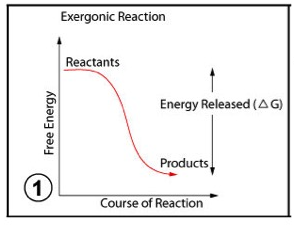
Exergonic Reactions
Exergonic reactions release energy, so that ΔG < 0 and the reaction is spontaneous.
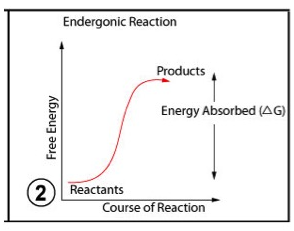
Endergonic Reactions
Endergonic reactions require energy to proceed, so that ΔG > 0 and the reaction is non-spontaneous.
Equilibrium
If ΔG = 0, the reaction is at equilibrium such that the rate fo the forward reaction = the rate of the backwards reaction.
Exercise 1 (Understanding Free Energy)
The following questions concern Reactions 1, 2, and 3 that are shown below with their ΔG values.
Reaction 1: A → B, ΔG < 0
Reaction 2: A → B, ΔG > 0
Reaction 3: A → B, ΔG = 0
Exercise 2 (Evaluating Reactions)
The following questions concern Reactions A - F, which are shown here with their ΔG values.
| Reaction | Chemical Formula | ΔG |
| A | 2 Mg (s) + O2 (g) → 2 MgO (s) | ΔG = -1137 kJ/mol |
| B | NH3 (g) + HCl (g) → NH4Cl (s) | ΔG = -91.1 kJ/mol |
| C | AgCl (s) → Ag+ (aq) + Cl- (aq) | ΔG = 55.6 kJ/mol |
| D | 2 H2 (g) + O2(g) → 2 H2O (g) | ΔG = 456 kJ/mol |
| E | C (s) + H2O (l) → CO(g) + H2 (g) | ΔG = 90.8 kJ/mol |
| F | CH4 (g) + 2 O2 (g) → CO2(g) + 2 H2O (l) | ΔG = -820 kJ/mol |
MIT OpenCourseWare / MIT Open Learning Library. Hazel Sive and Diviya Ray. Adapted for local study under Creative Commons Attribution–NonCommercial–ShareAlike 4.0. License terms.