Assignment 2.3: Pathways
Your answers are saved in this browser. Check them against the downloaded answer key, or open the explanation when you are ready.
Lecture 2.3
Transcript
HAZEL SIVE: Chemical reactions in the cell
are not only governed by the laws of thermodynamics
and are not only catalyzed by enzymes.
They are also often linked into pathways
where one chemical reaction will proceed another
and another and another.
And the whole thing forms a kind of production line
so that starting from point A, you
land up with a particular product
that the cell really needs.
This is just like a factory production line
where you have to make something from lots of components.
And there are lots of steps involved in the manufacture.
So we can define pathways and something
that I'll call feedback control in the chemical reactions
of the cell.
And the point that you should get
is that in order to get somewhere, in order
to manufacture something in the cell,
there are multistep pathways comprising linked chemical
reactions.
And these pathways can be governed
so that you can make more of the product or less of the product
depending on the need of the cell, really analogous
again to the factory.
The control of a pathway and how much of the outcome there is
can be positive in which case you'll make more
along that particular reaction.
Or it can be negative in which case you will make less.
These controls are called feedbacks.
And you can have positive or negative feedback.
And then finally, pathways can be
controlled by within the cell.
They can also be controlled by external influences
just like in a factory.
If one needs more cars because there's
more demand from the consumers, the factory production line
will speed up.
In the cell, if there is something
that happens outside the cell, this
can give a signal to a particular pathway.
And that can speed up or slow down the pathway.
So there can be external signals from outside the cell
that control pathways.
Let's look at a diagram of this.
I've drawn you here a pathway that starts off
with reactants labeled A. And those reactants can go down
one of two pathways.
They can either make B in which case they will go on
and make C. Or they can make D and go on to make E.
And those are a splitting pathway.
Each of those arrows, I should note,
is governed by a particular enzyme.
Each of those are chemical reactions.
So that is your basic pathway that splits in my diagram.
Here is an example of positive feedback.
Let us say that when you get a lot of product C,
you also need a lot of product E.
And the way that this is controlled
is that C, whatever the molecule is,
goes and speeds up the production of D, which
then gives you the increased production of E.
You can also have a negative feedback
where once you've gotten lots of D,
you might want to turn off the other pathway.
And so D might inhibit production of B and C
with this feedback inhibition, this negative feedback.
This is what it looks like in a diagram.
And we can add to it an external signal.
Here I've shown you a signal coming
from somewhere else that's going to speed up
the production of B and C. What does it
look like actually in the cell?
This is the pathway diagram for phenylalanine, an amino acid.
And these are all the different ways
that phenylalanine is metabolized
in the cell, all the different chemical reactions that
lead to its synthesis and leads to its breakdown.
And you can see that it is really complicated.
This is a circuit diagram with both activation and inhibition
components.
And if we were to zoom out and look
at the chemical pathways in the cell, the metabolic pathways
in the cell shown in this kind of line diagram,
we would fill the space with very complicated activation
and inhibition pathways.
The circuitry of the cell is really, really complicated.
Good.
So take a moment now and go and do an exercise on pathways
so that you can practice the positive
and the negative aspect of what pathways mean.
Reference Summary
Principles of Pathways
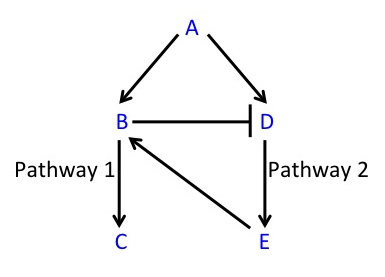
Biochemical pathways include activation (positive control), represented by a pointed arrow (→),
and inhibition (negative control), represented by a T-bar arrow.
Feedback serves to regulate product levels within a pathway.
Exercise 1 (Pathway Principles)
The following questions center around the diagram shown below.
Exercise 2 (Interpreting Pathways)
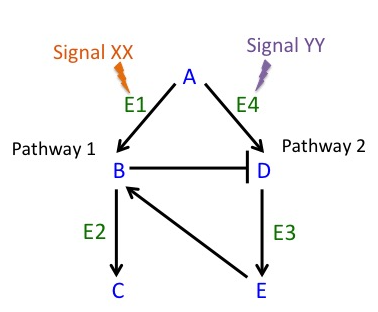
The following questions center around the diagram below.
The steps in Pathways 1 and 2 are catalyzed by enzymes (E1, E2, E3, E4). Each enzyme is shown next to the arrow that the enzyme controls.
E1 is activated by Signal XX.
E4 is activated by Signal YY.
MIT OpenCourseWare / MIT Open Learning Library. Hazel Sive and Diviya Ray. Adapted for local study under Creative Commons Attribution–NonCommercial–ShareAlike 4.0. License terms.