Assignment 2.4: Organelles
Your answers are saved in this browser. Check them against the downloaded answer key, or open the explanation when you are ready.
Lecture 2.4
Transcript
HAZEL SIVE: In conclusion of our first topic
today, cellular chemistry, you should now
be familiar with condensation and hydrolysis reactions.
You should know what free energy means
and be able to predict whether a reaction will
proceed spontaneously or not.
And you should know something about how biological pathways
are put together.
Let us move on then to our next topic, which
is organization of the cell.
Last time we talked about the cell
as the building block of life, a little package of chemical
reactions and macromolecules that
can be used kind of like a brick to build a living organism.
So let us consider this further in topic
2, cellular organization, and let
us talk about the cell as some kind of building block.
If you like, you can add of life next to it.
So how do you get a building block?
When you think about anything that is some kind of brick
or some kind of package, it has some kind
of surrounding material.
And for the cell, this is the cell membrane.
So the cell is surrounded by an important structure called
the cell or plasma membrane.
Can also call it the cell membrane.
That is fine.
And in fact, as we'll discuss, there all sorts of
membranes even inside the cell.
I want you to think back to the lipid
section from our previous discussion
where we talked about amphipathic lipids.
And the plasma membrane is made of hydrolysis lipids
that have got both polar and nonpolar character.
And they form a bilayer as I'll show you
on some slides in a moment.
Now, one of the things about the plasma membrane
is that it is hydrophobic.
It is largely hydrophobic.
And so the cell, this package of chemical reactions and products
that are being made, is effectively
sealed in a plastic bag.
In order to get things into the cell or out of the cell,
you therefore have to make some holes in this hydrophobic cell
membrane to allow things in and out.
And so various structures called channels or pores
allow molecules through the cell membrane.
Let's take a look at a couple of things here.
Let's firstly talk a little about cells.
There are lots of different kinds of cells.
I've shown you three different kinds here-- red blood
cells, spermatozoa, and neurons, each of which
carry different functions.
Red blood cells carry oxygen. Neurons are the information
transfer system of the body.
And spermatozoa carry the hereditary material of males.
Each of these is surrounded by the lipid bilayer
that we just discussed.
And let me throw out something cool
while we're thinking about cells as building blocks.
You really can build with cells.
They are sturdy enough to do so.
Your whole body is made of microscopic cells.
10 microns-- a micron is a millionth
of a meter in diameter-- all stuck together.
And that's what makes our bodies.
And you can build with them in really cool current ways.
Here for example, a 3D printer is making an organ.
You're making it mixing a polymer and various cells
together and printing out a body part that can then
be used in transplants.
So these cells are held together by the lipid bilayer
and can be used as building blocks.
And let us take a little look at what the lipids look
like that surround the cell.
These are phospholipids.
They have got a positive charge on one side
of the molecule that makes them interact with water.
And then they've got a really hydrophobic part
that makes them not interact with water
that makes them hydrophobic.
These lipids spontaneously join together
so that their hydrophobic ends are touching,
and their hydrophilic ends are facing the water.
So they make for themselves a hydrophobic internal core.
And then on either side, they are
facing the water which they like to interact
with through their hydrophilic heads.
And you can see here the bilayer.
This is one layer of lipid molecules.
And the top is another layer of lipid molecules
that have come together in this lipid bilayer.
And then as I mentioned, one has to get things
through this hydrophobic lipid bilayer.
And there are really two ways.
Hydrophobic molecules can generally
diffuse across the plasma membrane or other membranes.
But hydrophilic molecules need to go through special openings
in the membrane.
And we've shown you here a channel or a pore
that really is a hole in the membrane.
It may have a way of opening and closing.
But it will allow particular molecules
into and out of the cell.
We can schematize cells as shown in the slide.
And I've written here that cells are replicating,
membrane-bound factories.
That's my way of thinking about what these building
blocks actually are.
So we've talked about the membrane bound part.
What about the insides of the factory?
What is inside the cell that makes it function?
And what is inside the cell are a set
of soft cellular structures called organelles.
These are subcellular structures.
And they have specific function.
They may be surrounded themselves by a membrane.
So they may be membrane bound.
And there are lots of them.
And what we're going to do in a moment is to list some of these
so that you can see what's inside a cell.
On this diagram, you can see again
a whole bunch of different schematics depicted
inside the schematic of a cell.
Gives you a kind of a sense that the cell is packed
with various subcellular structures each of which
carry out specific functions and are really,
really both absolutely essential and really fascinating.
So let's make a listing that has the particular organelles
and then the function of that organelle in the cell.
And the first one we'll start with is the nucleus.
And this is the part of the cell that carries the genes.
It's where most of the hereditary material is kept.
Now, on the slides, you will see that there
is both a prokaryote like a bacterium that actually doesn't
have a nucleus and, in fact, doesn't have
a lot of these same structures that I'm
listing for you on this board.
And on the other side is a eukaryote,
cells like human cells like our own cells.
So we're going to talk pretty much about organelles that
are in eukaryotes, e.g. human.
The rest of the cell other than the nucleus
is called the cytoplasm, everything that's non-nuclear.
And the cytoplasm contains the various other organelles.
The mitochondria has a number of functions.
But the one that is best understood
is its role in energy conversion.
It's where the ready energy, the dollars and cents of being able
to actually carry out chemical reactions,
it's where the ready energy is produced.
In plants, there is something called
a chloroplast that again is involved in energy production.
There is a set of organelles that
are all involved in synthesizing proteins
that we discussed previously.
These are the endoplasmic reticulum,
which always sounds like something from a horror movie--
this is involved in protein synthesis--
the ribosomes and the Golgi apparatus.
And all of these are somehow involved in protein synthesis
and production and figuring out what
proteins are going to go where.
There is the lysosome, which is involved
in breaking down cellular components that
are no longer needed.
And then there is a set of structural components
that gives the cell its shape and its integrity
so it stays together and also may allow the cell to move.
So we are going to list these all here as the cytoskeleton,
cilia, and flagella.
And all of these have got something
to do with movement and in some cases
with shape and structure of a cell.
That is a real quick flyby of a huge amount of information.
But I want you to have heard of all of these things.
Here is a listing of the organelles and the things
that they do.
So let us take a moment for you to go and do a review question
and really understand a bit about what is inside the cell.
Reference Summary
What is a cell?
A cell is a smallest unit of life that is bound by a membrane and can self-replicate.
There are two types of cells: eukaryotic cells (such as the cells that make up plants and animals) and prokaryotic cells (such as bacteria cells).
An organism that is made up of one or more eukaryotic cells is called a eukaryote, and an organism whose cells are prokaryotic is called a prokaryote. In this way, plants and animals can be referred to as eukaryotes and bacteria are examples of prokaryotes.
Organelles
An organelle is defined as a specialized structure within a cell that serves a specific function.
The chart below lists eukaryotic organelles with a short summary of their functions. Pay particular note to the nucleus, mitochondrion (plural: mitochondria), and ribosome.
| Common Organelles of Eukaryotic Cells | |
| Name | Function |
| Organelles with membranes | |
| Nucleus | Protecting, controlling access to DNA |
| Endoplasmic Reticulum (ER) | Routing, modifying new polypeptide chains; synthesizing lipids; other tasks |
| Golgi body | Modifying polypeptide chains; sorting, shipping proteins and lipids |
| Vesicle | Transporting, storing, or digesting substances in the cell, other functions |
| Mitochondrion | Making ATP by breaking down sugars |
| Chloroplast | Making sugars in plants and some protists |
| Lysosome | Intracellular digestion |
| Peroxisome | Inactivation of toxins |
| Vacuole | Storage |
| Organelles without membranes | |
| Ribosome | Assembling polypeptide chains |
| Centriole | Anchor for the cytoskeleton |
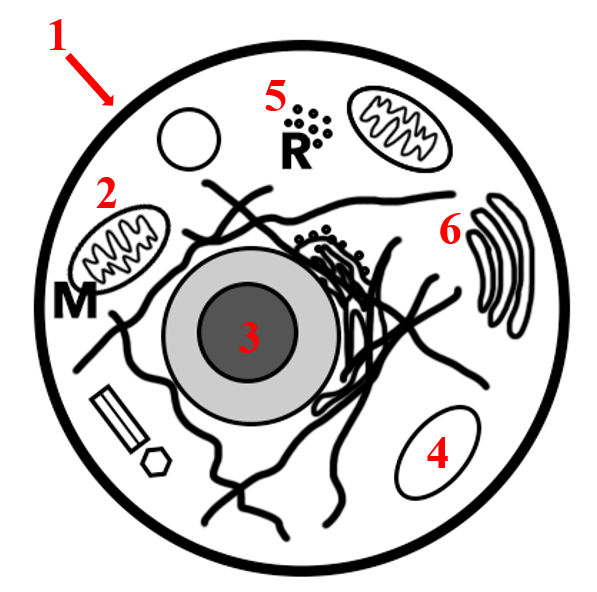
Exercise 1 (Organelle Locations and Functions)
The following questions center around the diagram of a cell shown below. Certain parts of the cell have been labeled by a red number, one through six (1 - 6).
MIT OpenCourseWare / MIT Open Learning Library. Hazel Sive and Diviya Ray. Adapted for local study under Creative Commons Attribution–NonCommercial–ShareAlike 4.0. License terms.