Assignment 3.1: DNA rules
Your answers are saved in this browser. Check them against the downloaded answer key, or open the explanation when you are ready.
Lecture 3.1
Transcript
[SQUEAKING] [RUSTLING] [CLICKING]
HAZEL SIVE: Welcome back to Getting Up to Speed in Biology.
This is lecture three, class three,
because you're going to participate in the class
with a number of exercises, as you have been doing.
Today we're going to talk about information
transfer in biology.
Information transfer and molecular biology
are some of the most key, crucial aspects
of modern biology, and you need to know this material
very carefully in order to understand anything
at a higher level in biology.
It is very cool stuff.
Understanding information transfer
explains lots and lots of things.
For example, why babies look like their parents,
how you control the number of fingers, how a bird gets
its colors, and how pathogens, including viruses, make us ill.
This is just the tip of the iceberg
when we think about what information
transfer and molecular biology can teach us.
Today I want to cover four aspects.
We're going to talk about the gene and some rules about DNA.
Then we're going to talk about DNA replication, how
DNA makes more DNA.
We're going to talk about a process called transcription,
and we're going to talk about a process called .
These aspects of the lecture will
draw on what you know before, and you'll also
have an opportunity to expand your practice
of the various concepts.
Let's get started, then, with the notion of a gene
and some rules associated with DNA.
We previously discussed that the gene, the unit of hereditary,
of how things are passed on from generation to generation,
is usually made of DNA.
If we pose the question, what is a gene,
there is a number of ways that we can answer it.
We can say that it is this unit of inheritance, hereditary,
and we'll explore that more in the next lecture
of this series.
But there is another way that I want
to define the gene, which is that it is a piece of DNA that
contains all the instructions to make
the final product of the gene.
I'm going to be generic and talk about nucleic acid and not DNA,
because genes can be RNA sometimes, in a virus,
for example.
But let us say that a gene are the nucleic acid instructions
in order to define a product, and the product can be RNA
or it can be a protein.
The gene is usually DNA, as I've mentioned,
and it is, as we discussed, the unit of hereditary.
The notion of information transfer
is part and parcel of the field of biology
called molecular biology.
So molecular biology, a term you should know,
includes biological information transfer,
and in this notion of information transfer,
the gene, usually DNA, replicates.
It makes more of itself.
The gene is copied into another related nucleic acid, RNA.
So the gene is copied into RNA, and the process involved here
is called transcription.
And then the RNA is used in a process called translation
to make a protein.
So the RNA is translated into protein.
This is the information transfer,
and it's often graphically represented as DNA
replicating itself, with the circular arrow leading
to production of RNA and leading to production of protein.
Some of these arrows can go backwards,
but these are really the essential arrows
that you need to understand information transfer.
We can depict this graphically, DNA
making RNA and making protein.
So that's something about the gene and information transfer.
Let's now talk about some rules of DNA.
These rules of DNA are incredibly important,
and with them you'll be able to manipulate nucleic acid
and understand this information transfer pretty well.
Here they go.
DNA rules.
It does.
Here they are.
We talked last time about nucleotides.
We talked about A, G, C, and T and U in RNA.
What I didn't tell you is that those nucleotides can hydrogen
bond to one another, and they do that
in a very defined, stereotypical, always
the same way.
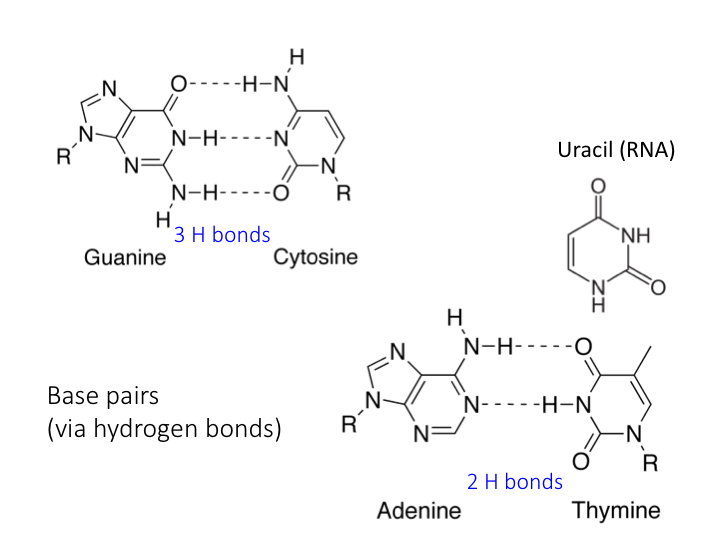
So the bases hydrogen bond such that A makes two hydrogen bonds
with T, and G makes three hydrogen bonds with C.
This is called base pairing, and what it does
is to allow two strands of DNA to hydrogen bond
to one another, if the bases match,
in a way that is called complementary.
So the base pairing is associated
with complementary DNA strands.
For example, we could write AATC,
and that would be one strand of DNA,
and we would know what the opposite strand of DNA
looked like because of these rules of base pairing.
The other strand would be T opposite the A, TA,
opposite the T, and G. Those are our complementary strands.
But there's more.
Remember that five prime and three prime
that we talked about, the five prime phosphate, the three
prime hydroxyl?
We have to put those somewhere in.
I told you you always had to write them.
If we put in the five prime and the three prime ends,
look what we see.
Here is five prime AATC, and on the other end is three prime.
The complementary matching strand goes the other way.
Three prime TTAG and five prime on the other end.
This arrangement, whereby the complementary or base
paired strands, go in opposite directions
is called an antiparallel arrangement,
and it is how nucleic acids always
lie when they are base paired.
So these are called antiparallel strands.
This rule-- these rules of DNA really
make double stranded nucleic acid, especially DNA,
very, very stable.
So we can think about the notion of double stranded, or DS DNA,
as the kind of currency of the gene.
And then the last thing I want to remind you
in these DNA rules is something we talked about previously.
When you add on nucleotides to nucleic acid,
they always add to the three prime end, to that free,
three prime .
So we will write this over here as a reminder.
Three prime nucleotide addition, and this
is a reminder from what we spoke about last time.
Let's look at some slides that have
to do with these really important DNA rules.
Here are the base pairs.
Guanine base pairing with cytosine, adenine base
pairing with thymine through three or two double bonds.
This base pairing leads to very stable double stranded DNA
structures that roll up, because of the thermodynamics involved,
into this famous double helix that you may have heard of.
So the double helix is double stranded
DNA that takes on this particular spiral,
or helical, structure because it is
a chemically stable structure.
This is what genes are made of, and you will see in a moment
why this is so important for hereditary.
This reminds you-- I took it from one
of our previous slides.
This reminds you that the free group on the last nucleotide
is the place where the next nucleotide adds,
and the direction of nucleic acid polymerization
goes from five prime to three prime.
Good.
Now it's time for you to practice
using some of these concepts and practicing some DNA rules.
Reference Summary
DNA Polarity
Recall that DNA strands have a 3’ end and a 5’ end and that new nucleotides are added to the free -OH group of the 3’ end.
Base Pairing
For DNA, there are 4 nucleotide bases: Guanine (G), Cytosine (C), Adenine (A), and Thymine (T).
G pairs with C between complimentary strands via the formation of 3 hydrogen bonds.
Similarly, A pairs with T via the formation of 2 hydrogen bonds.
For RNA, the bases are the same, except Uracil (U) is used instead of Thymine.
In RNA, A pairs with U, and they form 2 hydrogen bonds.
(Therefore, the RNA bases are: G, C, A, U.)
Exercise 1 (Complementarity)
Exercise 2 (Extension & Hybridization)
MIT OpenCourseWare / MIT Open Learning Library. Hazel Sive and Diviya Ray. Adapted for local study under Creative Commons Attribution–NonCommercial–ShareAlike 4.0. License terms.