← Unit 3

Assignment 3.2: DNA replication

Your answers are saved in this browser. Check them against the downloaded answer key, or open the explanation when you are ready.

Lecture 3.2

Transcript

HAZEL SIVE: Good.

From your practice, you should now

be familiar with the following DNA rules.

You should understand base and be

able to put in the opposite complementary strand

relative to a piece of DNA.

You should understand polarity that we

talked about before, the 5 prime and the 3

prime ends of nucleic acid.

And you should understand the concept of antiparallel strands

where one strand goes 5 prime to 3 prime and the other 3 prime

to 5 prime.

This will set you up for the next thing

that we're going to talk about, which is DNA replication.

What do we mean by DNA replication?

We mean that DNA is produced by copying a DNA template.

DNA replication produces DNA from a DNA template.

This is a process that takes place

in the nucleus of the cell.

And it is the mechanism by which DNA, the genes,

make more of themselves before they undergo cell division,

mitosis or meiosis.

What do we mean by DNA replication?

Let us start by looking at a piece of double-stranded DNA.

And I'm not going to put in the exact nucleotides.

I'm just going to put some dots and things to represent

the nucleotides.

So here is one strand.

And here is the antiparallel strand

with the complementary bases.

DNA is replicated firstly by separating the strands.

So a process of strand separation

leads to two strands, the top one 5 prime plus

the bottom one that goes 3 prime to 5 prime.

These two separated strands now serve as templates, something

to copy in order to make more DNA.

So each strand is a template that is then copied

to make the complementary DNA.

And the outcome will be that this top strand

5 prime to 3 prime will be filled in with its complement,

the matching other strand.

And the bottom template that went 3 prime to 5 prime

will be filled in with its matching complementary strand.

So out of this one DNA template or this one

double-stranded piece of DNA, there

are two single-stranded templates

that then lead to two new DNA molecules that

are identical to the one that you started with.

So you'll have doubled the amount of DNA

and made identical new molecules starting with this parental DNA

template.

This is DNA replication.

It is how your genes are replicated from cell division

to cell division from parent to offspring.

The process is absolutely dependent on base pairing.

Without base pairing, you wouldn't know

which the right strand was.

It would be a mess.

But because of base pairing, because of complementarity,

you can take the two strands, fill them in,

and come up with DNA that is identical to the parent.

So here is your parent DNA.

And here is your new DNA.

And they are identical.

Very profound.

Let's take a look at a couple of slides.

So here is a double-stranded DNA template.

I put in just some of the nucleotides.

The strands separate.

DNA replication occurs from each 3 prime end.

Now, there's a little wrinkle here that you need to know.

DNA replication doesn't exactly occur

the way I drew it on the board.

It occurs with a running start.

It needs a little, tiny piece of DNA

called a primer that allows the DNA then to elongate

from that 3 prime end.

So there's something called an RNA primer which matches

a little bit of the DNA.

And that then gets elongated.

What is really, really crucial here

is that using the rules of complementarity

and adding on to the 3 prime end,

we make two identical DNA molecules that

are identical to the parent.

And I see here on the board I must add a 3 prime end there.

If we look at a representation of the double helix,

this is what it looks like more in the cell.

The DNA has the spiral helical form.

It unwinds so that you get two single strands in part

of the helix, and then those single strands

get filled in with new DNA.

There's some various nuances that we're not discussing here.

I threw out the notion of a primer to you.

All that means is that there's a 3 prime end you can add on to.

But the notion is as we have put it on the board--

single strands filled in with the complementary bases.

And voila, you have DNA replication.

Take a look at the next assignment, the next class

exercise, and see if you can replicate DNA.

Reference Summary

The steps of DNA Replication

Step 1. The two strands of the original DNA separate.
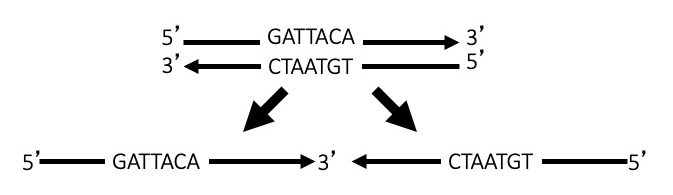
This image depicts double stranded D N A being separated into two pieces of single stranded D N A. The top strand represented as a black arrow that starts at the 5 prime end and ends at the 3 prime end. A sequence is given in the middle of the arrow. The sequence is G A T T A C A. The bottom strand is complementary and antiparallel. The bottom strand also represented as a black arrow that goes from the 5 prime end to the 3 prime end; the 3 prime end is on the left and the 5 prime end is on the right. The sequence of this strand is C T A A T G T. This double stranded D N A has two thick arrows that show it being separated into two single stranded molecules. The top strand is shown on the left and the bottom strand is shown on the right.


Step 2. RNA primers attach to the separated DNA strands.
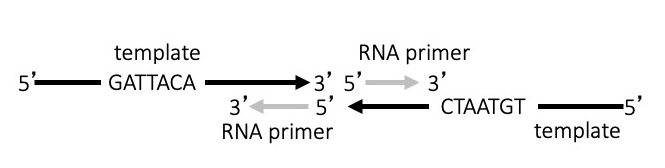
This image depicts R N A primers attaching to the single stranded D N A strands. At the left, the D N A sequence is represented as a black arrow that starts at the 5 prime end and ends at the 3 prime end. This strand has the following sequence: G A T T A C A. The D N A strand is labelled as a template. There is a short gray arrow that is aligned at the bottom right of the D N A template. This gray arrow is labelled as an R N A primer. The gray arrow goes from the 5 prime end to the 3 prime end but the 3 prime end is on the left and the 5 prime end is on the right. In this way, the 5 prime end of the R N A primer is aligned with and attached to the 3 prime end of the D N A template. At the right, the other D N A sequence is represented as a black arrow that goes from the 5 prime end to the 3 prime end; the 3 prime end is on the left and the 5 prime end is on the right. This strand has the following sequence: C T A A T G T. The D N A strand is labelled as a template. Just as before, there is a short gray arrow that is aligned at the top left of the D N A template. This gray arrow is also labelled as an R N A primer. The gray arrow goes from the 5 prime end at the left to the 3 prime end at the right. In this way, the 5 prime end of the R N A primer is aligned with and attached to the 3 prime end of the D N A template.


Step 3. The DNA is replicated off of the 3’ end of the RNA primers.
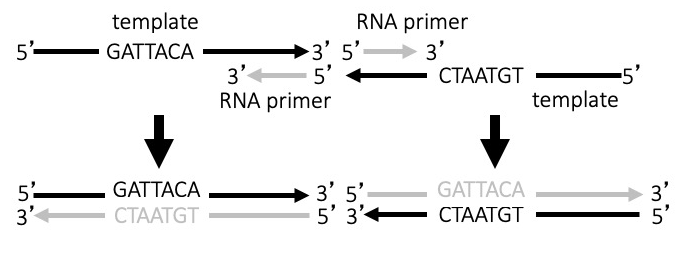
This image depicts the synthesis of new D N A via extention of the R N A primers that are attached to the single stranded D N A strands. The diagram starts with a replication of the figure from step 2. The description of this first part of the diagram is repeated here. At the left, the D N A sequence is represented as a black arrow that starts at the 5 prime end and ends at the 3 prime end. This strand has the following sequence: G A T T A C A. The D N A strand is labelled as a template. There is a short gray arrow that is aligned at the bottom right of the D N A template. This gray arrow is labelled as an R N A primer. The gray arrow goes from the 5 prime end to the 3 prime end but the 3 prime end is on the left and the 5 prime end is on the right. In this way, the 5 prime end of the R N A primer is aligned with and attached to the 3 prime end of the D N A template. At the right, the other D N A sequence is represented as a black arrow that goes from the 5 prime end to the 3 prime end; the 3 prime end is on the left and the 5 prime end is on the right. This strand has the following sequence: C T A A T G T. The D N A strand is labelled as a template. Just as before, there is a short gray arrow that is aligned at the top left of the D N A template. This gray arrow is also labelled as an R N A primer. The gray arrow goes from the 5 prime end at the left to the 3 prime end at the right. In this way, the 5 prime end of the R N A primer is aligned with and attached to the 3 prime end of the D N A template. Now, there are two thick arrows that show each of these D N A and R N A pairs being converted to new double stranded D N A molecules. The product from the left template is a double stranded D N A where the top strand is black and bears the sequence 5 prime G A T T A C A 3 prime. This strand was from the original double stranded D N A. The bottom strand is gray and bears the sequence 3 prime C T A A T G T 5 prime. This strand is newly synthesized. The product from the right template is a double stranded D N A where the top strand is gray and bears the sequence 5 prime G A T T A C A 3 prime. This strand is newly synthesized. The bottom strand is black and bears the sequence 3 prime C T A A T G T 5 prime. This strand was from the original double stranded D N A.

Thus, the result of DNA replication is two semiconservative, identical DNA molecules.

Exercise 1 (DNA Synthesis)

The following 2 questions center around the double-stranded DNA shown below.
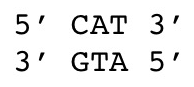
This image shows the sequences of two complementary strands of D N A. The top strand is written as 5 prime C A T 3 prime. The bottom strand is written as 3 prime G T A 5 prime.

Question 1

If both strands are replicated, which of the strands above will serve as a template strand?
Check all that apply.

Note: Make sure you select all correct options!

Show answer and explanation
  1. Top strand (5' CAT 3'), Bottom strand (3' GTA 5')

Explanation:

If both strands are replicated, then both will serve as the template strand, as each strand the complementary to the other. For example, to replicate the top strand, DNA polymerase must "read" the bottom strand to synthesize the top strand.

Question 2

Select the products of replicating the DNA molecule shown above.

Show answer and explanation

Explanation:

Replicating the entire DNA molecule shown above means BOTH the top and bottom strand must be duplicated. Then, the "new" strands hybridize to the "old" strands, creating two double-stranded products, where the paired stands are anti-parallel and complementary (the base pairs match A to T, C to G).

Question 3

In what direction does DNA synthesis proceed for the RNA primer in the figure below? Select the best answer.

Two nucleic acid strands. The top strand is the D N A template and reads 5 prime G C A T T T T A A C C G G A A 3 prime. The bottom strand is the R N A primer and reads A A U U G 5 prime.

Show answer and explanation
  1. from right to the left (extending the 3' end of the primer)

Explanation:

Recall that nucleic acids are synthesized from 5' to 3', which in this figure is from the right to the left. New bases are added onto the primer at the 3' end.

Question 4

Write below the next 5 bases that will be added to the sequence from the figure in the question above.
Be sure to indicate polarity! (Ex: 5'XXXX3' or 3'XXXX5')

Show answer and explanation
  1. 5' AATGC 3' or 5'AATGC3' or 5' AATGC3' or 5'AATGC 3' or 3' CGTAA 5' or 3'CGTAA5' or 3' CGTAA5' or 3'CGTAA 5'

Explanation:

When counting the next bases added to the primer strand, be sure to count the bases added to the 3' end (not reading left to right). The 5 bases added must be complementary to the top strand. Try to rewrite the top strand and primer on paper to match up the next bases easier!

Exercise 2 (RNA Primers)

The following questions center around the following DNA template sequence.

5' GTGTCGGTTACG 3'

Question 1

Which of the RNA primers below would allow replication of the template?
Check all that apply.

Note: Make sure you select all correct options!

Show answer and explanation
  1. 5' CGUAA 3'

Explanation:

To replicate the template, the primer must hybridize to the 3' end. More specifically, the 5' end of the primer must match up to the 3' end of the template, so that the 3' end of the primer is "free" to have new, complementary bases added to replicate the given template. To solve this question, you can write the answer choices from 3' to 5' and compare them to the 3' end of the template to see which are complementary.

Question 2

Write below the bases of the template DNA that the primer will hybridize to.
Be sure to indicate polarity! (Ex: 5'XXXX3' or 3'XXXX5')

Show answer and explanation
  1. 5' TTACG 3' or 5'TTACG 3' or 5' TTACG3' or 5'TTACG 3' or 3' GCATT 5' or 3'GCATT5' or 3' GCATT5' or 3'GCATT 5'

Explanation:

As mentioned in the answer to the problem above, the primer will hybridize to the 3' end of the template. Since the primers are all 5 bases in length, then the primer will hybridize to the last 5 bases of the template.

MIT OpenCourseWare / MIT Open Learning Library. Hazel Sive and Diviya Ray. Adapted for local study under Creative Commons Attribution–NonCommercial–ShareAlike 4.0. License terms.