Assignment 3.3: Transcription
Your answers are saved in this browser. Check them against the downloaded answer key, or open the explanation when you are ready.
Lecture 3.3
Transcript
HAZEL SIVE: At this point, you should
have had practice with these aspects of DNA replication.
You should understand which the template strands
are, both of them.
You should be able to, again, use complementarity,
or base pairing, to fill in the opposite strand.
You should have some sense of what a primer is.
Really, what you need to know is it's
the 3-prime end you add onto.
And you should have a sense of the direction of DNA synthesis,
the 3-prime and addition rule.
So bearing those rules in mind, and DNA replication in mind,
let us go on to our next topic, which is that of transcription.
If you like, transcription is the first step
in the information transfer.
Transcription produces RNA that is copied from a DNA template.
The difference between transcription and DNA
replication are really twofold.
Firstly, the RNA uses uracil, where DNA uses thymine.
And secondly, unlike the case for DNA replication,
only one of the strands is used as a template.
So there is only one template strand.
Let's see how it works.
Let's start off again with our double-stranded DNA, our gene,
going in antiparallel arrangement--
5-prime to 3-prime, 3-prime to 5-prime.
So this is our gene.
It's DNA.
As before, for DNA replication, the strands
are going to separate.
Here they are--
5-prime to 3-prime and 3-prime to 5-prime.
The top strand is not the template strand in our example,
so we're going to call this non-template.
The bottom strand is the template strand.
I just made that up.
I could have done it the other way around.
It wouldn't have mattered, OK?
But you'll see in this example why I've done it this way.
That template strand is now going
to be copied into RNA in much the same way that DNA
replication takes place--
a different set of components, but the complementary idea
is the same.
So this template strand is now copied into RNA,
and the RNA will go 5-prime to 3-prime.
The RNA will then leave the template.
The RNA leaves the template.
And the two strands, the template
and the non-template strand, will come together again,
and they will make their complementary base-paired
arrangement.
That is transcription.
Let's look at a couple of slides.
Let's firstly talk about the difference
between the nucleotides in RNA and DNA.
I've told you, one, that there's uracil instead of thymine.
The other one that I'll point out to you
is that ribonucleotides, the ones that make RNA,
have got an extra hydroxyl group on them.
They've got that 2-prime hydroxyl on the sugar.
That is not there in the deoxyribonucleotides
that make DNA.
The "deoxy" in deoxyribonucleic acid
refers to that 2-prime hydrogen that
is a hydroxyl in the ribose.
OK?
So there is a difference of hydroxyl group
as well as this uracil versus thymine in the nucleotides.
The reason that you care at all about this extra hydroxyl group
is that it makes the ribonucleotides more reactive.
It makes RNA less stable than DNA.
That hydroxyl group on the 2-prime is a reactive group,
and RNA is much less stable than DNA.
So DNA is a better storage material for the genes,
because it doesn't break down as much as RNA,
because it doesn't have this reactive 2-prime hydroxyl.
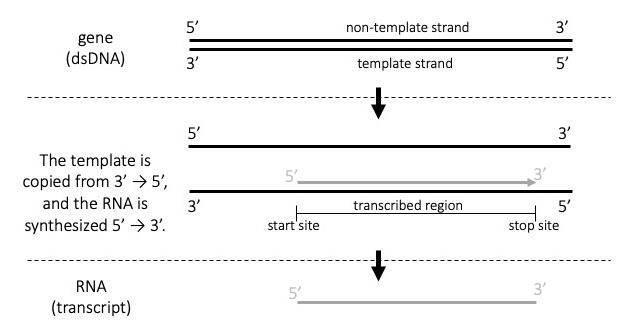
Here's a schematic of transcription.
I haven't put the exact nucleotides in here.
But you can see template and non-template strand.
You can see that the RNA is copied
from just one of the strands, and after it's
copied it leaves the template, and the template strands
go back together again.
You should note on the slide that I've
indicated a start site and a stop site for RNA synthesis.
There is a choice, and there are particular DNA sequences
that regulate where RNA is made from,
where transcription begins, and where transcription ends.
And one thing I want to really emphasize here--
and you'll have practice in a moment on this--
is that the complementary DNA strands are transcribed
into different RNAs.
You just have to do the exercise to know this.
Here's a nucleic acid sequence, double-stranded DNA.
If you use the top strand as the template,
you get a piece of RNA made.
If you use the bottom strand, you get another piece of RNA
made.
If you compare the RNAs that are made by flipping them around
so that the 5-prime end is on the same side for each
of the RNAs--
then you can compare them with the correct polarity--
you'll see, obviously, that the two
strands made from the two different templates
are different.
So it really matters in transcription
which strand you're copying from as to what the outcome will be.
I want you now to go to this class exercise
and practice some rules of transcription.
They'll be your nucleic acid rules applied now
to RNA synthesis.
Reference Summary
Transcription
An RNA molecule is synthesized from one strand of a dsDNA; this strand used for synthesis is called the template strand.
Like DNA, RNA is synthesized 5' to 3'.
Once finished, the RNA transcript dissociates from the template strand, and the two DNA strands hybridize again to form dsDNA.
Exercise 1 (Transcribing DNA 1)
The following RNA strand was produced by transcription of the gene shown in Question 1.
Exercise 2 (Transcribing DNA 2)
The following RNA strand was produced by transcription of the gene shown in Question 1.
MIT OpenCourseWare / MIT Open Learning Library. Hazel Sive and Diviya Ray. Adapted for local study under Creative Commons Attribution–NonCommercial–ShareAlike 4.0. License terms.