← Unit 3

Assignment 3.4: Translation

Your answers are saved in this browser. Check them against the downloaded answer key, or open the explanation when you are ready.

Lecture 3.4

Transcript

HAZEL SIVE: We're well along our sequence

of molecular information transfer.

The thing that I want to talk with you about now

is kind of the culmination of information transfer.

And that is the process of translation.

Translation refers to a process that produces protein

from an RNA template.

If we think about DNA replication and transcription,

they are, in a way, quite similar.

DNA replication is just copying one language

into the same language.

Transcription is kind of like changing fonts in your Word

document.

You go from Calibri to Georgia.

The letters are the same.

You can recognize them.

There's a U, the UT, thing.

But otherwise, the letters are the same.

You're in the same language with RNA transcription from DNA.

Translation is different.

We're producing a protein here that's

made of amino acids, its own language,

from a different language, the language of nucleic acids.

And that sense of how does nucleic acid encode

protein, a different language, was a huge question

for early molecular biologists.

This process is done in the cytoplasm,

unlike DNA replication and transcription,

which are done in the nucleus.

And it uses the genetic code.

We'll write down what the genetic code is.

And then we'll do some explanation.

The genetic code refers to triplets, three sets of three,

of RNA bases, each of which, each triplet,

encodes one amino acid.

These triplets are called codons.

And each encodes an amino acid.

The process requires lots of components.

The key ones are a kind of RNA called tRNA, or transfer RNA,

and also the organelles called ribosomes

that we mentioned when we flew through the cell

and listed the organelles.

I will also mention that the kind of RNA

that is used for translation is a special RNA called

messenger RNA, or mRNA.

And that is the protein coding type of RNA.

The RNA is read 5-prime to 3-prime.

And the protein is made from the amino to the carboxyl end.

The RNA is read 5-prime to 3-prime.

And the protein is made from amino to carboxyl end, OK?

Let's look at a slide here.

This is what the genetic code looks like.

You always see it as a kind of table.

And there are three parts to every codon.

These are the triplets--

GUU, GUC, GUA, GUG.

Those all encode the amino acid valine.

AUG, very important one, encodes methionine.

All proteins start with that, you'll see why in a moment.

And then there are some codons that don't code for anything.

They're UAA, UAG, and UGA.

Those stop protein synthesis.

We'll talk about those more in a moment.

So let's carry on with some board work

and lay out a bit more about how translation works.

In any kind of language change, you need an interpreter.

You need someone who understands both languages.

You need something in the case of translation

that understands both the language of the nucleic acid

and the language of the protein.

And as we started alluding to, this

has got something to do with the codons that

encode each amino acid.

But the interpreter is this type of RNA

called tRNA, small RNAs that are present throughout living

cells.

And those are really the interpreters for translation.

So tRNA is the interpreter.

And it's the interpreter for two reasons.

Firstly, it recognizes codons on the mRNA.

A tRNA has got something called an anticodon that base pairs

with a codon on the mRNA.

For example, if this is an mRNA codon,

it goes 5-prime AUG 3-prime.

You know it's RNA because of that U.

The tRNA would have the complement of that 3-prime

TAC--

not T, ah, UAC and 5-prime because it's also RNA.

This would be the codon on the mRNA

and the anticodon on the tRNA.

They can base pair with one another.

So tRNAs will base pair three nucleotides at a time

to the messenger RNA.

That's part of being interpreters.

The other part is that tRNAs also

carry the corresponding amino acid that is covalently

bonded to the tRNA, very cool.

For example, for this particular codon,

for the mRNA 5-prime AUG, this encodes the amino acid

methionine.

And a particular tRNA that has the anticodon 5-prime CAU also

carries methionine.

Methionine is kind of interesting

because it's the amino acid that all proteins start with.

I'll make a note of it down here.

Methionine is the starting amino acid.

So let's think how this works.

Let's write a small piece of nucleic acid,

and then turn it into protein.

Let's write 5-prime AUG AAA and ACU 3-prime.

This is our messenger RNA.

When we look at our messenger RNA, the first thing to do

is to break it into codons.

I like to put a slash.

You can underline them, if you want.

But we can put a slash.

We'll break our messenger RNA sequence into codons.

Then we can start thinking about what amino acids correspond

to those codons.

So codon 1 will correspond to methionine.

Codon 2 corresponds to lysine.

And codon 3 corresponds to threonine.

These are the three letter codes for the amino acids.

The way translation works is that you start at methionine.

That is your start signal.

You read the mRNA code without spaces.

And you keep translating until you come to a stop codon.

The name there is a bit misleading

because they're not actually codons.

They don't code for any amino acid.

That's why they stop translation.

The whole thing falls apart.

The ribosome falls apart.

The protein comes off the ribosome.

And you're done when you get to a stop codon.

So stop codons do not code.

And they end translation.

That is their job.

Let's look again at the genetic code bearing

what I've told you in mind.

The way it is written is with the first letter--

it's actually the first nucleotide, the first base--

the second letter, and the third letter, as indicated.

So the first letter--

here, all of these start with an A. The second letter, all

of them start with a U. And the third letter is different.

You can see that, for some amino acids,

there are a number of possibilities.

This one here called isoleucine has a number of possibilities.

It has three possibilities.

This one here, threonine has, again, a number

of different possibilities.

Methionine has just one possible codon, OK?

For each of these codons, again, there's

a matching tRNA that carries the right amino acid

and recognizes the correct codon.

Now, let's look how we go from DNA to protein.

Here is a DNA template.

I'm showing you just one strand of the DNA template.

I've taken away the other one--

the 3-prime to 5-prime strand.

It is translated-- it is transcribed, excuse me,

into RNA in the anti-parallel direction, 5-prime to 3-prime.

And I'm telling you that it is messenger RNA.

And it's coding RNA.

And I've broken it up now into codons.

And each of those codons then corresponds

to a particular amino acid.

So transcription is going in the 5-prime to 3-prime direction,

as all nucleic acid synthesis does.

Protein synthesis goes in the amino to carboxyl direction,

as we discussed.

And you can match this all up to go from the DNA template

to the corresponding complementary RNA

and the corresponding protein that would be translated

from that particular RNA.

We're not going to go into detail

of how ribosomes work and the exquisitely

complicated, beautiful process of translation in the same way

as we haven't for replication or transcription.

The idea is that you get the basics,

you get the general idea of translation.

And when you take a higher level course,

you'll be able to understand a lot more of the details.

But the idea here is, just as we have shown,

the messenger RNA 5-prime to 3-prime.

The tRNA is the little anticodons indicated

that have their 5-prime to 3-prime,

their anti-parallel bonding to particular codons

on the messenger RNA, and are also carrying

the corresponding amino acids.

Coming in sequentially into the ribosome as the amino acids are

brought next to each other by virtue of the tRNAs,

they form peptide bonds between them.

And voila, you get the protein chain

that is busy growing from amino to carboxyl end.

I want you now to go to the assignment that

has to do with translation and get some good practice on how

you go from RNA to protein and from gene to protein.

Reference Summary

Translation

Translation is the process by which RNA is decoded by the ribosome to produce a polypeptide.

A codon is a set of 3 consecutive nucleotides that together code for an amino acid.

Adaptor RNA molecules called tRNAs bring amino acids to the ribosome.
The tRNAs have anticodons that pair (antiparallelly) with the codon to ensure that the correct amino acid is being added.


The Codon Chart

The codon chart is used to determine which amino acid corresponds to which codon. Notice that some amino acids have multiple codons but each codon only codes for one amino acid.

Here is a codon chart.
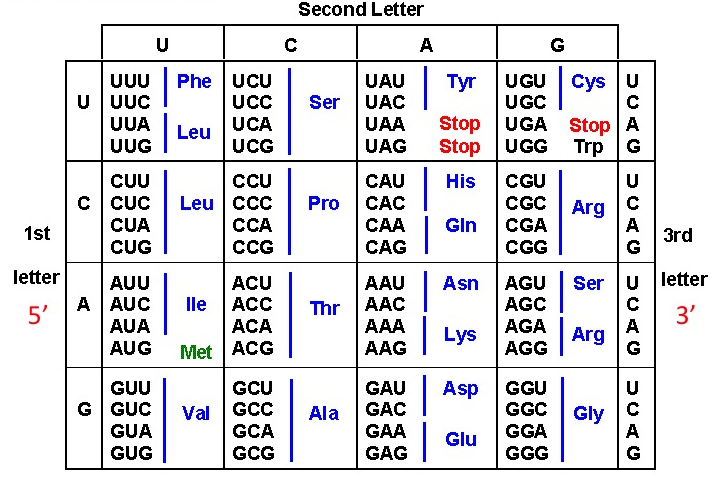
Here is a codon chart that is used to identify the amino acids that correspond to each R N A codon. The chart has 4 rows and 4 columns, both of which correspond to the 4 possible nucleotides of R N A (which are U, C, A, G). The rows correspond to the first letter of the codon (at the 5 prime end of the sequence) and is selected first. Then, a column is chosen; the columns correspond to the second letter of the codon. Then, the 4 possible codons (corresponding to the 4 possible options for the third letter (at the 3 prime end of the sequence)) are listed in the selected box with the corrresponding amino acid written next to the codon. Each amino acid is notated with its three-letter abreviation. The codons of all the boxes will now be enlisted in the order (from left to right) written on the chart: U U U = Phenylalanine or P h e, U U C = Phenylalanine or P h e, U U A = Leucine or L e u, U U G = Leucine or L e u, U C U = Serine or S e r, U C C = Serine or S e r, U C A = Serine or S e r, U C G = Serine or S e r, U A U = Tyrosine or T y r, U A C = Tyrosine or T y r, U A A = STOP, U A G = STOP, U G U = Cysteine or C y s, U G C = Cysteine or C y s, U G A = STOP, U G G = Tryptophan or T r p, C U U = Leucine or L e u, C U C = Leucine or L e u, C U A = Leucine or L e u, C U G = Leucine or L e u, C U A = Leucine or L e u, C U G = Leucine or L e u, C C U = Proline or P r o, C C C = Proline or P r o, C C A = Pro, C C G = Proline or P r o, C A U = Histidine or H i s, C A C = Histidine or H i s, C A A = Glutamine or G l n, C A G = Glutamine or G l n, C G U = Arginine or A r g, C G C = Arginine or A r g, C G A = Arginine or A r g, C G G = Arginine or A r g, A U U = Isoleucine or I l e, A U C = Isoleucine or I l e, A U A = Isoleucine or I l e, A U G = Methionine or M e t, A C U = Threonine or T h r, A C C = Threonine or T h r, A C A = Threonine or T h r, A C G = Threonine or T h r, A A U = Asparagine or A s n, A A C = Asparagine or A s n, A A A = Lysine or L y s, A A G = Lysine or L y s, A G U = Serine or S e r, A G C = Serine or S e r, A G A = Arginine or A r g, A G G = Arginine or A r g, G U U = Valine or V a l, G U C = Valine or V a l, G U A = Valine or V a l, G U G = Valine or V a l, G C U = Alanine or A l a, G C C = Alanine or A l a, G C A = Alanine or A l a, G C G = Alanine or A l a, G A U = Aspartic acid or A s p, G A C = Aspartic acid or A s p, G A A = Glutamic acid or G l u, G A G = Glutamic acid or G l u, G G U = Glycine or G l y, G G C = Glycine or G l y, G G A = Glycine or G l y, G G G = Glycine or G l y.

When using this chart, remember that nucleic acids are read from 5' to 3'. Therefore, the first nucleotide, or letter, will always be the one closest to the 5' end and the third nucleotide will always be the one closest to the 3' end.

(A codon chart will always be given to you, so you do not need to memorize it.)


Exercise 1 (Understanding Codons)

There is a codon chart at the end of this page in case you would like it as a reference.

Question 1

For the RNA below, determine the codons (triplets of bases, starting at the 5' end).

An R N A polymer with the 5 prime end labeled on the left and the 3 prime end labeled on the right. From 5 prime to 3 prime the bases are: A, U, G, C, C, G, C, C, G.

Show answer and explanation
  1. 5'AUG/CCG/CCG3' or 5' AUG/CCG/CCG3' or 5' AUG/CCG/CCG 3' or 5'AUG/CCG/CCG 3'

Explanation:

Recall that each codon is made of 3 bases, starting from the 5' end of the nucleic acid. Denote the triplets of bases with a "spacer" (in this question, use /) to determine what codons are present. In this question, there are only three codons, with the first being AUG.

Question 2

Create the peptide (small protein) sequence that would be produced by the RNA in Question 1 (reproduced below). To make the peptide sequence, type the correct amino acid three (3) letter code into the text box. (Using the codon chart, find amino acids that match the codons, starting at the 5' end.)

An R N A polymer with the 5 prime end labeled on the left and the 3 prime end labeled on the right. From 5 prime to 3 prime the bases are: A, U, G, C, C, G, C, C, G.

Also, indicate polarity of the peptide by typing "N" and "C" at the proper termini.

Place a single hyphen (the "-" character) between each termini and amino acid without adding spaces. Begin with the N terminus. (Example: N-XXX-YYY-ZZZ-C)

Show answer and explanation
  1. N-Met-Pro-Pro-C or N Met-Pro-Pro-C or N-Met-Pro-Pro C or N Met-Pro-Pro C

Explanation:

Nucleic acids are read from 5' to 3' to give peptides that are read from the N terminus to the C terminus. After performing the steps in Question 1 (placing a spacer like "/" between each codon), use the codon chart to translate codons to amino acids. Look for the first base of the codon on the left side of the chart and the second base on top to find the grid square associated with the codon. Then use the third letter on the right side of the chart to guide you to the full 3-base codon and its corresponding amino acid.

Here is a codon chart.

Here is a codon chart that is used to identify the amino acids that correspond to each R N A codon. The chart has 4 rows and 4 columns, both of which correspond to the 4 possible nucleotides of R N A (which are U, C, A, G). The rows correspond to the first letter of the codon (at the 5 prime end of the sequence) and is selected first. Then, a column is chosen; the columns correspond to the second letter of the codon. Then, the 4 possible codons (corresponding to the 4 possible options for the third letter (at the 3 prime end of the sequence)) are listed in the selected box with the corrresponding amino acid written next to the codon. Each amino acid is notated with its three-letter abreviation. The codons of all the boxes will now be enlisted in the order (from left to right) written on the chart: U U U = Phenylalanine or P h e, U U C = Phenylalanine or P h e, U U A = Leucine or L e u, U U G = Leucine or L e u, U C U = Serine or S e r, U C C = Serine or S e r, U C A = Serine or S e r, U C G = Serine or S e r, U A U = Tyrosine or T y r, U A C = Tyrosine or T y r, U A A = STOP, U A G = STOP, U G U = Cysteine or C y s, U G C = Cysteine or C y s, U G A = STOP, U G G = Tryptophan or T r p, C U U = Leucine or L e u, C U C = Leucine or L e u, C U A = Leucine or L e u, C U G = Leucine or L e u, C U A = Leucine or L e u, C U G = Leucine or L e u, C C U = Proline or P r o, C C C = Proline or P r o, C C A = Pro, C C G = Proline or P r o, C A U = Histidine or H i s, C A C = Histidine or H i s, C A A = Glutamine or G l n, C A G = Glutamine or G l n, C G U = Arginine or A r g, C G C = Arginine or A r g, C G A = Arginine or A r g, C G G = Arginine or A r g, A U U = Isoleucine or I l e, A U C = Isoleucine or I l e, A U A = Isoleucine or I l e, A U G = Methionine or M e t, A C U = Threonine or T h r, A C C = Threonine or T h r, A C A = Threonine or T h r, A C G = Threonine or T h r, A A U = Asparagine or A s n, A A C = Asparagine or A s n, A A A = Lysine or L y s, A A G = Lysine or L y s, A G U = Serine or S e r, A G C = Serine or S e r, A G A = Arginine or A r g, A G G = Arginine or A r g, G U U = Valine or V a l, G U C = Valine or V a l, G U A = Valine or V a l, G U G = Valine or V a l, G C U = Alanine or A l a, G C C = Alanine or A l a, G C A = Alanine or A l a, G C G = Alanine or A l a, G A U = Aspartic acid or A s p, G A C = Aspartic acid or A s p, G A A = Glutamic acid or G l u, G A G = Glutamic acid or G l u, G G U = Glycine or G l y, G G C = Glycine or G l y, G G A = Glycine or G l y, G G G = Glycine or G l y.

Exercise 2 (Polypeptide Synthesis)

There is a codon chart at the end of this page in case you would like it as a reference.

Question 1

Create the peptide (small protein) sequence that would be produced by the RNA below. To make the peptide sequence, type the correct amino acid three (3) letter code into the text box. (Using the codon chart, find amino acids that match the codons, starting at the 5' end.)

5' UUACUGAAAGGG 3'

Also, indicate polarity of the peptide by typing "N" and "C" at the proper termini.

Place a single hyphen (the "-" character) between each termini and amino acid without adding spaces. Begin with the N terminus. (Example: N-XXX-YYY-ZZZ-C)

Show answer and explanation
  1. N-Leu-Leu-Lys-Gly-C or N Leu-Leu-Lys-Gly-C or N-Leu-Leu-Lys-Gly C or N Leu-Leu-Lys-Gly C

Explanation:

Start by adding a "spacer" between the codons (every three bases) so it is easier to (a) see how many codons make up this RNA strand and (b) find these codons on the chart provided. Use the chart to translate each codon from 5' to 3' to get a peptide from N to C terminus.

Question 2

For the first codon of the RNA from Question 1, write the anticodon sequence (the sequence on the tRNA, that hybridizes to the codon).
Be sure to include polarity! (Ex: 5'XXX3' or 3'XXX5')

Show answer and explanation
  1. 3' AAU 5' or 3'AAU 5' or 3' AAU5' or 3'AAU5' or 5' AAU 3' or 5'AAU 3' or 5' AAU3' or 5'AAU3'

Explanation:

The anticodon is merely the sequence that is complementary and anti-parallel to the codon. It can be found in the same way the anti-parallel complement strand is found for RNA or DNA. In this question, the first codon is 5'UUA3', so the anticodon is 3'AAU5'.

Here is a codon chart.

Here is a codon chart that is used to identify the amino acids that correspond to each R N A codon. The chart has 4 rows and 4 columns, both of which correspond to the 4 possible nucleotides of R N A (which are U, C, A, G). The rows correspond to the first letter of the codon (at the 5 prime end of the sequence) and is selected first. Then, a column is chosen; the columns correspond to the second letter of the codon. Then, the 4 possible codons (corresponding to the 4 possible options for the third letter (at the 3 prime end of the sequence)) are listed in the selected box with the corrresponding amino acid written next to the codon. Each amino acid is notated with its three-letter abreviation. The codons of all the boxes will now be enlisted in the order (from left to right) written on the chart: U U U = Phenylalanine or P h e, U U C = Phenylalanine or P h e, U U A = Leucine or L e u, U U G = Leucine or L e u, U C U = Serine or S e r, U C C = Serine or S e r, U C A = Serine or S e r, U C G = Serine or S e r, U A U = Tyrosine or T y r, U A C = Tyrosine or T y r, U A A = STOP, U A G = STOP, U G U = Cysteine or C y s, U G C = Cysteine or C y s, U G A = STOP, U G G = Tryptophan or T r p, C U U = Leucine or L e u, C U C = Leucine or L e u, C U A = Leucine or L e u, C U G = Leucine or L e u, C U A = Leucine or L e u, C U G = Leucine or L e u, C C U = Proline or P r o, C C C = Proline or P r o, C C A = Pro, C C G = Proline or P r o, C A U = Histidine or H i s, C A C = Histidine or H i s, C A A = Glutamine or G l n, C A G = Glutamine or G l n, C G U = Arginine or A r g, C G C = Arginine or A r g, C G A = Arginine or A r g, C G G = Arginine or A r g, A U U = Isoleucine or I l e, A U C = Isoleucine or I l e, A U A = Isoleucine or I l e, A U G = Methionine or M e t, A C U = Threonine or T h r, A C C = Threonine or T h r, A C A = Threonine or T h r, A C G = Threonine or T h r, A A U = Asparagine or A s n, A A C = Asparagine or A s n, A A A = Lysine or L y s, A A G = Lysine or L y s, A G U = Serine or S e r, A G C = Serine or S e r, A G A = Arginine or A r g, A G G = Arginine or A r g, G U U = Valine or V a l, G U C = Valine or V a l, G U A = Valine or V a l, G U G = Valine or V a l, G C U = Alanine or A l a, G C C = Alanine or A l a, G C A = Alanine or A l a, G C G = Alanine or A l a, G A U = Aspartic acid or A s p, G A C = Aspartic acid or A s p, G A A = Glutamic acid or G l u, G A G = Glutamic acid or G l u, G G U = Glycine or G l y, G G C = Glycine or G l y, G G A = Glycine or G l y, G G G = Glycine or G l y.

MIT OpenCourseWare / MIT Open Learning Library. Hazel Sive and Diviya Ray. Adapted for local study under Creative Commons Attribution–NonCommercial–ShareAlike 4.0. License terms.