← Unit 4

Assignment 4.1: Genes to proteins

Your answers are saved in this browser. Check them against the downloaded answer key, or open the explanation when you are ready.

Lecture 4.1

Transcript

[SQUEAKING]

[RUSTLING]

[CLICKING]

HAZEL SIVE: Welcome back to Getting Up to Speed in Biology.

By now, you have had a lot of basic information

that should be getting you ready to take introductory biology

at MIT or elsewhere.

You should have completed your first problem set

in addition to all the class exercises that we've given you.

So you're on pretty good ground now

to move on to the last two lecture units.

Today's lecture, today's class, is

going to be about how changes in DNA, changes in genes,

govern the outcome for the organism.

We're going to talk about mutations.

We're going to talk about alleles.

We're going to talk about pedigrees.

And if you don't know what those words mean,

you're in the right place.

Here are our topics for today.

We'll firstly talk about mutations.

We'll talk about something I'll term allele segregation.

We'll talk about genetics and genetic crosses.

And finally, we'll talk about pedigrees.

The overall theme of today is, how does a DNA sequence

connect with a trait?

A trait is something you can see,

an observable characteristic-- your eye color, your hair

color, for example, also called a phenotype.

DNA sequence may alter the protein that's made,

the amount or the type of protein,

and may change all sorts of things, including

whether a dog is big or little or whether an insect has

got normal mouth parts or has got legs

growing out of its head.

Let's begin by talking about mutations.

Let me start by reminding you what

we talked about last time-- the information flow from DNA

to protein to a trait.

DNA, the gene, is transcribed into RNA, which is then

translated into protein.

This is the information flow we talked about yesterday.

That protein then has a function that

may give an observable characteristic which

we call a trait.

Let's write that down.

A trait is something you can see,

an observable characteristic.

And the scientific term for that is phenotype.

If you change the DNA, you may change the RNA,

and you may change the protein, and you may change the trait.

These DNA changes occur in the bases.

So DNA base sequence changes are called mutations,

and they are relative to something

else, whether you have a mutated gene or not.

More usually, we think about genes

that have got different variants of sequence.

We'll come to that in a moment.

But mutations may alter protein sequence

and may alter protein function, and therefore,

may change a trait.

That's your general notion of mutations.

There are really two classes that I want you to know about,

two types of mutation.

The first are point mutations.

These change one base at a time.

They change one base, and they substitute another base

at the same position in the DNA sequence.

The second type that I want you to know about

are the insertions and deletions.

Insertions add one or more bases,

and deletions remove one or more bases.

There's also a whole other class of mutations

that affect something other than the actual protein coding

sequence.

And we'll talk about those very briefly in a moment.

But let's look at some slides here

so we can get a sense of how you might change protein

sequence by changing the DNA.

I've shown you here on this slide a double-stranded piece

of DNA.

You see all the polarity that you know now

and the base pairing.

The bottom strand I've designated

as the template strand.

And I've shown you the messenger RNA

that is transcribed using that bottom strand as a template.

And then I've shown you the protein

that is translated from the codons of that messenger RNA.

I've designated this the wild type gene.

It's a reference point.

Wild type-- sometimes people use the term "normal,"

but that's not correct.

It's usually the most common version of that gene.

OK.

Let's see what happens now if we change that gene.

So on top, again, I've got what I

had on the previous slide, the wild type gene and protein.

And now we've made a point mutation

where we've changed a single base in the DNA.

It's underlined in pink.

We've changed it so that instead of reading--

what was it?

It was GGA previously.

It now reads GGT.

You can look at it the same time I do.

So we've changed there an A to a T.

And on the other strand, that also flips the base,

changes it from a T to an A. The messenger RNA is now

changed because the template for the messenger RNA has changed.

And when that messenger RNA is translated into protein,

you can see that there is now a different amino acid

in the protein chain.

There is a valine instead of an asparagine or aspartic acid,

the valine instead of aspartic acid.

OK?

So the protein sequence, the actual sequence

of amino acids in the protein, has changed.

This type of mutation is a point mutation, as I said,

and it's called a missense mutation.

You get a protein, but it's a bit different.

Here's another kind where, again, you make a single base

change in the DNA.

It's underlined.

And then if you start your protein translation

from the RNA that is made using this now-new template,

you see that immediately after the first amino acid,

methionine, there is a stop codon that stops translation.

And the protein isn't made at all

except for that first amino acid.

This is called a nonsense mutation,

and it truncates or prematurely stops the protein.

And obviously, you wouldn't get a functional protein here.

In the case of the missense protein,

it might be functional, but it might have a slightly different

function than the starting one.

Here's another example of a point mutation,

and this one's going to be a silent mutation.

In this case, there has again been a base substitution

so that the DNA template changes.

But now, if one makes the messenger RNA conceptually

and the protein, you see that the protein

sequence of the mutated gene is the same as the parental gene.

And that's because more than one codon

can code for the same amino acid,

as we saw previously when we looked at the genetic code.

So although the DNA has changed, the protein hasn't changed.

And this is called a silent mutation.

Here's an example of an insertion.

The arrow indicates where a base has been inserted

in the DNA that wasn't there.

And this does something profound to the protein.

It changes something called the reading frame.

You recall that proteins start with ATG AUG as the RNA codon,

and that corresponds to methionine.

And then you read the RNA with no spaces.

We explored that in the previous class.

You read three by three right next to each other.

And that sets the reading frame.

It tells you what the protein codons

are going to look like one after the other.

If you add anything other than a multiple of three bases,

you change the reading frame.

Here I've put in one, one extra base.

And look what happens to the protein coding sequence.

You now see you start the same, the thiamine tryptophan.

But now, instead of having leucine, proline, aspartic

acid, you now have threonine, proline, lysine, and so on.

OK?

So you've changed the reading frame and the protein that is

made from this particular gene.

And that might profoundly change the function of the protein.

It might make it non-functional.

It might sometimes give it a new function.

It might give it a function that causes disease.

So this is the insertion changing the reading frame,

and the same idea is true for a deletion

changing the reading frame.

So the last thing that I'll indicate here on the board

is that mutations can change protein coding sequence,

but they may also change the sequence of what

I'll call control regions--

control DNA, let's call it, where the control DNA is

actually dictating whether or not the RNA is

made in the first place.

And we didn't discuss this really at all

when we talked about transcription,

but I'm planting this notion in your mind

now so you will have heard of it--

this control DNA which regulates RNA synthesis, transcription.

And this can change the amount of the RNA

and the amount of the protein made.

Good.

You are empowered now to go to assignment 1, class exercise 1,

and practice your protein coding skills

and figure out what happens when you

make various mutations in DNA to the protein that is made.

Correction: On the slide that appears at 6:07...

  1. The second DNA sequence (the sequence with the underlined point mutation) should read 3' at the end.
  2. The second template (containing the point mutation) should read 5' TACAGCGAGGACCAAATT 3'.
  3. The second mRNA sequence (containing the point mutation) should read 3' at the end.

Reference Summary

Types of Mutations

A point mutation is a change in a single nucleotide base.

Point mutations may result in...
- a missense mutation, in which the changed nucleotide base results in a single amino acid change in the protein product.
- a silent mutation, in which the changed nucleotide base does not result in any changes to the amino acids in the protein product.
- a nonsense mutation, in which the codon that includes changed nucleotdie base changes from coding for an amino acid to a stop codon that terminates translation.


An insertion is the addition of an extra nucleotide(s) within the sequence. Similarly, a deletion is the elimination of a nucleotide(s) from the sequence.

Insertions and deltions frequently result in frameshift mutations, by which the extra or missing nucleotide bases change the reading frame (the grouping of three adjacent nucleotides into codons), thus resulting in a change in the amino acids that are encoded by that nucleotide sequence.


Also, remember that...

A codon is a set of 3 consecutive nucleotides that together code for an amino acid.

And, a codon chart is used to determine which amino acid corresponds to which codon.
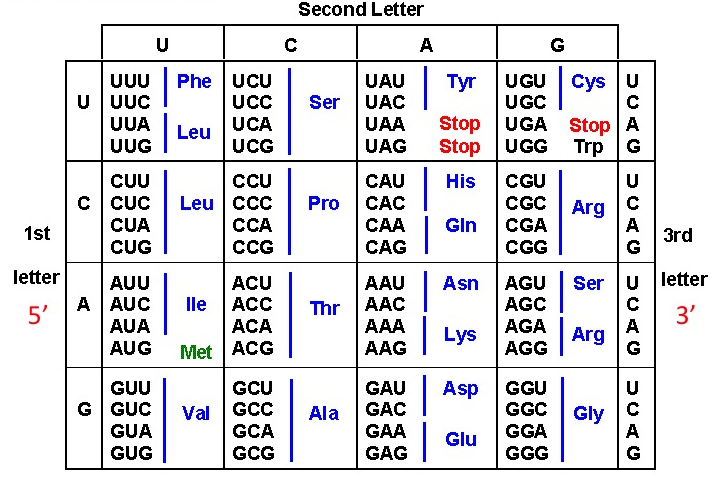
Here is a codon chart that is used to identify the amino acids that correspond to each R N A codon. The chart has 4 rows and 4 columns, both of which correspond to the 4 possible nucleotides of R N A (which are U, C, A, G). The rows correspond to the first letter of the codon (at the 5 prime end of the sequence) and is selected first. Then, a column is chosen; the columns correspond to the second letter of the codon. Then, the 4 possible codons (corresponding to the 4 possible options for the third letter (at the 3 prime end of the sequence)) are listed in the selected box with the corrresponding amino acid written next to the codon. Each amino acid is notated with its three-letter abreviation. The codons of all the boxes will now be enlisted in the order (from left to right) written on the chart: U U U = Phenylalanine or P h e, U U C = Phenylalanine or P h e, U U A = Leucine or L e u, U U G = Leucine or L e u, U C U = Serine or S e r, U C C = Serine or S e r, U C A = Serine or S e r, U C G = Serine or S e r, U A U = Tyrosine or T y r, U A C = Tyrosine or T y r, U A A = STOP, U A G = STOP, U G U = Cysteine or C y s, U G C = Cysteine or C y s, U G A = STOP, U G G = Tryptophan or T r p, C U U = Leucine or L e u, C U C = Leucine or L e u, C U A = Leucine or L e u, C U G = Leucine or L e u, C U A = Leucine or L e u, C U G = Leucine or L e u, C C U = Proline or P r o, C C C = Proline or P r o, C C A = Pro, C C G = Proline or P r o, C A U = Histidine or H i s, C A C = Histidine or H i s, C A A = Glutamine or G l n, C A G = Glutamine or G l n, C G U = Arginine or A r g, C G C = Arginine or A r g, C G A = Arginine or A r g, C G G = Arginine or A r g, A U U = Isoleucine or I l e, A U C = Isoleucine or I l e, A U A = Isoleucine or I l e, A U G = Methionine or M e t, A C U = Threonine or T h r, A C C = Threonine or T h r, A C A = Threonine or T h r, A C G = Threonine or T h r, A A U = Asparagine or A s n, A A C = Asparagine or A s n, A A A = Lysine or L y s, A A G = Lysine or L y s, A G U = Serine or S e r, A G C = Serine or S e r, A G A = Arginine or A r g, A G G = Arginine or A r g, G U U = Valine or V a l, G U C = Valine or V a l, G U A = Valine or V a l, G U G = Valine or V a l, G C U = Alanine or A l a, G C C = Alanine or A l a, G C A = Alanine or A l a, G C G = Alanine or A l a, G A U = Aspartic acid or A s p, G A C = Aspartic acid or A s p, G A A = Glutamic acid or G l u, G A G = Glutamic acid or G l u, G G U = Glycine or G l y, G G C = Glycine or G l y, G G A = Glycine or G l y, G G G = Glycine or G l y.

Exercise 1 (Wild type)

The following questions concern this gene, where the bottom strand is the template strand.

5' ATGAATGTGTGC 3'
3' TACTTACACACG 5'

There is a codon chart at the bottom of this page in case you would like it as a reference.

Question 1: DNA to RNA

Write the corresponding RNA from the DNA sequence above. Separate each codon by a hyphen "-" and write your answer 5' to 3'.

(RNA sequence is similar to the non-template strand; 5' to 3'; codon = base triplets)

Show answer and explanation
  1. 5' AUG-AAU-GUG-UGC 3' or 5'-AUG-AAU-GUG-UGC-3' or 5'AUG-AAU-GUG-UGC3'

Explanation:

Be sure to use the bottom strand of the DNA to write the corresponding RNA sequence from 5' to 3' (left to right), where A and U match and C and G match. Since codons are made up of three base pairs, insert a hyphen between the third and fourth base, the sixth and seventh base, and the ninth and tenth base.

Question 2: RNA to Protein

Create the peptide sequence that corresponds to the RNA in the answer above. To make the peptide sequence, type the correct amino acid three (3) letter code into the text box. (Using the codon chart, find amino acids that match the codons, starting at the 5' end.)

Also, indicate polarity of the peptide by typing "N" and "C" at the proper termini.

Place a single hyphen (the "-" character) between each termini and amino acid without adding spaces. Begin with the N terminus. (Example: N-XXX-YYY-ZZZ-C)

Show answer and explanation
  1. N-Met-Asn-Val-Cys-C or N Met-Asn-Val-Cys-C or N-Met-Asn-Val-Cys C or N Met-Asn-Val-Cys C

Explanation:

Use the answer to the question above and the codon chart provided below to translate each codon to an amino acid. Be sure to read the RNA from 5' to 3' to produce a peptide that begins at the N terminus and ends at the C terminus.

Here is a codon chart.

Here is a codon chart that is used to identify the amino acids that correspond to each R N A codon. The chart has 4 rows and 4 columns, both of which correspond to the 4 possible nucleotides of R N A (which are U, C, A, G). The rows correspond to the first letter of the codon (at the 5 prime end of the sequence) and is selected first. Then, a column is chosen; the columns correspond to the second letter of the codon. Then, the 4 possible codons (corresponding to the 4 possible options for the third letter (at the 3 prime end of the sequence)) are listed in the selected box with the corrresponding amino acid written next to the codon. Each amino acid is notated with its three-letter abreviation. The codons of all the boxes will now be enlisted in the order (from left to right) written on the chart: U U U = Phenylalanine or P h e, U U C = Phenylalanine or P h e, U U A = Leucine or L e u, U U G = Leucine or L e u, U C U = Serine or S e r, U C C = Serine or S e r, U C A = Serine or S e r, U C G = Serine or S e r, U A U = Tyrosine or T y r, U A C = Tyrosine or T y r, U A A = STOP, U A G = STOP, U G U = Cysteine or C y s, U G C = Cysteine or C y s, U G A = STOP, U G G = Tryptophan or T r p, C U U = Leucine or L e u, C U C = Leucine or L e u, C U A = Leucine or L e u, C U G = Leucine or L e u, C U A = Leucine or L e u, C U G = Leucine or L e u, C C U = Proline or P r o, C C C = Proline or P r o, C C A = Pro, C C G = Proline or P r o, C A U = Histidine or H i s, C A C = Histidine or H i s, C A A = Glutamine or G l n, C A G = Glutamine or G l n, C G U = Arginine or A r g, C G C = Arginine or A r g, C G A = Arginine or A r g, C G G = Arginine or A r g, A U U = Isoleucine or I l e, A U C = Isoleucine or I l e, A U A = Isoleucine or I l e, A U G = Methionine or M e t, A C U = Threonine or T h r, A C C = Threonine or T h r, A C A = Threonine or T h r, A C G = Threonine or T h r, A A U = Asparagine or A s n, A A C = Asparagine or A s n, A A A = Lysine or L y s, A A G = Lysine or L y s, A G U = Serine or S e r, A G C = Serine or S e r, A G A = Arginine or A r g, A G G = Arginine or A r g, G U U = Valine or V a l, G U C = Valine or V a l, G U A = Valine or V a l, G U G = Valine or V a l, G C U = Alanine or A l a, G C C = Alanine or A l a, G C A = Alanine or A l a, G C G = Alanine or A l a, G A U = Aspartic acid or A s p, G A C = Aspartic acid or A s p, G A A = Glutamic acid or G l u, G A G = Glutamic acid or G l u, G G U = Glycine or G l y, G G C = Glycine or G l y, G G A = Glycine or G l y, G G G = Glycine or G l y.

Exercise 2 (Mutation 1)

The following questions concern the same gene from Exercise 1, where the bottom strand is the template strand. The original gene sequence has beeen copied here.

Original Sequence:
5' ATGAATGTGTGC 3'
3' TACTTACACACG 5'

However, now the sequence has a mutation in its last base pair, as shown in this updated sequence. Here, the mutation is emphasized with a bolded and underlined font.

Mutated Sequence:
5' ATGAATGTGTGA 3'
3' TACTTACACACT 5'

There is a codon chart at the bottom of this page in case you would like it as a reference.

Question 1: DNA to RNA

Write the corresponding RNA from the mutated DNA sequence above. Separate each codon by a hyphen "-" and write your answer 5' to 3'.

Show answer and explanation
  1. 5' AUG-AAU-GUG-UGA 3' or 5'-AUG-AAU-GUG-UGA-3' or 5'AUG-AAU-GUG-UGA3'

Explanation:

Be sure to use the bottom strand of the DNA to write the corresponding RNA sequence from 5' to 3' (left to right), where A and U match and C and G match. Since codons are made up of three base pairs, insert a hyphen between the third and fourth base, the sixth and seventh base, and the ninth and tenth base.

Question 2: RNA to Protein

Create the peptide sequence that corresponds to the RNA in the answer above. To make the peptide sequence, type the correct amino acid three (3) letter code into the text box. (Using the codon chart, find amino acids that match the codons, starting at the 5' end.)

Also, indicate polarity of the peptide by typing "N" and "C" at the proper termini.

Place a single hyphen (the "-" character) between each termini and amino acid without adding spaces. Begin with the N terminus. (Example: N-XXX-YYY-ZZZ-C)

Show answer and explanation
  1. N-Met-Asn-Val-C or N Met-Asn-Val-C or N-Met-Asn-Val C or N Met-Asn-Val C

Explanation:

Use the answer to the question above and the codon chart provided below to translate each codon to an amino acid. Be sure to read the RNA from 5' to 3' to produce a peptide that begins at the N terminus and ends at the C terminus. Note the difference between this peptide and the one you translated in Exercise 1.

Question 3: Mutation Type

This mutation is an example of a...

(Check all that apply.)

Note: Make sure you select all correct options!

Show answer and explanation
  1. point mutation.

Explanation:

There has only been a single base change/substitution, not the addition or removal of a base(s), so this is a point mutation.

Here is a codon chart.

Here is a codon chart that is used to identify the amino acids that correspond to each R N A codon. The chart has 4 rows and 4 columns, both of which correspond to the 4 possible nucleotides of R N A (which are U, C, A, G). The rows correspond to the first letter of the codon (at the 5 prime end of the sequence) and is selected first. Then, a column is chosen; the columns correspond to the second letter of the codon. Then, the 4 possible codons (corresponding to the 4 possible options for the third letter (at the 3 prime end of the sequence)) are listed in the selected box with the corrresponding amino acid written next to the codon. Each amino acid is notated with its three-letter abreviation. The codons of all the boxes will now be enlisted in the order (from left to right) written on the chart: U U U = Phenylalanine or P h e, U U C = Phenylalanine or P h e, U U A = Leucine or L e u, U U G = Leucine or L e u, U C U = Serine or S e r, U C C = Serine or S e r, U C A = Serine or S e r, U C G = Serine or S e r, U A U = Tyrosine or T y r, U A C = Tyrosine or T y r, U A A = STOP, U A G = STOP, U G U = Cysteine or C y s, U G C = Cysteine or C y s, U G A = STOP, U G G = Tryptophan or T r p, C U U = Leucine or L e u, C U C = Leucine or L e u, C U A = Leucine or L e u, C U G = Leucine or L e u, C U A = Leucine or L e u, C U G = Leucine or L e u, C C U = Proline or P r o, C C C = Proline or P r o, C C A = Pro, C C G = Proline or P r o, C A U = Histidine or H i s, C A C = Histidine or H i s, C A A = Glutamine or G l n, C A G = Glutamine or G l n, C G U = Arginine or A r g, C G C = Arginine or A r g, C G A = Arginine or A r g, C G G = Arginine or A r g, A U U = Isoleucine or I l e, A U C = Isoleucine or I l e, A U A = Isoleucine or I l e, A U G = Methionine or M e t, A C U = Threonine or T h r, A C C = Threonine or T h r, A C A = Threonine or T h r, A C G = Threonine or T h r, A A U = Asparagine or A s n, A A C = Asparagine or A s n, A A A = Lysine or L y s, A A G = Lysine or L y s, A G U = Serine or S e r, A G C = Serine or S e r, A G A = Arginine or A r g, A G G = Arginine or A r g, G U U = Valine or V a l, G U C = Valine or V a l, G U A = Valine or V a l, G U G = Valine or V a l, G C U = Alanine or A l a, G C C = Alanine or A l a, G C A = Alanine or A l a, G C G = Alanine or A l a, G A U = Aspartic acid or A s p, G A C = Aspartic acid or A s p, G A A = Glutamic acid or G l u, G A G = Glutamic acid or G l u, G G U = Glycine or G l y, G G C = Glycine or G l y, G G A = Glycine or G l y, G G G = Glycine or G l y.

Exercise 3 (Mutation 2)

The following questions concern the same gene from Exercise 1, where the bottom strand is the template strand. The original gene sequence has beeen copied here.

Original Sequence:
5' ATGAATGTGTGC 3'
3' TACTTACACACG 5'

However, now the sequence has a different mutation. As shown in this new sequence, the original gene was mutated near the middle of the sequence this time. Here, the mutation is emphasized with a bolded and underlined font.

Mutated Sequence:
5' ATGAATAGTGTGC 3'
3' TACTTATCACACG 5'

There is a codon chart at the bottom of this page in case you would like it as a reference.

Question 1: DNA to RNA

Write the corresponding RNA from the new DNA sequence above. Separate each codon by a hyphen "-" and write your answer 5' to 3'.

Show answer and explanation
  1. 5' AUG-AAU-AGU-GUG-C 3' or 5'-AUG-AAU-AGU-GUG-C-3' or 5'AUG-AAU-AGU-GUG-C3'

Explanation:

Be sure to use the bottom strand of the DNA to write the corresponding RNA sequence from 5' to 3' (left to right), where A and U match and C and G match. Since codons are made up of three base pairs, insert a hyphen between the third and fourth base, the sixth and seventh base, and the ninth and tenth base. There is also a hyphen between the twelfth and thirteenth base, but the last "codon" is only one base. Note the difference between this sequence and the ones you found in Exercises 1 and 2.

Question 2: RNA to Protein

Create the peptide sequence that corresponds to the RNA in the answer above. To make the peptide sequence, type the correct amino acid three (3) letter code into the text box. (Using the codon chart, find amino acids that match the codons, starting at the 5' end.)

Also, indicate polarity of the peptide by typing "N" and "C" at the proper termini.

Place a single hyphen (the "-" character) between each termini and amino acid without adding spaces. Begin with the N terminus. (Example: N-XXX-YYY-ZZZ-C)

Show answer and explanation
  1. N-Met-Asn-Ser-Val-C or N Met-Asn-Ser-Val-C or N-Met-Asn-Ser-Val C or N Met-Asn-Ser-Val C

Explanation:

Use the answer to the question above and the codon chart provided below to translate each codon to an amino acid. Be sure to read the RNA from 5' to 3' to produce a peptide that begins at the N terminus and ends at the C terminus. Since the last base is not part of a full codon, it will not translate into an amino acid. Note the difference between this peptide and the one you translated in Exercises 1 and 2.

Question 3: Mutation Type

This mutation is an example of a...

(Check all that apply.)

Note: Make sure you select all correct options!

Show answer and explanation
  1. insertion.

Explanation:

To determine the type of mutation, compare the sequence given in this exercise to that given in 4.1 Exercise 1. Note that there is an additional base in the sequence given in this exercise, making this an insertion.

Here is a codon chart.

Here is a codon chart that is used to identify the amino acids that correspond to each R N A codon. The chart has 4 rows and 4 columns, both of which correspond to the 4 possible nucleotides of R N A (which are U, C, A, G). The rows correspond to the first letter of the codon (at the 5 prime end of the sequence) and is selected first. Then, a column is chosen; the columns correspond to the second letter of the codon. Then, the 4 possible codons (corresponding to the 4 possible options for the third letter (at the 3 prime end of the sequence)) are listed in the selected box with the corrresponding amino acid written next to the codon. Each amino acid is notated with its three-letter abreviation. The codons of all the boxes will now be enlisted in the order (from left to right) written on the chart: U U U = Phenylalanine or P h e, U U C = Phenylalanine or P h e, U U A = Leucine or L e u, U U G = Leucine or L e u, U C U = Serine or S e r, U C C = Serine or S e r, U C A = Serine or S e r, U C G = Serine or S e r, U A U = Tyrosine or T y r, U A C = Tyrosine or T y r, U A A = STOP, U A G = STOP, U G U = Cysteine or C y s, U G C = Cysteine or C y s, U G A = STOP, U G G = Tryptophan or T r p, C U U = Leucine or L e u, C U C = Leucine or L e u, C U A = Leucine or L e u, C U G = Leucine or L e u, C U A = Leucine or L e u, C U G = Leucine or L e u, C C U = Proline or P r o, C C C = Proline or P r o, C C A = Pro, C C G = Proline or P r o, C A U = Histidine or H i s, C A C = Histidine or H i s, C A A = Glutamine or G l n, C A G = Glutamine or G l n, C G U = Arginine or A r g, C G C = Arginine or A r g, C G A = Arginine or A r g, C G G = Arginine or A r g, A U U = Isoleucine or I l e, A U C = Isoleucine or I l e, A U A = Isoleucine or I l e, A U G = Methionine or M e t, A C U = Threonine or T h r, A C C = Threonine or T h r, A C A = Threonine or T h r, A C G = Threonine or T h r, A A U = Asparagine or A s n, A A C = Asparagine or A s n, A A A = Lysine or L y s, A A G = Lysine or L y s, A G U = Serine or S e r, A G C = Serine or S e r, A G A = Arginine or A r g, A G G = Arginine or A r g, G U U = Valine or V a l, G U C = Valine or V a l, G U A = Valine or V a l, G U G = Valine or V a l, G C U = Alanine or A l a, G C C = Alanine or A l a, G C A = Alanine or A l a, G C G = Alanine or A l a, G A U = Aspartic acid or A s p, G A C = Aspartic acid or A s p, G A A = Glutamic acid or G l u, G A G = Glutamic acid or G l u, G G U = Glycine or G l y, G G C = Glycine or G l y, G G A = Glycine or G l y, G G G = Glycine or G l y.

MIT OpenCourseWare / MIT Open Learning Library. Hazel Sive and Diviya Ray. Adapted for local study under Creative Commons Attribution–NonCommercial–ShareAlike 4.0. License terms.