Assignment 4.2: Allele segregation
Your answers are saved in this browser. Check them against the downloaded answer key, or open the explanation when you are ready.
Lecture 4.2
Transcript
HAZEL SIVE: At this point after your class exercise,
you should be familiar with these three
aspects of mutation.
You should be able to take a piece of DNA,
conceptually turn it into RNA, and conceptually translate it
into protein.
You should understand what happens to the protein sequence
when the DNA is changed by a point mutation
or by an insertion or deletion mutation.
And so with that in mind, let us go
on to our second topic today, which
is called allele segregation.
OK, first thing we need to think about is what an allele means.
And so let us write down on the board
the first line, which is that an allele is
a alternate form of a gene.
Alleles can be called variants.
And they may be designated relative to some reference DNA
sequence, some reference gene, that is called wild type.
Although this is not done in humans,
it's done in various other organism.
So variants-- and let's say may be relative to wild type.
That may be your reference.
Alleles are there because of different DNA sequences.
That's the point.
So an allele is due to DNA sequence variations
or differences.
We may not know them all the time.
And we'll get to that in a moment.
But we can designate how a gene's alleles
look by this kind of notation.
So for example, let's designate the apple gene.
And it might have alleles apple big B--
and maybe that gives you a green apple--
or apple little b.
And maybe that gives you a yellow apple.
How do these genes relate to the chromosomes
that we talked about way back when,
these collections of genes that form huge arrays in the cell
and are how the cell's genes are organized?
They relate like this.
In a diploid cell, each of these alleles
would be on the matching chromosome,
would be on one of the matching chromosomes.
So in diploid cells, two n cells, each chromosome, chr,
pair has the same or different alleles of particular genes.
That is a little background to then look and see
what we mean by alleles in a visual sense.
One can look at flower color and see
that flower color in a particular floral species
varies enormously.
And these variations in flower color
are due to different alleles of one or more genes
encoding flower color pigments.
Eye color-- it's the same idea.
Eye color comes from different alleles
of the same genes that contribute
to the color of our eyes.
And labradors-- I have a black labrador at home.
But there's a whole array of different colors.
Actually, there's really four colors of labrador.
And their color fur depends on particular alleles
again of the pigment that makes fur color.
So this is the notion behind alleles.
And it is hugely important in understanding how life works.
Let us continue thinking about the chromosomes and the alleles
on the chromosomes.
And we'll get a bit more visual here rather than
just writing it on the board.
So I want to talk here about cell division
and allele segregation.
During the process of mitosis, division of the body cells,
the outcome cells, the daughter cells,
have got exactly the same set of alleles as the parent cell.
There are some variations on this occasionally
that can lead to disease.
But by and large, during mitosis,
the alleles that start off in the parent cell
are the ones that land up in the daughter cell.
So in the body cells, the daughter cell
has alleles equal to the parent, identical to the parent.
And that actually is just another way
of saying that mitosis gives identical daughter
cells to the parent.
We talked about that previously.
We also talked about meiosis, the process
that gives rise to the germ cells, the egg and sperm.
These are also called gametes.
And that's a term you'll need to know today, gametes.
During meiosis, things get a little strange.
And you remember from our previous discussion
that you land up with four cells.
From every starting diploid cell,
you land up with four haploid cells.
During the process of meiosis, alleles
can really sort themselves out.
That is true even for just one chromosome.
But when you've got lots of chromosomes as in our cells,
we have 23 pairs of chromosomes, you
can get all sorts of sorting out of alleles between the germ
cells so that they don't look anything
like the parental cell.
So I will write here that in the germ cells
in the gametes, the alleles--
"segregate" is the term--
it means sort out such that the gametes do not
have the same alleles as the parent allele set, let us say.
So you need to bear this in mind as we go through some visuals
because words do not show it as well as visuals.
Here to get us back into the frame of molecular biology
is the notion of alleles that there would be the apple B
gene that would have the particular protein sequence
on the top of the slide.
And the apple small b allele would have the protein sequence
on the bottom of the slide.
They're both apple genes, but they've
got different DNA sequences and maybe some different function.
Let's look at allele segregation during mitosis.
This is also called somatic inheritance, body cell
inheritance.
We're starting off with a cell that
has a pair of homologous chromosomes, just one pair,
including the apple gene with its two alleles.
DNA replication occurs, and you get duplicated chromosomes.
Now, I've shown you on these chromosomes one of the homologs
has the large B allele.
And the other homolog has the little b allele.
After DNA replication, the cell has now
duplicated its chromosomes.
And it has two big B and two little b alleles.
But those segregate to the daughter cells
so that each daughter cell looks just
like the parent cell with a big B and a little b allele.
That is mitosis slightly restated
from the way we did before where now we're
following the alleles, the variations
of genes that are on homologous chromosomes,
matching chromosomes.
Now we're going to look at meiosis.
And you'll see things get a little different.
We start again with the diploid parental cell.
It undergoes DNA replication.
And then meiosis I occurs such that the replicated homologs
move entirely to each of the daughter cells.
One daughter cell has two big Bs.
And the other daughter cell has two little Bs after meiosis I.
But then there's this process of meiosis II where
there's a second division.
And you land up with four haploid cells.
And you can see in my example that there are two kinds
of gametes that come out here.
Two of the gametes have got the big B allele.
And two of the gametes have got the little b allele.
That's different than the parent cell.
And depending on whether that's an egg or a sperm and depending
on what the mating of the organism looks like,
the outcomes of using the big B or the little b gametes
are going to be different.
We'll explore that a bit later today.
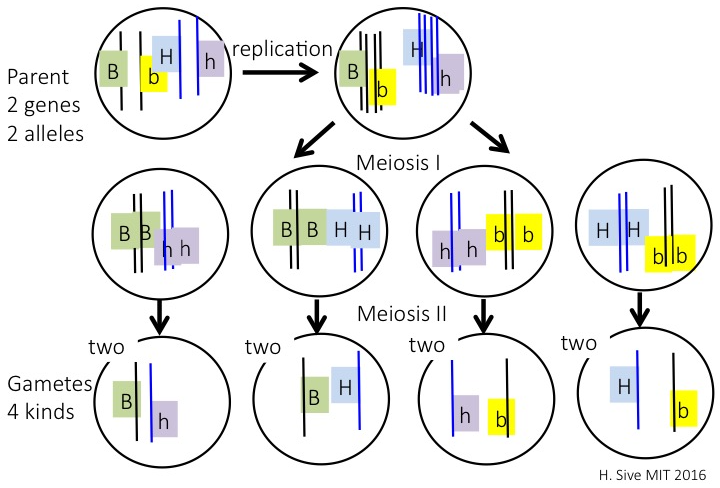
And then let's get even more complicated
and throw another chromosome in the mix
because most organisms don't just have one chromosome.
They have a number of them.
So I've drawn you some schematics here
where the parent has two pairs of chromosomes.
And on each chromosome, there are two different alleles
of a particular gene.
There again is the apple gene with its big B and little b
alleles.
And there is the honey gene with its big H and its little h
alleles.
So that's what we're starting with in the parent cell.
DNA replication occurs, and you get
the duplication of the whole array of chromosomes
and all the alleles.
In meiosis I, there is four possibilities
for what might happen because these alleles, the chromosomes,
segregate independently at this point.
Big B, the duplicated big B, can segregate with the little h
chromosomes, or it can segregate with the big H chromosomes.
Little b can segregate with the little h chromosomes
or with the big H chromosomes.
This is a stochastic.
It's probabilistic.
After meiosis II, there are four kinds
of gametes that have come out.
I've drawn you four of them because each is duplicated.
You can either be big B little h, big B big H, little h little
b, or big H little b.
This is what is meant by allele segregation--
how these different gene variants sort out.
And how they sort out really dictates
what the next generation of the organism is going to look like.
And this is something that we have
to bear in mind when we think about inheritance
and we think about phenotypes and traits associated
with inheritance.
So I want you to go and do the class exercise associated
with allele segregation now so that you can play around
with understanding allele segregation.
Correction: On the slide that appears at 7:07...
- The second DNA sequence (the sequence with the underlined point mutation) should read 3' at the end.
- The second template (containing the point mutation) should read 5' TACAGCGAGGACCAAATT 3'.
Reference Summary
Alleles
An allele is a version of a gene that determines which trait will be expressed. This occurs because each allele encodes slightly different versions of the same protein product.
Segregation of Alleles
In mitosis, each daughter cell will end up with the same alleles as the original mother cell.
Therefore, if the mother cell possesses alleles B and b for gene 1, then both daughters will have both B AND b.
However, in meiosis, each gamete produced will have only one allele of each gene from the mother cell.
Therefore, if the mother cell possesses alleles D and d for gene 2, then each gamete will have either D OR d.
Which allele a gamete will inherit for one gene is independent of which allele it will inherit for another gene. This means that all of the allelic combinations shown in the diagram below are equally likely to arise in the gametes from the mother cell.
Exercise 1 (Meiosis)
MIT OpenCourseWare / MIT Open Learning Library. Hazel Sive and Diviya Ray. Adapted for local study under Creative Commons Attribution–NonCommercial–ShareAlike 4.0. License terms.