Assignment 4.3: Punnett squares
Your answers are saved in this browser. Check them against the downloaded answer key, or open the explanation when you are ready.
Lecture 4.3
Transcript
HAZEL SIVE: At this point, you've
tried your class exercise on allele segregation.
You should be able to follow alleles
segregating during meiosis.
And you should be able to do this for two
chromosomes and two alleles.
Let's move on now to the next topic, which you will see
is highly related to allele segregation.
And that is the topic of genetics and crosses.
We've talked a lot about genes and gene variants
that are caused by changes in DNA sequence.
And that, indeed, is how inheritance works and changes.
It's all about what the gene looks like at the DNA sequence
level.
But sometimes, we really don't understand
what the DNA sequences are that are giving rise
to a particular trait.
And then we need a different set of tools
to help us understand something about how traits are inherited,
and how a particular trait might be regulated.
And this is important across the board.
It's very important when it comes
to things like diseases, where we try to understand what
it is that is causing the disease,
even if we don't know what the gene or genes are,
and even if we really think that there might be something very
complicated going on.
So genetics is the set of tools to help us understand
inheritance and gene function--
genetics tools to understand genes and inheritance.
These tools are what we need to discuss so that you
can use the power of genetics to understand something
about a particular question.
And we need some definitions before we can move on.
Let's make a listing, a short listing of some key
points you need to know the terms for.
"Genotype" refers to the genes of an individual.
"Phenotype," we've mentioned, is an observable trait
that you can see by eye or by some kind of other assay.
"Gene"-- in molecular biology, we
talked about the DNA sequence required
to make the final product.
In genetics, the definition is slightly different.
It's a little vaguer.
It's referred to as the "hereditary unit."
"Allele"-- for completeness' sake we'll write it again--
are alternate gene forms.
And then the last one we need is "generation."
And this refers to individuals that
are born at the same time from the same parents.
We can talk about the P generation,
which are the parents.
We can talk about the F1 generation, which are
the first generation offspring.
We can talk about the F2, which are the second generation
offspring, et cetera., abbreviating "generation" there
with "gen."
Those are some of the key terms that we need as we go
and we consider some of these observable characteristics.
Well, let's think about some of the observable characteristics
and some of the genetics that we are going to talk about
by looking at this slide.
Genetic traits can have the following terminology--
they can be dominant.
They can be recessive, co-dominant,
or incompletely dominant.
And we'll talk about some of those in a moment.
But for example, you may have freckles or not freckles.
Freckles is considered dominant.
And if someone were to mate with someone
who didn't have freckles, probably the offspring
would be freckled.
You might know about rolling your tongue.
Some people can roll their tongue.
I can roll my tongue, can you?
Rolling your tongue is considered dominant.
It's something that if two people get together and have
offspring, then the children, or some of them,
will be able to roll their tongues.
In flowers, moving away from humans,
there are flowers that are mixed colors.
There is a dahlia that's red and white.
That's an example of a trait that is called "incompletely
dominant" or "co-dominant," sometimes.
And that, again, will give you a sense
of how genetic traits can move around in different organisms.
And this bottom example is very interesting.
This is a sickle cell, a red blood cell
that, with a particular gene variant, a particular allele,
can change from a round cell or a disk-shaped cell
to a kind of a plate-shaped, indented cell.
And this has to do with a characteristic called
"recessive."
And it's associated with various disorders,
but can also be very useful in certain circumstances.
So this gives you some sense of where
we're going to go in this part of the lecture.
And you may not have ever heard of these terms,
and that's fine, because you will now.
I've also given you a listing of some
of these genetic terms that you can
refer to in addition to what is on the board.
Let us now consider genetic crosses.
And we're going to start off with genetic crosses that
follow a genotype.
And particularly, we are going to talk
about monohybrid crosses, which means
that there is one single trait involved and likely one gene.
"Monohybrid cross"-- that means one trait, probably one gene.
And we can write down this genetic cross
in the following way--
we'll write the parents.
We'll write the genome type.
We'll write what gametes they are going to form.
And then we'll write what the first generation offspring
are going to look like.
So we're going to do a theoretical breeding
experiment here.
The parents are designated P1 and P2.
And let us say that the genotype of the first parent
is big B, big B.
This means that that parent has the alleles of the Apple gene
that we previously talked about, the big B version and the big B
version, on that particular chromosome.
We're ignoring all the other chromosomes,
just looking at the B.
So that's the allele.
And it's diploid.
So it's got two of the alleles--
allele and it's diploid.
P2 let's designate as having two little b's.
It's also diploid.
So it's got two of them and that's the alleles
that it has of the Apple gene.
Now let's think about meiosis and the products
of meiosis in Parent 1.
In this case, it's pretty simple.
You're big B, big B and so there's
only one type of outcome, one type of gamete you're
going to make after meiosis.
And it is going to have the haploid genotype of big B.
So that is the haploid genotype, because gametes are always
haploid.
And for P2, the gamete is going to be little b,
because that's the only option.
There's only little b's.
And it's only going to be one of them,
because again, it's haploid.
So we are now going to cross these parents to one another.
When mating occurs, there is one male gametes
and one female gamete that come together
to make a diploid organism.
They restore the diploid number of chromosomes.
And so these two gametes will come together.
And in the first generation offspring,
there will be one big B and one little b.
This offspring is diploid, again,
and 100% of those offspring will be big B, little
b in their genotype.
This is really important in genetics.
And this is one way you can represent this type of thing,
but there's actually a better way.
And I'm going to show it to you on a slide.
And the better way is called a "Punnett square."
I'm going to make a note here--
Punnett square representation.
I have lots of practice of working with Punnett squares,
but I needed to do this in longhand
before you could look at a Punnett square.
So let us look at this Punnett square.
And actually, I want to make one other point
before we look at the Punnett square representation.
If you have two of the same alleles--
big B, big B or little b, little b--
you get a special term, and that is called "homozygous."
If you have one big B and one little b, two
different alleles, you are called "heterozygous."
So these big B, big B and little b, little b are homozygous.
And the big B, little b, of which 100% of the cross
results in, those would be called "heterozygous."
And those are terms you should know.
So let's look at our slides.
And here in the Punnett square, you
can see that there's a kind of formalization
of how you represent things.
The parents are represented along the sides
and the top of the square.
And the gametes are represented next to the parent.
So you kind of start with the parental genotype.
And then you split it into the gametes
that can form along the top and along the side.
And then you do the cross.
You say that gamete big B will match up with gamete little b,
and give you big B, little b.
Gamete big B will match up with this little b
to give you big B, little b, and so on.
And you do this for every combination of gametes
from each parent, filling in the squares
with the outcome of the combination.
It's logical and it's organized.
And it's very helpful in figuring out
the genotype and the proportions of the different genotypes.
This is a simple example.
And every one-- this is the same example that I did
on the board--
all of the offspring are big B, little b.
But this is a different Punnett square representation
of genetic crosses using genotype.
Genetic crosses can also follow traits,
so that you can match up the genotype with the trait,
or indeed, just follow the trait and later on try
to figure out the genotype.
For example-- let's have another example to extend our example--
let us have our parents and our genotype.
And now we're going to add phenotype,
another word for "trait."
And then we're going to have our first generation.
So our parents, again, are P1 and P2.
And they're going to cross.
They're going to mate.
Here is P1.
We'll give it the same genotype as before,
but the difference is we're now going to add a phenotype.
Big B, big B has a green phenotype.
The apples are green.
Little b, little b has a yellow phenotype.
The apples are yellow.
When you cross those together, as before, you get out the F1.
The F1 is big B, little b.
And they are all green.
Aha-- so you started with green and yellow apple plants,
apple trees.
And when you cross them, you came out with all green.
In this example, green is said to be dominant.
And this would refer to the B allele.
Yellow is said to be recessive relative to big B.
That would be the little b allele.
So here are two terms, green and yellow,
defining dominant and recessive.
Which of the traits carries on into the next generation?
What does this look like on a Punnett square?
We can do the same example exactly,
but now we can add phenotypes.
And I'm going to do something a little tricky
here, because in the example that I've given you,
I've shown you actually an F1 cross.
So let us keep that slide in our minds,
but let's go back to the board just for a moment
before you can really interpret the slide that I've put up.
So we've followed the cross with various traits.
But then, what I've done to make it interesting and to show you
some other principles is that I've done an F1 cross.
In an F1 cross, you're taking the offspring
from that initial parental cross and you are crossing them
to one another.
So here, the parents, genotype, and the phenotype--
the parents would be the F1 crossed by the F1.
And from our previous board, those F1 plants
have the genotype big B, little b, both of them.
And the phenotype they have is green.
And now, we can look and see how this cross reads out
using a Punnett square, looking at a Punnett square.
So let's now look at our slide where
I've got this cross indicated.
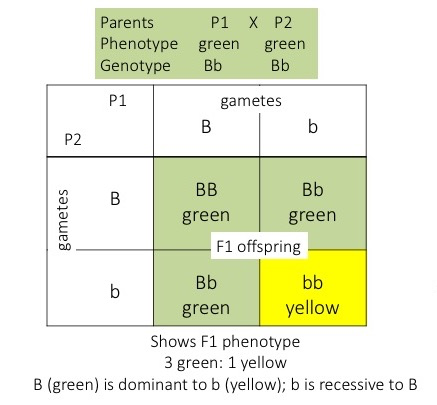
The parents are F1 with green phenotypes and the genotype
is big B, little b.
And you can see now that the gametes from each parent
can be one of two kinds.
They can be big B or they can be little b.
Parent 1 can give big B and little b, Parent 2
big B, little b.
And when you fill in your Punnett square,
you can see that there are actually
three different genotypes.
There is big B, big B, big B, little b,
and little b little b, three genotypes.
There are only two phenotypes.
There is green or there is yellow.
Two points from this--
firstly, you can see that genotype does not always
go with phenotype.
The big B, big B and the big B, little b
have the same phenotype, but they've got different genotype.
And the little b, little b has a different phenotype
to the genotypes that have got a big B.
And this, again, is an example of how
we know that the big B allele is dominant
to the little b allele.
You only get yellow apples when you've got two little b's.
When you've got any one big B, you're a green apple.
So this is a Punnett square representation
that has both genotype and phenotype.
And then the last thing I want to tell you,
which I'll put on the same board here,
is something called a "test cross."
You may not know what the genotype of the parents are.
You might want to figure this out.
You might think, are the parents big B, big B,
or big B, little b?
You can figure this out if you cross
those parents to something that is a true breeding strain.
And a true breeding strain in this case
will be a homozygous recessive strain.
So you're going to cross this to little b, little
b, which is homozygous.
It's got two of the same alleles.
And it is recessive.
And it is called "true breeding,"
where "true breeding" means that if you cross little b, little
b to itself, you'll come up with yellow all the time.
You'll never suddenly start getting green.
True breeding means you know what you
have in your breeding stock.
So this notion of a test cross is
something you can use to figure out genotype.
And here is a slide that has got a test cross
where you're not sure if it's big
B, big B or big B, little b.
You make two separate or you make a number of crosses.
And I've shown you two outcomes.
If Parent 1 was big B, big B, all of your offspring
would be green.
If Parent 1 was big B, little b, half of your offspring
would be green and half of them would be yellow.
And you can follow that on the Punnett square
with the genotypes associated.
So we've talked now a bunch about monohybrid cross.
And you can go and look at the class exercise
and practice some Punnett squares on the class exercise
to cement these kinds of concepts.
Reference Summary
A List of Genetic Terminology
- Genotype = genes of the individual
- Phenotype = observable characteristics
- Gene = a unit of hereditary (inheritance)*
- Allele = alternate forms of a gene; for example, the gene "apple" could have different forms (different DNA sequences) such as "appleB" and "appleb"
- Gametes = germ cells, egg or sperm
Generation = individuals born at the same time from the same parents or their parents' siblings
- P = parent
- F1 = first generation offspring
- F2 = second generation
*NOTE: this is the genetic definition of a gene. In terms of molecular biology, a gene is defined as the DNA instructions for a product.
Dominant v. Recessive
When in combination, different traits can be either dominant or recessive. If a trait is dominant, it will be expressed whenever an allele for that trait is present. If a trait is recessive, it will be expressed ONLY when the allele for that trait is present AND dominant alleles are absent.
For example, for a gene determines color, there may be an allele (A) that codes for red color and an allele (a) that codes for green color.
If A is dominant to a (meaning that a is recessive to A), then AA = red, Aa = red, and aa = green.
However, some traits have more complicated expression patterns. With the same example gene, incomplete dominance would result in a new, blended trait when different alleles are present.
For example: Aa = orange.
There is also codominance in which the traits of both alleles are expressed leading to a mixed trait.
For example: Aa = red and green spots.
Punnett Squares
Punnett Squares are a method to visually represent the likelihood of potential genotypes (and their resulting phenotypes) of the progeny of a cross (the F1 generation) based on the genotypes of the parents.
Exercise 1 (Punnett Squares: Genotypes)
Exercise 2 (Punnett Squares: Phenotypes)
MIT OpenCourseWare / MIT Open Learning Library. Hazel Sive and Diviya Ray. Adapted for local study under Creative Commons Attribution–NonCommercial–ShareAlike 4.0. License terms.