Assignment 4.4: Pedigrees
Your answers are saved in this browser. Check them against the downloaded answer key, or open the explanation when you are ready.
Lecture 4.4
Transcript
HAZEL SIVE: After the genetics plus crosses segment
of this class, you should be able to think
about a monohybrid cross and know what that means.
You should be able to work a Punnett square
and look how gametes segregate, how alleles segregate,
and what the F1 looks like.
You should be able to do an F1 cross.
You should understand the difference
between phenotype and genotype.
You should understand dominant and recessive
as two characteristics of traits.
And you should understand the notion of a test cross.
The kind of genetics that we've been talking about
is very important using the tools
that we've been talking about.
But sometimes, the genetics of a particular trait
are very complicated.
There might be many genes involved.
There might be traits that are associated with sex.
There might be traits that are influenced in ways that we just
don't understand.
And then we turn to another set of tools
to understand these complicated traits.
And those are called pedigrees.
Geneticists and doctors understand the likelihood
that you'll come down with a particular disorder, perhaps
Alzheimer's or some kind of cancer.
They can help understand things like coat color or disease
in dogs as well, which are complicated just as in humans.
And we're going to spend a bit of time now talking
about pedigrees and how one uses them to understand something
about the genetics of a particular trait.
And the way we can define pedigrees
is that this is genetics from a family history.
And because it's from a family history,
we have to be able to write down notations of what the family
history looks like.
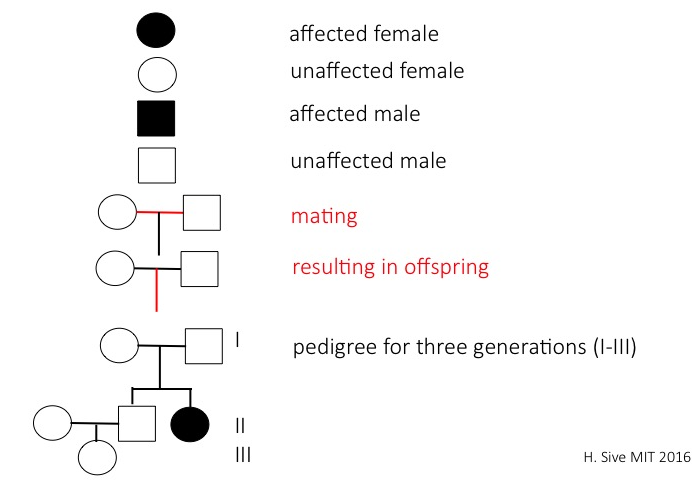
When you write a pedigree, there are certain designations
that you should know.
A circle refers to a female, a square to a male.
And if either the circle or the square is filled in,
it refers to the trait that you're looking at is present.
It might be disease.
It might be some other trait.
You can define it, but the trait is present.
For example, you might have a mating
between a male and a female.
The line indicates that there's a mating.
And the offspring-- showing you female here--
might have the particular trait that you're interested in.
In this case, we can actually say something
about the genetics of this trait.
This is an affected child--
they have the trait--
that's born to two unaffected parents.
And this is always a hallmark of a recessive trait.
An affected child or an affected offspring
born to two unaffected--
we'll write it out long because it's the first time--
born to two unaffected parents.
And this would be a characteristic
of a recessive trait.
We can do another example where we
can see what a dominant trait would look like in a pedigree.
For example, we might have an affected parent mating
with an unaffected parent.
And the offspring would be affected.
And we could further say that that offspring then
mates with someone who is not affected.
And they have an offspring.
And that offspring is affected.
That kind of pattern where every affected offspring has
an affected parent is characteristic of
a dominant trait in a pedigree.
So in this case, every affected offspring
has an affected parent.
You have to look carefully how I've worded it.
It's not that every offspring will be affected.
It's that every offspring that is affected
has an affected parent.
And every affected offspring having an affected parent
is characteristic of a dominant trait in the pedigree.
Let's look at a couple of slides that will--
let's finish off that board so that they
look nice and uniform.
And then let us look at a couple of slides.
Here on this slide is some nomenclature
to show you what we have--
affected females, unaffected females, and so on,
and the bars showing matings and offsprings.
Pedigrees for three generations are
indicated by Roman numerals I, II, and III
and so on the right hand side of the pedigree.
So you can pull out the particular generation.
Before we look at some more examples of pedigrees,
go back and put together a bunch of information.
And the information we need to put together
has to do with chromosomes and different types of chromosomes
and how different pedigrees can be
interpreted based on these different types of chromosomes.
There are two types of chromosomes in most organisms.
There are autosomes, which are the kind of chromosome
we've been talking about.
They're the ones that have got an exactly matching pair.
They might have different alleles
as we've explored today, but they've got a matching pair.
There's two chromosome 1s, two chromosome 2s, two chromosome
3s.
So the autosomes are the paired chromosomes,
and then there are the sex chromosomes.
I'll abbreviate chromosomes as I did before, chr.
And these sex chromosomes are a bit complicated.
In mammals, if you are XX and where X is one of the sex
chromosomes, you are female.
If you're XY, you're male.
And there are all sorts of variations of this.
But today these are our designations.
In the XX case in a female, this is just
like another pair of chromosomes.
And it's kind of equivalent to the case in autosomes.
In the case of males, these chromosomes are unpaired.
The X and the Y chromosomes are really
different from one another.
And that has a bunch of implication for the traits
that come out of people who have got particular variance
on the X chromosome.
I'm going to list a bit more.
We'll come back to the implications in a moment.
For our purposes in this discussion,
I'm going to distinguish three main types of pedigree that
are based on the autosomes or the sex chromosomes.
There is autosomal recessive, autosomal dominant.
And these are kind of examples we talked about above.
And these affect males and females equally.
But then there are X-linked recessive traits.
And in these, males are affected more.
And they're affected more because there's
no other allele, there's no other X, to protect them.
And if you have a particularly bad allele that causes disease,
let's say, on your X chromosome, and you're a male,
that trait is going to show itself.
It will not have another X that might
have a different allele that could somehow
modulate the bad allele.
And so you're going to see a trait in males
more than in females.
And you know it's X-linked recessive
because this trait on the X is always transmitted to the sons
from the mother.
And that is a diagnostic for an X-linked recessive trait.
This is a bunch of words.
So I'm going to go now to some slides
that I've put together for you that
will show the pedigrees and the interpretations
for these three different examples.
Let's start with a pedigree for an autosomal dominant trait.
And the clue is that every affected offspring
has one affected parent.
And the autosomal part will give us
the indication because both sexes will be equally affected.
So here's a pedigree.
And you might get a problem where
you're given this pedigree.
You will get a problem where you're given this pedigree
or something like it.
And you have to figure out is it autosomal dominant, autosomal
recessive, X-linked recessive.
And there's some other variations
that we won't talk about here in this course.
So that is our challenge.
Given a pedigree, how do we figure it out?
So you know the designations.
You know the female is the circle.
The male is the square.
And you know filled in means they have a particular trait.
So let us look at this.
And a clue that it might be autosomal
is that we see both males and females affected.
And it's not exactly the same numbers.
But that's because things are not always
going to be exactly equal as expected.
Has to do with which gametes are used and so on.
And then we can say every affected offspring
has one affected parent.
Is that true?
And it is true.
You can see if you look at the black filled-in parents
and the black filled-in offspring,
they always can be traced back to a parent that is
filled in that has the traits.
We can do better, though, because we
can start putting in theoretical genotypes
and asking how this works on this pedigree.
So let us, having thought that this
might be an autosomal dominant trait,
let us now say, OK, that parent, if it's dominant,
remember, if you have the dominant allele of the gene,
you're going to have the trait.
So the parent who doesn't have the trait
is going to be recessive.
And I've designated the alleles little d, little d.
And the other parent could be big D, big D,
or big D, little d.
And we can in the corner--
and you can do this while you're doing your problems.
You can go, and you can do the Punnett square
for this kind of theoretical cross.
We're trying to fit the cross to the pedigree.
And you can look at the ratio of affected to unaffected
individuals that would come out.
And you could see that half of the offspring
of the cross between little d, little d, and big D,
little D would be affected.
And so that's interesting.
And if you look at your pedigree,
you can say, ah, well, that's interesting
because it looks like about half of the offspring
are affected more or less.
And we can get rid of the notion that the affected parent
in this case would be big D, big D. Because in that case,
all of the offspring would have the big D dominant allele.
And they all would be affected.
And you can see that in the generation II here, which
is really the F1 generation, not all the offspring are affected.
These are affected, and these are not affected.
So that gives us a sense of the genotype
and the type of inheritance from this pedigree.
And the last thing that I'll say about this particular example
is that you don't always get ratios
of affected to unaffected offspring
exactly as you would predict because there's
some randomness in which gametes are going to be
used in the mating process.
Example two-- and this is an autosomal recessive trait.
But if you got this in a problem, you wouldn't know.
We would just give you the problem.
And you would have to figure out is it autosomal recessive
or not.
So let's take a look at it.
Recessive traits usually show less frequently
than dominant traits.
And you can see there's not that many affected offspring
in this pedigree.
So that might plant the seed that this
might be a recessive trait.
You can see that there are both males and females affected.
So that's another clue that this might be autosomal.
And you can see that there are affected
offspring that are arising from two unaffected parents.
And so that gives you a good clue
that this is an autosomal dominant trait--
excuse me-- an autosomal recessive trait.
We can do what we did before and just throw out some genotypes
and see if they work.
So let's designate that parent as a heterozygote big R,
little r, and the other parents as big R, little r or big R,
big R. The gametes from the cross of the big R, little r
cross big R, little r would look as follows.
And you'd have one, two, three affected individuals.
And if you look at the offspring,
there are two affected offspring and four--
and let's see-- two affected and two unaffected offspring.
You can see I'm hesitating there because you
have to make sure that you are looking
at the vertical lines which give you
the offspring from the parents and don't
get confused with the horizontal lines, which refer to matings.
So OK, that sounds reasonable.
We can get rid of the big R, big R genotype possibility.
Because if one of the parents did have two dominant alleles,
no offspring would be affected.
And so it seems most likely that the genotypes here
would be that both parents had one dominant allele and one
recessive allele of a particular gene or of a particular trait.
And then finally, let's look at the pedigree
for an X-linked recessive trait.
Now, when you look at this pedigree,
the first thing you notice is that
the only affected individuals are male.
They're the squares.
So that should start something thinking,
ah, this has one characteristic of X-linked recessive.
When we write these X-linked recessive traits,
we actually write X for the chromosome.
And we write the allele as a kind of a superscript.
And so we're going to make the mom--
we're going to make the dad X superscript R
and Y. Males are XY.
And we know that if it was a recessive trait,
the dad must have the genotype.
I've written, otherwise, he would have the trait.
The mom could either be X little r, little r, X big R,
X little r.
Or actually, she could be X little r, little r.
But in that case, she would have the trait.
And so we can get rid of that notion.
And so what I've done is to draw the Punnett square
for the parents where the dad just has the big R allele that
would not give the trait.
And the mom has one big R, one little R allele.
And you can see again what I come up
with from the Punnett square--
and this is a bit more complicated now
because the gametes can be either X or Y--
is that there is one to one affected to unaffected males.
And in this family, in certainly the first generation,
you can't really tell that because it's only--
there are not enough offspring to do so.
And so that's often the case.
With pedigrees, you have to look for several generations
to get enough offspring to get some kind of good statistics
so that you can draw the conclusions.
And that's why you're often given several generations.
But you can see that following through several generations,
there are male offspring that are affected that are
coming from unaffected parents.
And so we got rid of the little r, little r.
And that gives us our three types
of pedigree characteristics that I wanted to go over here.
As I say, there are a couple of others that you'll
get in the more full course.
But this is enough for now.
So I want you to take that information.
And go and do assignment 4 for today
that has to do with pedigrees.
And go and practice figuring out which of the pedigrees
you're seeing.
Correction: On the slide shown at 4:21, the second generation affected male offspring (filled-in square) should be mated to a second generation unaffected female (a hollow circle, not a hollow square). This is shown correctly on the chalkboard at 4:30.
Reference Summary
Pedigrees and Modes of Inheritance
A pedigree is a visual diagram used to map out the inheritance of genetic traits within a family. Pedigrees are often useful for determining the mode of inheritance, or inheritance pattern, of a particular trait.
Genetic traits can display various modes of inheritance. They can be either dominant or recessive, and they can be either autosomal or X-linked. This course focuses on the following modes of inheritance:
- Autosomal recessive: a recessive trait that is inherited on any chromosome that is not X or Y
Pedigrees of autosomal recessive traits exhibit affected offspring from TWO unaffected parents (both sexes should be affected equally). - Autosomal dominant: a dominant trait that is inherited on any chromosome that is not X or Y
For pedigrees of autosomal dominant traits, every affected offspring has one affected parent (both sexes should be affected equally). - X-linked recessive: a recessive trait that is inherited on the X chromosome (this means that females will each have two alleles and males will only have one)
Pedigress of X-linked recessive traits will often have only males affected.
Pedigree Nomenclature
Exercise 1 (Pedigree Features)
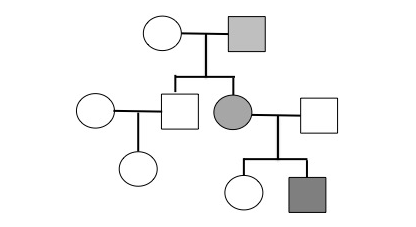
The following questions will center around this pedigree showing the ability to roll the tongue.
Exercise 2 (Mode of Inheritance)
The following questions will continue to center around this same pedigree from Exercise 1.
Exercise 3 (Another Punnett Square)
The following question will continue to center around this same pedigree from Exercises 1 and 2 that shows the ability to roll the tongue.
MIT OpenCourseWare / MIT Open Learning Library. Hazel Sive and Diviya Ray. Adapted for local study under Creative Commons Attribution–NonCommercial–ShareAlike 4.0. License terms.