Assignment 5.3: PCR
Your answers are saved in this browser. Check them against the downloaded answer key, or open the explanation when you are ready.
Lecture 5.3
Transcript
HAZEL SIVE: All right.
After your class exercise that has
to do with vectors and ligation, you
should be able to find compatible ends
and figure out whether or not they will ligate or not.
And you should understand the concept of a vector
and how this is used to carry a piece of DNA
and to amplify a piece of DNA that you are interested in.
I want now to move to our last topic in this discussion today.
And that has got the acronym, or the abbreviation, PCR.
PCR stands for polymerase chain reaction,
polymerase chain reaction, PCR.
And it is a very cool technique that
allows one to exponentially amplify
DNA in a test tube in the lab.
Exponential amplification or synthesis of DNA in the lab--
why do we care about this?
Why is PCR of interest?
It's of interest because it means
that you can take a tiny, tiny amount of starting DNA
and you can make lots, and lots, and lots,
and huge amounts of it.
When we talked about molecular cloning,
you also amplify DNA a great deal.
But you have to start off with quite a bit more DNA
than you do for PCR.
With PCR, you can start with one molecule of DNA.
And you can use it to do all sorts of things, including,
if you look on this slide, you can do things
like diagnose disease.
You can get a very tiny amount of cells from the patient.
And you can extract the DNA really quickly.
And you can do a PCR reaction to figure out
if any one of a number of different viruses is present,
or pathogens is present in the patient.
You can use PCR for forensics.
You can use PCR for a whole huge number of different things.
It is a technique that really has
had an enormous amount of traction
in genetic engineering.
And that's why I want to discuss with you
now the basic idea behind PCR.
Here is the basic idea.
You start off with a DNA molecule, a double stranded DNA
molecule.
You denature it.
You break it apart into two single strands.
And then you use something called a primer
to amplify both of the strands so that you get more DNA.
And if this sounds kind of familiar, it should.
It's how DNA synthesis works.
And it's what we talked about before.
But there's a little difference that I'll
tell you about that allows us to be useful.
So let us start off with double stranded DNA.
We'll make it 5-prime to 3-prime and 3-prime to 5-prime as ever.
And you're going to break apart those two strands--
one strand 5-prime to 3-prime, the other 3-prime
to 5-prime, as usual.
And then you're going to add to the mix
small pieces of DNA that are complementary to the ends
of each of those molecules.
Let us separate the strands.
And this is usually done at high temperature,
let's say 95 degrees Celsius, high temp.
Put that in your notes now.
And now, we're going to add a primer that hybridizes one
to one strand, one to the other, OK?
So we're going to say we're now going
to add primers that are complementary,
that can base pair with each of the strands.
And these are short pieces of DNA.
You can synthesize them in a special DNA synthesizer, OK?
And what these primers do is to give you
a 3-prime hydroxyl from which DNA synthesis can proceed.
And I threw this at you when we talked about DNA synthesis
several lectures back.
But now, you will be able to go back to that class
and think about DNA synthesis in a slightly more informed way.
So these are short pieces of DNA.
They have the 3-prime hydroxyl to allow polymer elongation
or DNA polymerization.
Let's see what this looks like for the 5-prime to 3-prime
strand.
The primer would actually be a bit of the other strand.
You synthesize it, but the sequence is complementary.
So here it is.
It would just be a little bit, OK?
So here is your strand.
This would be your primer.
This would be your template.
And now, you can get DNA synthesis
from that 3-prime hydroxyl of the primer.
And you can get it in PCR with a special kind of DNA polymerase
that comes from organisms that grow
at very high temperature, comes from bacteria that
grow at very high temperature.
And I'll tell you why that's useful in a moment.
And this is called Taq polymerase.
There's that "-ase" again.
It tells you it's an enzyme.
DNA polymerase is the enzyme that makes the DNA polymers.
And this is a special kind of DNA polymerase
called Taq polymerase.
And the outcome of this is that you now
have replicated your little DNA molecule.
No big deal, you say.
We do that all the time.
Sure, we do.
And you can do the same thing to the other strand,
where you have your 3-prime to 5-prime strand.
And you put on a primer.
It's got a free 3-prime hydroxyl.
And we'll get DNA synthesis.
And you'll get out of it another DNA molecule.
OK.
So you started with one DNA molecule on the first board.
And you now have two.
OK, that's good.
So what's the big deal?
Well, the big deal is that you do this again,
and again, and again, and again.
And you can do it in the same test tube
because this special Taq polymerase
is able to withstand the very high temperatures of breaking
the DNA strands apart before they can be used
for DNA synthesis again, OK?
So let's write, on the next board, that what happens
is you repeat the cycle.
And the cycle looks like strand separation--
not just of your first DNA molecule,
but now of the two DNA molecules you've made
in your first round of PCR--
primer annealing, and DNA polymerization,
or DNA synthesis.
And you can do this all in one tube.
The strand separation occurs at about 95 degrees.
The primers anneal when you bring the temperature down
automatically in a special machine to about 55 degrees.
And then the DNA polymerization you
can do at a slightly different temperature, maybe
something like 65 degrees.
You can repeat the cycle automatically
in a special machine.
And you can do this because the Taq polymerase is heat stable.
Most proteins when heated to 95 degrees
will undergo a change in their structure.
They will denature.
And they will be non-functional.
Not Taq polymerase, it can survive
and be used again and again because the polymerase is
heat stable.
And this is unusual for most proteins.
This is a way that bacteria that grow in hot springs
at very high temperatures have been
used in a way that is useful for molecular biology.
OK.
So you repeat the cycle over and over.
And after about 30 cycles, you have taken one DNA molecule
to about a billion, 10 to the ninth molecules.
That is enough to do all sorts of things with.
If we look on the slides, you'll see that I've
shown you how primers work.
And you will have to be able to design primers.
The easiest way is to look at the double stranded DNA.
And then if you want a primer that
will elongate your top strand, you'll
take a little bit of the sequence that would
have been on the bottom strand.
It's complementary to the top strand.
It's got to have the 3-prime hydroxyl facing
in such a direction that it can elongate.
And you can get the full molecule replicated.
Remember, you could never add onto a 5-prime end.
So it's always got to be the 3-prime end that is
available for polymerization.
And then you get out of your DNA synthesis
the complete molecule that has been filled in.
Schematically, the polymerase chain reaction
starts with one molecule.
Cycle 1 gives you two molecules.
Cycle 2 will give you four molecules;
cycle 3, eight; and so on until you go to cycle 30.
And you'll get a billion molecules or more.
And you can do more cycles as well.
Sometimes, you go to 40 or so cycles.
OK.
So PCR gives exponential DNA amplification in a test tube
because of exploiting this property of the heat
stable Thermophilus aquaticus Taq polymerase, very
cool technique.
And I'd like you to practice now designing some primers
and figuring out how you would PCR amplify a piece of DNA.
Reference Summary
The PCR Process
The following diagram depicts the process of PCR (Polymerase Chain Reaction), which has 3 main steps:
- denaturation
- primer annealing
- extension (synthesis of new DNA by the DNA polymerase, Taq Polymerase)
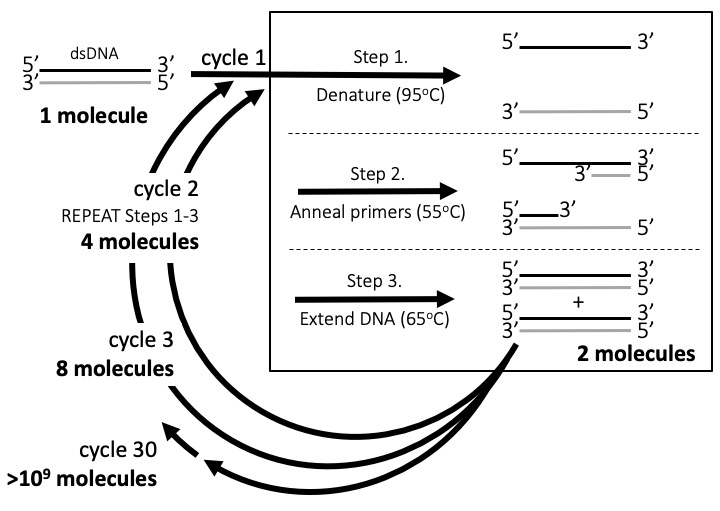
It is important to note that this reaction, while based off of the principle of DNA replication, happens in a test tube (not a cell!) with the goal of amplifying a DNA sequence.
Notes about PCR Primers
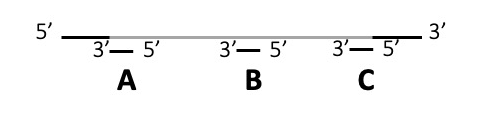
The primers used in this reaction are DNA primers, not RNA primers, because they are synthetically made and added to the test tube. The primers should anneal to the outermost region of the sequence that you would like to amplify. For each reaction, you should have two types of primers: one to extend along the top strand of the DNA sequence and one to extend along the bottom strand.
Exercise 1 (Understanding PCR)
MIT OpenCourseWare / MIT Open Learning Library. Hazel Sive and Diviya Ray. Adapted for local study under Creative Commons Attribution–NonCommercial–ShareAlike 4.0. License terms.