Optional Self-Assessment Quiz

Your answers are saved in this browser. Check them against the downloaded answer key, or open the explanation when you are ready.

Introduction

Getting up to Speed in Biology

Optional Self-Assessment Quiz


This self-test is designed to determine whether you have enough background knowledge to succeed in the MIT Course 7.01 Introductory Biology or an equivalent college-level introductory biology class. You should take the test closed book. It should take you no more than 30 min.

If the material is unfamiliar to you, you will benefit by taking Getting up to Speed in Biology. If you find the material familiar, you should not take it.

Question 1

Question 1

You may have learned that "cells are the units of life."
What are two characteristics of cells that are indispensible to life? Check the two correct responses.

Show answer and explanation
  1. possessing genetic information, the ability to self-replicate

Question 2

Question 2, part a

Our body is comprised of approximately 250 different cell types.

What are two examples of diploid, somatic cells types in our body? Check the two correct responses.

Show answer and explanation
  1. white blood cells, neurons

Explanation:

For further explanation, visit Lecture 2.5: Cell Division.

Question 2, part b

What are two examples of haploid cells types in humans? Check the two correct responses.

Show answer and explanation
  1. ova (egg cells), spermatozoa (sperm)

Explanation:

For further explanation, visit Lecture 2.5: Cell Division.

Question 3

Below are schematics of two cells: Cell A and Cell B. Please note that the cells are not drawn to the scale.
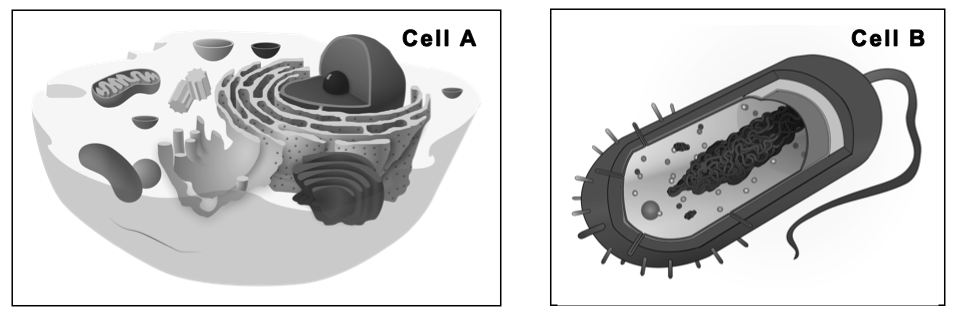
Cell A is a cutaway diagram of a spherical cell that contains many, highly-organized, membraneous structures of various shapes. Cell A includes a large, prominent spherical structure near its center. Cell B is a cutaway diagram of a rod-shaped cell with a thick cell wall. Cell B lacks the membrane-bound structures of Cell A. Cell B has a cluster of string-like material at its center and several, small structures dispersed throughout the cell interior. Cell B also has a flagella structure at one end.

Question 3, part a

Is Cell A an example of a prokaryotic or eukaryotic cell?
Select the correct response from the dropdown menu.

Show answer and explanation
  1. eukaryotic

Explanation:

For further explanation, visit Lecture 2.4: Organelles.

Question 3, part b

Is Cell B an example of a prokaryotic or eukaryotic cell?
Select the correct response from the dropdown menu.

Show answer and explanation
  1. prokaryotic

Explanation:

For further explanation, visit Lecture 2.4: Organelles.

Question 3, part c

In which subcellular organelle would you find the chromosomes?
Select the best answer.

Show answer and explanation
  1. nucleus

Explanation:

For further explanation, visit Lecture 2.4: Organelles.

Question 3, part d

In which subcellular organelle is energy generated in the form of ATP?
Select the best answer.

Show answer and explanation
  1. mitochondria

Explanation:

For further explanation, visit Lecture 2.4: Organelles.

Question 3, part e

What is mitotic cell division?

Show answer and explanation
  1. Somatic cell division where a diploid cell (2n) divides to form two diploid daughter cells that are each identical to the parent cell.

Explanation:

For further explanation, visit Lecture 2.5: Cell Division.

Question 3, part f

Do daughter cells have the same or different ploidy (i.e. number of chromosomes) as the parental cell?
Select the correct response from the dropdown menu.

Show answer and explanation
  1. same ploidy

Explanation:

For further explanation, visit Lecture 2.5: Cell Division.

Question 3, part g

What type of cell division results in the production of gametes?
Select the correct response from the dropdown menu.

Show answer and explanation
  1. meiosis

Explanation:

For further explanation, visit Lecture 2.5: Cell Division.

Question 4

Question 4

The key element employed in living cells is carbon (C). This element has a valency of 4. What does the term "valency" mean? Check all that apply.

Show answer and explanation
  1. Valency defines the number of bonds an element can form., Valency is the number of electrons in the outermost orbital of an atom.

Explanation:

For further explanation, visit Lecture 1.1: Representing Molecules.

Question 5

Question 5, part a

Many molecules found in biological systems are "polar."

What does "polar" mean with regard to charge distribution? Check all that apply.

Show answer and explanation
  1. A polar bond is one where the electrons are shared unequally between the two bonded atoms., Being polar means that an atom can either accept or donate electrons in order to attain a stable electronic configuration.

Explanation:

For further explanation, visit Lecture 1.2: Polar and Non-Polar Molecules.

Question 5, part b

The following is the structure of three biological molecules (1-3). Drag and drop a P icon over ALL the rectangular target zones that encompass polar groups. Drag and drop a NP icon over ALL the rectangular target zones that encompass nonpolar groups.

Choose a numbered location for each label. Leave unused labels as “Not placed.”

Three line-angle diagrams of chemistry molecules labeled 1, 2, and 3. Figure 1 is the lipid molecule cholesterol, figure 2 is the amino acid molecule asparagine, and figure 3 is the 5 carbon sugar molecule ribose.1234567891011
Show reference answer

This archived key gives example locations for repeated labels. It does not show a complete placement.

  • P: location 11
  • NP: location 4

Question 6

Question 6, part a

Nucleic acids, proteins, carbohydrates, and lipids are the four major classes of biological macromolecules.

Which is the major class of non-polar macromolecules in the cell?
Select the correct response from the dropdown menu.

Show answer and explanation
  1. lipids

Explanation:

For further explanation, visit Lecture 1.4: Recognizing Macromolecules.

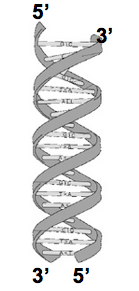
The molecule pictured has a helical structure. The helix is composed of two strands that have connections between them. One end of each strand is labelled as 5 prime and the other end of each strand is labelled as 3 prime. The 3 prime end of one strand is nearest the 5 prime end of the second strand and vice versa.

Question 6, part b

Which class of biologial macromolecule is shown in the image above?
Select the correct response from the dropdown menu.

Show answer and explanation
  1. nucleic acids

Explanation:

For further explanation, visit Lecture 1.5: Nucleic Acid Polarity.

Question 6, part c

Of what class of macromolecules are most enzymes made?
Select the correct response from the dropdown menu.

What is the function of enzymes?
Select the correct response from the dropdown menu.

Show answer and explanation
  1. proteins
  2. Enzymes function as biological catalysts.

Explanation:

For further explanation, visit Lecture 1.4: Recognizing Macromolecules.

Question 6, part d

What is a gene, and of what macromolecule are genes generally made?
Select the correct response from the dropdown menu.

What is the collection of all of the genes in an organism called?
Select the correct response from the dropdown menu.

Different copies of a single gene are called ___________.
Select the correct response from the dropdown menu to fill in the blank of the phrase above.

Show answer and explanation
  1. nucleic acids; A gene is a segment of DNA that codes for proteins (or RNA).
  2. a genome
  3. alleles

Question 7

Question 7

A fruit fly with red eyes is mated with a fruit fly with white eyes.

If red eye color is a dominant trait to white eyes, what color eyes would the offspring have?
Check all the possible ratios.

Show answer and explanation
  1. ONLY red-eyed flies (1 red-eyed:0 white-eyed), half red-eyed and half white-eyed (1 red-eyed:1 white-eyed)

Explanation

If both flies are homozygous for the alleles that regulated eye color, you will get only red-eyed flies.

If however, the red-eyed fly is heterozygous for the alleles that regulate eye-color, then you will get red-eyed and white-eyed flies in the ratio of 1:1.

For further information, visit Lecture 4.3: Punnett Squares.

Question 8

Question 8

The process of transcription produces ___________, which is translated to form the ___________.
Select the correct ordered pair of responses from the dropdown menu to fill in the blanks of the phrase above.

Show answer and explanation
  1. mRNA, protein

Explanation:

For further explanation, visit the videos and practice problems in Assignment 3, specifically the summary video, Lecture 3: Conclusion.

Question 9

Question 9

Below, check all of the statements that are true.

Show answer and explanation
  1. The ribosome is largely composed of RNA., DNA has the information to make proteins., Changes within the DNA may lead to genetic diseases.

Question 10

Question 10

What is the relationship between genes and chromosomes in a human cell?
Select the best answer.

Show answer and explanation
  1. Genes are included in the DNA that, together with histone proteins, make up chromosomes.

Question 11

Question 11, part a

Write the DNA sequence of the strand that is complementary to the DNA sequence below.
Be sure to indicate polarity!

5’ AATTCG 3’


Show answer and explanation
  1. 3' TTAAGC 5' or 3'TTAAGC5' or 3' TTAAGC5' or 3'TTAAGC 5' or 5'CGAATT3' or 5' CGAATT3' or 5'CGAATT 3' or 5' CGAATT 3'

Explanation:

For further explanation, visit Lecture 3.2: DNA Replication.

Question 11, part b

Give the RNA sequence that would be made using the same DNA sequence (rewritten below) as a template.
Be sure to indicate polarity!

5’ AATTCG 3’


Show answer and explanation
  1. 3' UUAAGC 5' or 3'UUAAGC5' or 3' UUAAGC5' or 3'UUAAGC 5' or 5'CGAAUU3' or 5' CGAAUU3' or 5'CGAAUU 3' or 5' CGAAUU 3'

Explanation:

For further explanation, visit Lecture 3.3: Transcription.

Question 12

Question 12

Which biological process is Polymerase Chain Reaction (PCR) similar to?
Select the best answer.

Why are these two processes similar?
Select the best answer.

Show answer and explanation
  1. replication
  2. They both involve the synthesis of new DNA from DNA.

Explanation:

For further explanation, visit Lecture 5.3: PCR.

Question 13

The following question concerns these restriction enzymes.


Restriction Enzyme A
5' G/TCGA C 3'
3' C AGCT/G 5'
Restriction Enzyme B
5' C/TCGA G 3'
3' G AGCT/C 5'
Restriction Enzyme C
5' G TCGA/C 3'
3' C/AGCT G 5'
Restriction Enzyme D
5' GTC/GAC 3'
3' CAG/CTG 5'

Question 13

Restriction enzymes are often used to digest the DNA. From the choices pictured above, which restriction enzymes will generate ends that are complementary with each other? Check all that apply.

Note: A slash (“/”) represents the site where the restriction enzyme cuts.

Show answer and explanation
  1. Restriction Enzyme B, Restriction Enzyme A

Explanation:

For further explanation, visit Lecture 5.2: Compatible Ends.

MIT OpenCourseWare / MIT Open Learning Library. Hazel Sive and Diviya Ray. Adapted for local study under Creative Commons Attribution–NonCommercial–ShareAlike 4.0. License terms.