Problem Set 2

Your answers are saved in this browser. Check them against the downloaded answer key, or open the explanation when you are ready.

Question 1

You are working with two double helical DNA molecules that are of the same length (in base pairs): DNA double helix 1 contains 25% Guanine (G) whereas DNA double helix 2 has 30% Adenine (A).

Question 1a, part i

Give the % of each of the following bases in DNA double helix 1.

Please type your answer in terms of a percent rounded to the nearest whole number, e.g. "91" for 90.5%.


%T=


%A=


%C=

The published course does not expose an answer key for this question.

Question 1a, part ii

Give the % of each of the following bases in DNA double helix 2.

Please type your answer in terms of a percent rounded to the nearest whole number, e.g. "91" for 90.5%.


%T=


%G=


%C=

The published course does not expose an answer key for this question.

Question 1b

Use the dropdown boxes to explain the relationship between proteins and the major classes of nucleic acids (DNA and RNA).

First, the process of
uses
to make

Next, the process of
uses
to make proteins.

The published course does not expose an answer key for this question.

Question 1c, part i

The following is a schematic of a replicating segment of double helical DNA molecule.

Based on the information provided, label the 5’ and the 3’ ends of each DNA strand in the schematic.

Choose a numbered location for each label. Leave unused labels as “Not placed.”

Three segments of DNA double helices. The left and right helices have the end of the first strand labeled 3 prime and 3 blank places to label. The middle helix has the end of the first strand labeled 5 prime and 3 blank places to label.123456789
Show reference answer

This archived key gives example locations for repeated labels. It does not show a complete placement.

  • 3': location 8
  • 5': location 9

Question 1c, part ii

Which of the following statements about replication of double-stranded DNA are TRUE?

Note: Make sure you select all correct options!

The published course does not expose an answer key for this question.

Question 2

The following is the sequence of a double stranded DNA that you want to amplify using Polymerase chain reaction (PCR).

5’ATGCCTAAC----------------------------------------------CCCGTACAT3’ TOP
3’TACGGATTG---------------------------------------------GGGCATGTA5’ BOTTOM

Question 2a, part i

Give the sequence of a 9-bases long primer that would bind to the BOTTOM strand and can be elongated to make a new TOP strand.

Please type your answer this format: X'NNNNX'

The published course does not expose an answer key for this question.

Question 2a, part ii

Give the sequence of a 9-bases long primer that would bind to the TOP strand and can be elongated to make a new BOTTOM strand.

Please type your answer this format: X'NNNNX'

The published course does not expose an answer key for this question.

Question 2b

Check three components that are common to both replication of DNA within a cell and amplification of DNA using PCR.

Note: Make sure you select all correct options!

The published course does not expose an answer key for this question.

Question 2c

Starting with one molecule of DNA duplex, approximately how many molecules of DNA would you get at the end of 30 PCR reaction cycles?

Note: Exponents may be written using the ^ symbol, e.g. to write 8^2. The text you enter will be represented in proper numerical format in the small preview box below the answer input.

The published course does not expose an answer key for this question.

Question 3

The following is the sequence of one strand of a double stranded DNA.

5’ ATTTCTAGCTTGGGCCAT3'
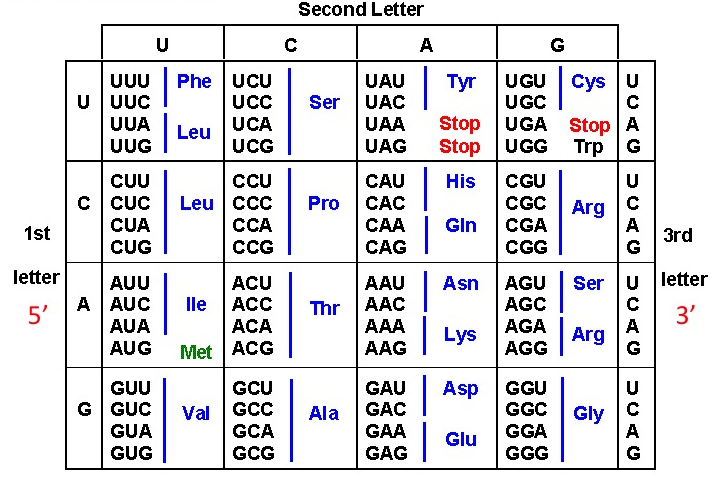
Question 3a

If the sequence above was used as a template strand for replication…

Give the sequence of the new strand and label its 5' and 3' ends.
Please give your answer without spaces in the form of: X'NNNNX'


In which direction would the new strand be synthesized?
Please give your answer in the form of: X' to X'

The published course does not expose an answer key for this question.

Question 3b

If the sequence above (given at the start of the question) used as a template strand for transcription…

Give the sequence of the newly transcribed RNA, label its 5' and 3' ends, AND separate each codon with a forward slash.
Please give your answer without spaces in the form of: X'NN/NNX'


In which direction would the new strand be transcribed?
Please give your answer in the form of: X' to X'


Give the amino acid sequence coded for by the newly transcribed RNA.
Please give your answer without spaces in the form of: X-Aaa-Aaa-X
Note: A codon chart has been provided at the bottom of this page.

The published course does not expose an answer key for this question.

Question 3c

Which of these two processes requires primer to make the new strand?

The published course does not expose an answer key for this question.

Question 3d

The same sequence is repeated here for you.

5’ ATTTCTAGCTTGGGCCAT3’

If the bold and underlined “G” in the above sequence was changed to “A” …

Give the sequence of the newly transcribed RNA, label its 5' and 3' ends, AND separate each codon with a forward slash.
Please give your answer without spaces in the form of: X'NN/NNX'


Give the sequence of the anti-codon corresponding to the 2nd codon and label its 5' and 3' ends.
Please give your answer without spaces in the form of: X'NNNX'


Give the amino acid sequence of the newly translated polypeptide.
Please give your answer without spaces in the form of: X-Aaa-Aaa-X


The published course does not expose an answer key for this question.

Question 4

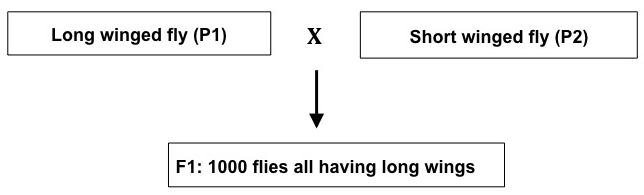
You want to study wing length (long or short) that is regulated by an autosomal Gene, Gene A, in fruit flies. Gene A can exist in the form of two different alleles; Allele A regulates the dominant phenotype whereas “Allele a” regulates the recessive phenotype.

You perform the following mating experiment.
Question 4a

The published course does not expose an answer key for this question.

Question 4b

In the mating experiment, the genotypes of parent 1 (P1), parent 2 (P2), and off-spring (F1) are unknown. Use the dropdown boxes to determine the correct genotype of P1, P2, and F1 flies.

A fly mating experiment scheme with phenotypes given but genotypes unknown. The phenotype of P1 is long winged. The phenotype of P2 is short winged. F1 consists of one thousand flies that all have long wings.

  • Genotype of P1:
  • Genotype of P2:
  • Genotype of F1:

The published course does not expose an answer key for this question.

Question 4c, part i

You mate two F1 flies to obtain 1000 flies in F2 generation.

Use the dropdown options to fill in the Punnett Square for this cross. Some information has been provided for you.

Complete the Punnett Square
Figure labeling the header and first column as the F 1 gametes. A
A

The published course does not expose an answer key for this question.

Question 4c, part ii

Give the phenotypes and corresponding ratios of the F2 flies based on the Punnett Square.

Please give your answers without spaces in the following format:
#long:#short

The published course does not expose an answer key for this question.

Question 4c, part iii

Give the genotypes and corresponding ratios of the F2 flies based on the Punnett Square.

Please give your answers without spaces in the following format:
#NN:#NN:#NN

The published course does not expose an answer key for this question.

Question 4d, part i

Using the Punnett Squares in the next two parts, design a mating experiment that can help you identify if a fly having long wings is homozygous or heterozygous for the alleles of Gene A.

Fill in the Punnett Square for this cross with the result of your designed experiment if the fly was homozygous for the alleles of Gene A. (The gametes for the long-winged fly that is homozygous have been given to you in the top row of the Punnett Square.)

Complete the Punnett Square
Figure labeling the header and first column as the F 1 gametes. A A

The published course does not expose an answer key for this question.

Question 4d, part ii

Fill in the punnett square for this cross with the result of your designed experiment if the fly was heterozygous for the alleles of Gene A. (The gametes for the long-winged fly that is heterozygous have been given to you in the top row of the Punnett Square.)

Complete the Punnett Square
Figure labeling the header and first column as the F 1 gametes. A a

The published course does not expose an answer key for this question.

Question 5

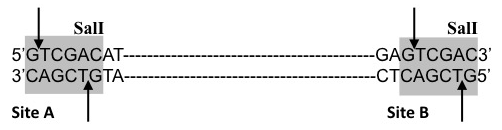
You want to clone part of Gene X that encodes Enzyme X. The following is the partial sequence of Gene X. It has recognition sites (shown in the grey boxes) for the restriction enzyme SalI, which cuts it at the positions shown by arrows.
Question 5a

Select the sequence of Gene X AFTER it has been cut with SalI at Site A and Site B.

The published course does not expose an answer key for this question.

Question 5b

Select the enzyme that would generate a base sequence which can ligate with SalI digested base sequence at Site A of Gene X.

Three different restriction enzyme sites are shown. The 6 base pair sequence is the same for all three enzymes with varying cut sites. For enzyme 1, the top strand reads 5' C T C G A cut G 3 prime and the bottom strand reads 3 prime G cut A G C T C 5 prime. For enzyme 2, the top strand reads 5' C T C cut G A G 3 prime and the bottom strand reads 3 prime G A G cut C T C 5 prime. For enzyme 3, the top strand reads 5' C cut T C G A G 3 prime and the bottom strand reads 3 prime G A G C T cut C 5 prime.

The published course does not expose an answer key for this question.

Question 5c

Ligation of the base sequences involves the formation of 3' to 5' phosphodiester bonds. This is an example of a...

The published course does not expose an answer key for this question.

MIT OpenCourseWare / MIT Open Learning Library. Hazel Sive and Diviya Ray. Adapted for local study under Creative Commons Attribution–NonCommercial–ShareAlike 4.0. License terms.