Appendix AThe Tree of Life
Phylogeny is the organizing principle of modern biological taxonomy. A guiding principle of modern phylogeny is monophyly. A monophyletic group is considered to be one that contains an ancestral lineage and all of its descendants. Any such group can be extracted from a phylogenetic tree with a single cut.
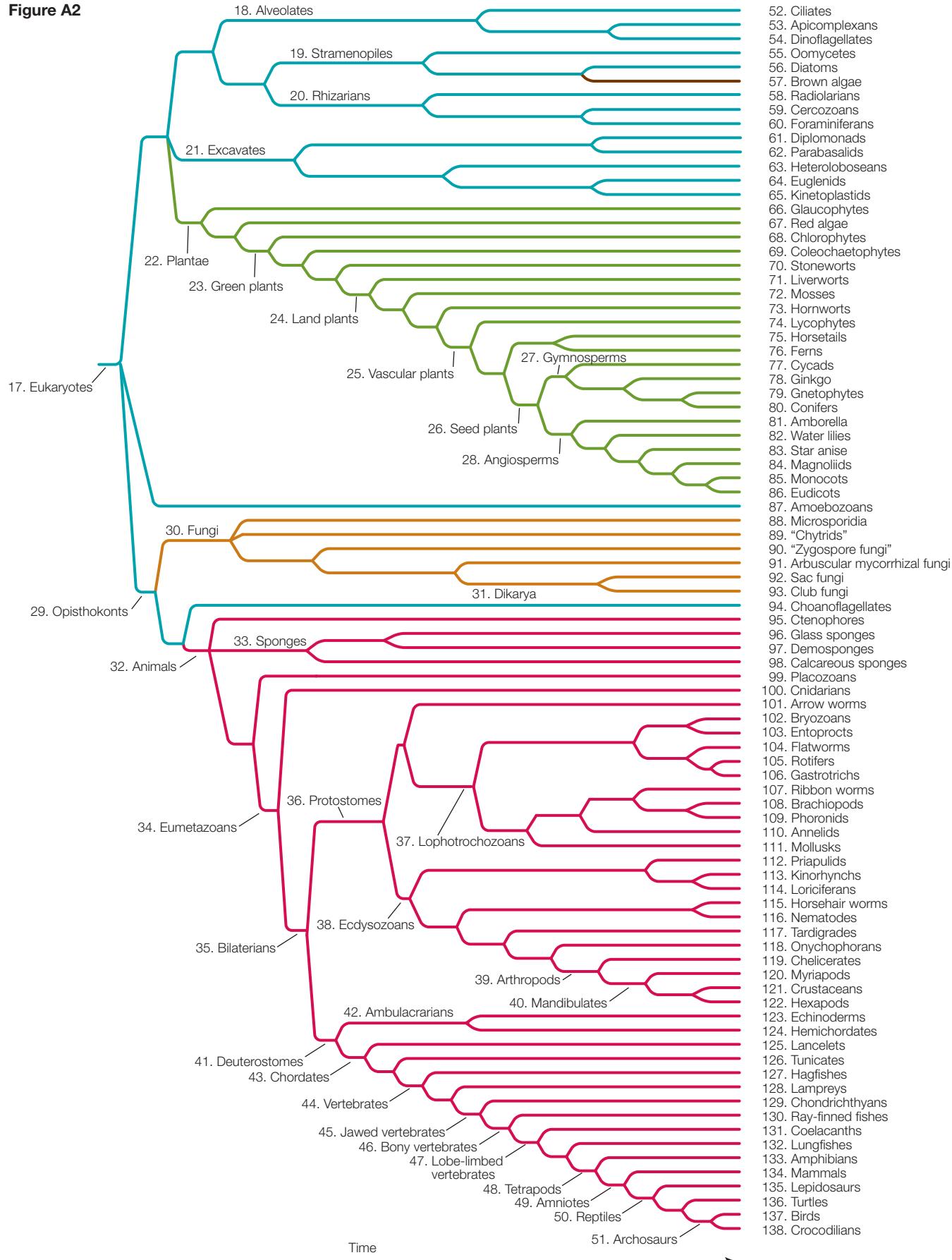
The trees shown here provide a guide to the relationships among the major groups of extant (living) organisms in the tree of life as we have presented them throughout this book. The position of the branching “splits” indicates the relative branching order of the lineages of life, but the time scale is not meant to be uniform. In addition, the groups appearing at the branch tips do not necessarily carry equal phylogenetic “weight.” For example, the ginkgo [78] is indeed at the apex of its lineage; this gymnosperm group consists of a single living species. In contrast, a phylogeny of the eudicots [86] could continue on from this point to fill many more trees the size of this one.
The glossary entries that follow are informal descriptions of some major features of the organisms described in Part Six of this book. Each entry gives the group’s common name, followed by the formal scientific name of the group (in parentheses). Numbers in square brackets reference the location of the respective groups on the tree.
It is sometimes convenient to use an informal name to refer to a collection of organisms that are not monophyletic but nonetheless all share (or all lack) some common attribute. We call these “convenience terms”; such groups are indicated in these entries by quotation marks, and we do not give them formal scientific names. Examples include “prokaryotes,” “protists,” and “algae.” Note that these groups cannot be removed with a single cut; they represent a collection of distantly related groups that appear in different parts of the tree. We also use quotation marks here to designate two groups of fungi that are not believed to be monophyletic.
Figure A1
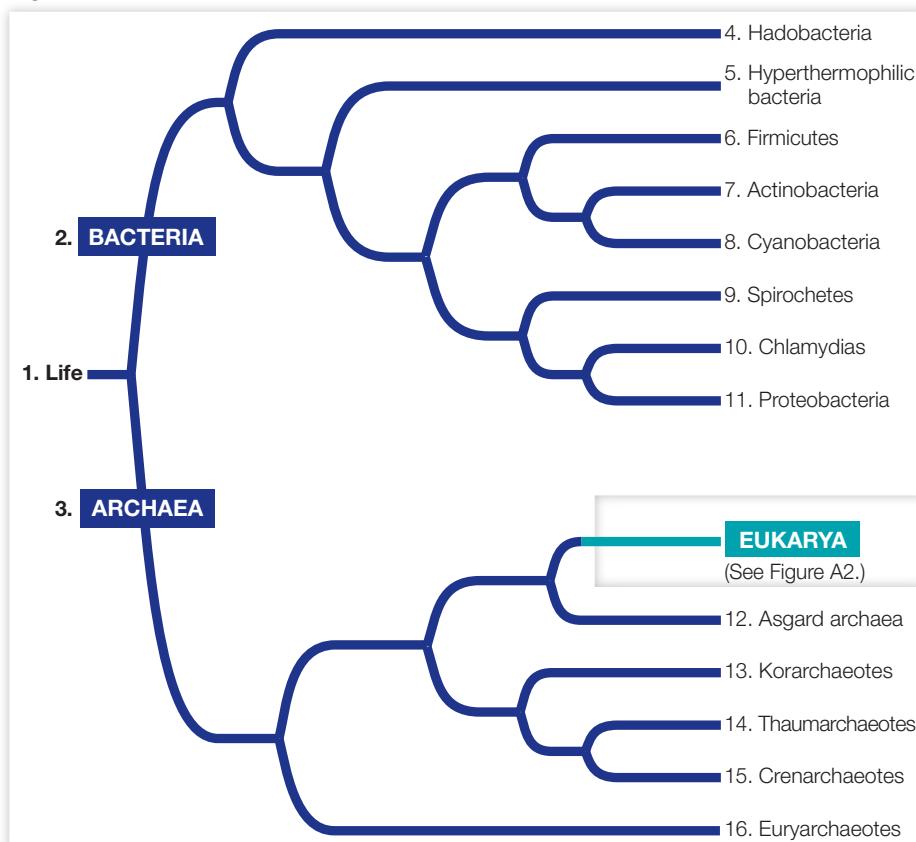
Figures A1 and A2 The Tree of Life
In this rendition, the prokaryotic lineages are shown in Figure A1 and the eukaryotic lineages are in Figure A2. Among the eukaryotes, the microbial lineages are shown in teal. The eukaryote groups that contain major radiations of large multicellular organisms are shown in brown (brown algae), green (Plantae), orange (fungi), and red (animals).
Figure A2
A
acoels (Acoela) A group of reduced bilaterians [35] of uncertain phylogenetic relationships. Placed variously among the protostomes [36], deuterostomes [41], or as a sister group of all other bilaterians [35].
actinobacteria (Actinobacteria) [7] High G-C Gram-positive bacteria [2] with genomes that have a high ratio of G-C to A-T nucleotide base pairs.
“algae” A term of convenience encompassing various distantly related groups of aquatic, photosynthetic eukaryotes [17].
ambulacrarians (Ambulacraria) [41] The echinoderms [123] and hemichordates [124].
amniotes (Amniota) [49] Mammals, reptiles, and their extinct close relatives. Characterized by many adaptations to terrestrial life, including an amniote egg (with a unique set of membranes—the yolk sac, amnion, chorion, and allantois), a water-repellant epidermis (with epidermal scales, hair, or feathers), and in males, a penis that allows internal fertilization.
amoebozoans (Amoebozoa) [87] A group of eukaryotes [17] that use lobe-shaped pseudopods for locomotion and to engulf food. Major amoebozoan groups include the loboseans, plasmodial slime molds, and cellular slime molds.
amphibians (Amphibia) [133] Tetrapods [48] with glandular skin that lacks epidermal scales, feathers, or hair. Many amphibian species undergo a complete metamorphosis from an aquatic larval form to a terrestrial adult form, although direct development is also common. Major amphibian groups include frogs and toads (anurans), salamanders, and caecilians.
annelids (Annelida) [110] Segmented worms, including earthworms, leeches, and polychaetes. One of the major groups of lophotrochozoans [37].
anthozoans (Anthozoa) One of the major groups of cnidarians [100]. Includes the sea anemones, sea pens, and corals.
apicomplexans (Apicomplexa) [53] Parasitic alveolates [18] characterized by having an apical complex at some stage in the life cycle.
arbuscular mycorrhizal fungi (Glomeromycotina) [91] A group of fungi [30] that associate with plant roots in a close symbiotic relationship.
archaea (Archaea) [3] One of the two primary divisions of life [1], and one of the three domains of life. The term is often used only for the prokaryotic archaea, which are unicellular organisms that lack a nucleus and lack peptidoglycan in the cell wall. Recent studies indicate that eukaryotes [17] are most closely related to the lokiarchaeotes [12] among the archaea.
archosaurs (Archosauria) [51] A group of reptiles [50] that includes dinosaurs and crocodilians [138]. Most dinosaur groups became extinct at the end of the Cretaceous; birds [137] are the only surviving dinosaurs.
arrow worms (Chaetognatha) [101] Small planktonic or benthic predatory marine worms with fins and a pair of hooked, prey-grasping spines on each side of the head.
arthropods (Arthropoda) The largest group of ecdysozoans [38]. Arthropods are characterized by a stiff exoskeleton, segmented body, and jointed appendages. Includes the chelicerates [119], myriapods [120], crustaceans [121], and hexapods (insects and their relatives) [122].
Asgard archaea [12] A group of recently discovered archaeal lineages (including lokiarchaeotes) that are the closest known prokaryotic relatives of eukaryotes.
B
bacteria (Bacteria or Eubacteria) [2] One of the two primary divisions of life [1], and one of the three domains of life. Unicellular organisms lacking a nucleus, possessing distinctive ribosomes and initiator tRNA, and generally containing peptidoglycan in the cell wall. Different bacterial groups are distinguished primarily on the basis of nucleotide sequence data.
bilaterians (Bilateria) [35] Those animal groups characterized by bilateral symmetry and three distinct tissue types (endoderm, ectoderm, and mesoderm). Includes the protostomes [36] and deuterostomes [41].
birds (Aves) [137] Feathered, flying (or secondarily flightless) tetrapods [48].
bivalves (Bivalvia) A major mollusk [111] group; clams, oysters, and mussels. Bivalves typically have two similar hinged shells that are each asymmetrical across the midline.
brachiopods (Brachiopoda) [108] Lophotrochozoans [37] with two similar hinged shells that are each symmetrical across the midline. Superficially resemble bivalve mollusks, except for the shell symmetry.
brown algae (Phaeophyta) [57] Multicellular, almost exclusively marine stramenopiles [19] generally containing the pigment fucoxanthin as well as chlorophylls a and c in their chloroplasts.
bryozoans (Ectoprocta or Bryozoa) [102] A group of marine and freshwater lophotrochozoans [37] that live in colonies attached to substrates; also known as ectoprocts or moss animals.
C
cellular slime molds
(Dictyostelida) Amoebozoans [87] in which individual amoebas aggregate under stress to form a multicellular pseudoplasmodium.
cephalopods (Cephalopoda) Active, predatory mollusks [111] in which the molluscan foot has been modified into muscular hydrostatic arms or tentacles. Includes octopuses, squid, and nautiluses.
cercozoans (Cercozoa) [59] Unicellular eukaryotes [17] that feed by means of threadlike pseudopods. Group together with foraminiferans [60] and radiolarians [58] to make up the rhizarians [20].
chelicerates (Chelicerata) [119] A major group of arthropods [39] with pointed appendages (chelicerae) used to grasp food (as opposed to the chewing mandibles of most other arthropods). Includes arachnids, horseshoe crabs, sea spiders, and extinct sea scorpions.
chitons (Polyplacophora) Flattened, slow-moving mollusks [111] with a dorsal protective calcareous covering made up of eight articulating plates.
chlamydias (Chlamydiae) [10] A group of very small Gram-negative bacteria; they live as intracellular parasites of other organisms.
chlorophytes (Chlorophyta) [68] The most abundant and diverse group of green algae, including freshwater, marine, and terrestrial forms; some are unicellular, others colonial, and still others multicellular. Chlorophytes use chlorophylls a and c in their photosynthesis.
chondrichthyans (Chondrichthyes) [129] One of the two main groups of jawed vertebrates [45]; includes sharks, rays, and chimaeras. They have cartilaginous skeletons and paired fins.
chordates (Chordata) [43] One of the three major groups of deuterostomes [41], characterized by the presence (at some point in development) of a notochord, a hollow dorsal nerve cord, and a post-anal tail. Includes the lancelets [125], tunicates [126], and vertebrates [44].
“chytrids” [89] A term of convenience used for a paraphyletic group of mostly aquatic, microscopic fungi [30] with flagellated gametes. Some exhibit alternation of generations.
ciliates (Ciliophora) [52] Alveolates [18] with numerous cilia and two types of nuclei (micronuclei and macronuclei).
clitellates (Clitellata) Annelids [110] with gonads contained in a swelling (called a clitellum) toward the head of the animal. Includes earthworms (oligochaetes) and leeches.
club fungi (Basidiomycota) [93] Fungi [30] that, if multicellular, bear the products of meiosis on club-shaped basidia and possess a long-lasting dikaryotic stage. Some are unicellular.
cnidarians (Cnidaria) [100] Aquatic, mostly marine eumetazoans [34] with specialized stinging organelles (nematocysts) used for prey capture and defense, and a blind gastrovascular c
crustaceans (Crustacea) [121] A major group of marine, freshwater, and terrestrial arthropods [39] with a head, thorax, and abdomen (although the head and thorax may be fused), covered with a thick exoskeleton, and with two-part appendages. Crustaceans undergo metamorphosis from a larva. Includes decapods, isopods, krill, barnacles, amphipods, copepods, and ostracods.
ctenophores (Ctenophora) [95] Radially symmetrical, gelatinous marine animals [32], with eight rows of fused plates of cilia (called ctenes).
cyanobacteria (Cyanobacteria) [8] A group of unicellular, colonial, or filamentous bacteria that conduct photosynthesis using chlorophyll a.
cycads (Cycadophyta) [77] Palmlike gymnosperms with large, compound leaves.
cyclostomes (Cyclostomata) This term refers to the possibly monophyletic group of lampreys [128] and hagfishes [127]. Molecular data support this group, but morphological data suggest that lampreys are more closely related to jawed vertebrates [45] than to hagfishes.
D
deuterostomes (Deuterostomia) [41] One of the two major groups of bilaterians [35], in which the mouth forms at the opposite end of the embryo from the blastopore in early development (contrast with protostomes). Includes the ambulacrarians [42] and chordates [43].
diatoms (Bacillariophyta) [56] Unicellular, photosynthetic stramenopiles [19] with glassy cell walls in two parts.
Dikarya [31] A group of fungi [30] in which two genetically different haploid nuclei coexist and divide within the same hypha; includes the club fungi [93] and sac fungi [92].
dinoflagellates (Dinoflagellata) [54] A group of alveolates [18] usually possessing two flagella, one in an equatorial groove and the other in a longitudinal groove; many are photosynthetic.
dinosaurs (Dinosauria) A group of archosaurs [51] that includes birds [137] as well as many extinct groups from the Mesozoic. Extinct Mesozoic dinosaurs included some of the largest terrestrial vertebrates that have ever lived. Informally, many people use the term to refer only to the extinct Mesozoic species.
diplomonads (Diplomonadida) [61] A group of eukaryotes [17] lacking mitochondria; most have two nuclei, each with four associated flagella.
dry-nosed primates (Haplorhini) A group of primate mammals [134] that includes apes, monkeys, and tarsiers.
E
ecdysozoans (Ecdysozoa) [38] One of the two major groups of protostomes [36], characterized by periodic molting of their exoskeletons. Nematodes [116] and arthropods [39] are the largest ecdysozoan groups.
echinoderms (Echinodermata) [123] A major group of marine deuterostomes [41] with fivefold radial symmetry (at some stage of life) and an endoskeleton made of calcified plates and spines. Includes sea stars, crinoids, sea urchins, sea cucumbers, and brittle stars.
embryophytes See land plants [24].
entoprocts (Entoprocta) [103] A group of marine and freshwater lophotrochozoans [37] that live as single individuals or in colonies attached to substrates. They are the sister group of bryozoans, from which they differ in having both their mouth and anus inside the lophophore (the anus is outside the lophophore in bryozoans).
euglenids (Euglenida) [64] Flagellated excavates [21] characterized by a pellicle composed of spiraling strips of protein under the cell membrane; the mitochondria have disc-shaped cristae. Some are photosynthetic.
eukaryotes (Eukarya) [17] A group of organisms made up of one or more complex cells in which the genetic material is contained in nuclei. Includes all plants [22], fungi [30], and animals [32]. One of the three main domains of life.
euphyllophytes (Euphyllophyta) The group of vascular plants [25] that is sister to the lycophytes [74] and which includes all plants with megaphylls.
euryarchaeotes (Euryachaeota) [16] A major group of archaea [3], diagnosed on the basis of rRNA sequences. Includes many methanogens, extreme halophiles, and thermophiles.
eutherians (Eutheria) A group of viviparous mammals [134], well developed at birth (contrast with prototherians and marsupials, the other two groups of mammals). Most familiar mammals outside the Australian and South American regions are eutherians (see Table 31.1).
excavates (Excavata) [21] A diverse group of unicellular, flagellated eukaryotes, many of which possess a feeding groove; some lack mitochondria.
F
firmicutes (Firmicutes) [6] Mostly low-GC Gram-positive bacteria [2] with genomes that have a low ratio of G-C to A-T nucleotide base pairs.
flatworms (Platyhelminthes) [104] A group of dorsoventrally flattened and generally elongated soft-bodied lophotrochozoans [37]. May be free-living or parasitic, found in marine, freshwater, or damp terrestrial environments. Major flatworm groups include the tapeworms, flukes, monogeneans, and turbellarians.
foraminiferans (Foraminifera) [60] Amoeboid organisms with fine, branched pseudopods that form a food-trapping net. Most produce external shells of calcium carbonate.
G
gastropods (Gastropoda) The largest group of mollusks [111]. Gastropods possess a well-defined head with two or four sensory tentacles (often terminating in eyes) and a ventral foot. Most species have a single coiled or spiraled shell. Common in marine, freshwater, and terrestrial environments.
gastrotrichs (Gastrotricha) [106] Tiny (0.06–3.0 mm), elongated acoelomate lophotrochozoans [37] that are covered in cilia. They live in marine, freshwater, and wet terrestrial habitats. They are simultaneous hermaphrodites.
ginkgo (Ginkgophyta) [78] A gymnosperm [27] group with only one living species. The ginkgo seed is surrounded by a fleshy tissue not derived from an ovary wall and hence not a fruit.
glaucophytes (Glaucophyta) [66] Unicellular freshwater algae with chloroplasts containing traces of peptidoglycan, the characteristic cell wall material of bacteria. Thought to be the sister group to the rest of Plantae.
gnathostomes (Gnathostomata) See jawed vertebrates [45].
gnetophytes (Gnetophyta) [79] A gymnosperm [27] group with three very different lineages; all have wood with vessels, unlike other gymnosperms.
green plants (Viridiplantae) [23] Organisms with chlorophylls a and b, cellulose-containing cell walls, starch as a carbohydrate storage product, and chloroplasts surrounded by two membranes.
H
hadobacteria (Hadobacteria) [4] A group of extremophilic bacteria [2] that includes the genera Deinococcus and Thermus.
hagfishes (Myxini) [127] Elongated, slimy-skinned vertebrates [44] with three small accessory hearts, a partial cranium, and no stomach or paired fins. See also craniates; cyclostomes.
hemichordates (Hemichordata) [124] One of the two primary groups of ambulacrarians [42]; marine wormlike organisms with a three-part body plan.
heteroloboseans (Heterolobosea) [63] Colorless excavates [21] that can transform among amoeboid, flagellated, and encysted stages.
hexapods (Hexapoda) [122] A major group of arthropods [39] characterized by a reduction (from the ancestral arthropod condition) to six walking appendages, and the consolidation of three body segments to form a thorax. Includes insects and their relatives (see Table 30.2).
hornworts (Anthocerophyta) [73] Nonvascular land plants with sporophytes that gro
There are more described species of insects than all other groups of life [1] combined, and many species remain to be discovered. The major insect groups are described in Table 30.2.
J
jawed vertebrates (Gnathostomata) [45] A major group of vertebrates [44] with jawed mouths. Includes chondrichthyans [129], ray-finned fishes [130], and lobe-limbed vertebrates [47].
K
kinetoplastids (Kinetoplastida) [65] Unicellular, flagellated organisms characterized by the presence in their single mitochondrion of a kinetoplast (a structure containing multiple, circular DNA molecules).
kinorhynchs (Kinorhyncha) [113] Small (< 1 mm) marine ecdysozoans [38] with bodies in 13 segments and a retractable proboscis.
korarchaeotes (Korarchaeota) [13] A group of archaea [3] known only by evidence from nucleic acids derived from hot springs.
L
lampreys (Petromyzontiformes) [128] Elongated, eel-like vertebrates [44] that often have rasping and sucking discs for mouths.
lancelets (Cephalochordata) [125] A group of weakly swimming, eel-like benthic marine chordates [43].
land plants (Embryophyta) [24] Plants with embryos that develop within protective structures; also called embryophytes. Both sporophytes and gametophytes of land plants are multicellular. Land plants possess a cuticle. Major groups are the liverworts [71], mosses [72], hornworts [73], and vascular plants [25].
lepidosaurs (Lepidosauria) [135] Reptiles [50] with overlapping scales. Includes tuataras and squamates (lizards, snakes, and amphibianians).
liverworts (Hepatophyta) [71] Nonvascular land plants lacking stomata; the stalk of the sporophyte elongates along its entire length.
lobe-limbed vertebrates (Sarcopterygii) [47] One of the two major groups of bony vertebrates [46], characterized by jointed appendages (paired fins or limbs).
loboseans (Lobosea) A group of unicellular amoebozoans [87]; includes the most familiar amoebas (e.g., Amoeba proteus).
lokiarchaeotes (Lokiarchaeota) [12] A group of archaea [3] known from deep-sea hydrothermal vents. Among the known archaea, they are among the closest relatives of the eukaryotes [17]. See Asgard archaea.
lophotrochozoans (Lophotrochozoa) [37] One of the two main groups of protostomes [36]. This group is morphologically diverse, and is supported primarily by information from gene sequences. Includes bryozoans [102], entoprocts [103], flatworms [104], rotifers [105], gastrotrichs [106], ribbon worms [107], brachiopods [108], phoronids [109], annelids [110], and mollusks [111].
loriciferans (Loricifera) [114] Small (< 1 mm) ecdysozoans [38] with bodies in four parts, covered with six plates.
lungfishes (Dipnoi) [132] A group of aquatic lobe-limbed vertebrates [47] that are the closest living relatives of the tetrapods [48]. They have a modified swim bladder used to absorb oxygen from air, so some species can survive the temporary drying of their habitat.
lycophytes (Lycopodiophyta) [74] Vascular plants [25] characterized by microphylls; includes the club mosses, spike mosses, and quillworts.
M
magnoliids (Magnoliidae) [84] A major group of angiosperms [28] possessing two cotyledons and pollen grains with a single opening. The group is defined primarily by nucleotide sequence data; it is more closely related to the eudicots and monocots than to three other small angiosperm groups.
mammals (Mammalia) [134] A group of tetrapods [48] with hair covering all or part of their skin; females produce milk to feed their developing young. Includes the prototherians, marsupials, and eutherians.
mandibulates (Mandibulata) [40] Arthropods [39] that include mandibles as mouthparts. Includes myriapods [120], crustaceans [121], and hexapods [122].
marsupials (Marsupialia) Mammals [134] in which the female typically has a marsupium (a pouch for rearing young, which are born at an extremely early stage in development). Includes such familiar mammals as opossums, koalas, and kangaroos.
microsporidia (Microsporidia) [88] A group of parasitic unicellular relatives of fungi [30] that lack mitochondria and have walls that contain chitin.
mollusks (Mollusca) [111] One of the major groups of lophotrochozoans [37], mollusks have bodies composed of a foot, a mantle (which often secretes a hard, calcareous shell), and a visceral mass. Includes monoplacophorans, chitons, bivalves, gastropods, and cephalopods.
monilophytes (Monilophyta) A group of vascular plants [25], sister to the seed plants [26], characterized by overtopping and possession of megaphylls; includes the horsetails [75] and ferns [76].
monoplacophorans (Monoplacophora) Mollusks [111] with segmented body parts and a single, thin, flat, rounded, bilateral shell.
mosses (Bryophyta) [72] Nonvascular land plants with true stomata and erect, “leafy” gametophytes; sporophytes elongate by apical cell division.
mycoplasmas Firmicutes [6] that lack cell walls and are among the smallest known cellular organisms.
myriapods (Myriapoda) [120] Arthropods [39] characterized by an elongated, segmented trunk with many legs. Include centipedes and millipedes.
N
nematodes (Nematoda) [116] A large group of elongated, unsegmented ecdysozoans [38] with thick, multilayer cuticles. They are among the most abundant and diverse animals, although most species have not yet been described. Includes free-living predators and scavengers, as well as parasites of most species of land plants [24] and animals [32].
neopterans (Neoptera) The largest group of flying (winged) hexapods [122], recognizable by the fact that they can fold their wings close to their body upon landing.
O
oomycetes (Oomycota) [55] Water molds and relatives; absorptive heterotrophs with nutrient-absorbing, filamentous hyphae.
opisthokonts (Opisthokonta) [29] A group of eukaryotes [17] in which the flagellum on motile cells, if present, is posterior. Includes the fungi [30], animals [32], and choanoflagellates [94].
P
parabasalids (Parabasalia) [62] A group of unicellular eukaryotes [17] that lack mitochondria; they possess flagella in clusters near the anterior of the cell.
phoronids (Phoronida) [109] A small group of sessile, wormlike marine lophotrochozoans [37] that secrete chitinous tubes and feed using a lophophore.
placozoans (Placozoa) [99] A poorly known group of structurally simple, asymmetrical, flattened, transparent animals found in coastal marine tropical and subtropical seas. Most evidence suggests that placozoans are secondarily simplified eumetazoans [34].
plantae (Plantae) [22] The most broadly defined plant group, corresponding to the group that descended from the primary endosymbiotic event that gave rise to chloroplasts. Includes green plants [23] as well as glaucophytes [66] and red algae [67]. In most parts of this book, we use the word “plant” as synonymous with “land plant” [24], a more restrictive definition.
plasmodial slime molds (Myxogastrida) Amoebozoans [87] that in their feeding stage consist of a coenocyte called a plasmodium.
pogonophorans (Pogonophora) Deep-sea annelids [110] that lack a mouth or digestive tract; they feed by taking up dissolved organic matter, facilitated by endosymbiotic bacteria in a specialized organ (the trophosome).
polychaetes (Polychaeta) A
“prokaryotes” Unicellular organisms that do not have nuclei. Not a monophyletic group; as commonly used, includes the bacteria [2] and archaea [3]. A term of convenience encompassing all cellular organisms that are not eukaryotes. (Contrast with eukaryotes.)
proteobacteria (Proteobacteria) [11] A large and extremely diverse group of Gram-negative bacteria that includes many pathogens, nitrogen fixers, and photosynthesizers. Includes the alpha, beta, gamma, delta, and epsilon proteobacteria.
“protists” A term of convenience used to encompass a large number of distinct and distantly related groups of eukaryotes, many but far from all of which are microbial and unicellular. Essentially a “catch-all” term for any eukaryotic group not contained within the land plants [24], fungi [30], or animals [32].
protostomes (Protostomia) [36] One of the two major groups of bilaterians [35]. In protostomes, the mouth typically forms from the blastopore (if present) in early development (contrast with deuterostomes). The major protostome groups are the lophotrochozoans [37] and ecdysozoans [38].
prototherians (Prototheria) A mostly extinct group of mammals [134], common during the Cretaceous and early Cenozoic. The five living species—four echidnas and the duck-billed platypus—are the only extant egg-laying mammals.
pterygotes (Pterygota) Flying (winged) insects, the largest group of hexapods [122].
R
radiolarians (Radiolaria) [58] Amoeboid organisms with needlelike pseudopods supported by microtubules. Most have glassy internal skeletons.
ray-finned fishes (Actinopterygii) [130]
A highly diverse group of freshwater and marine bony vertebrates [46]. They have reduced swim bladders that often function as hydrostatic organs and fins supported by soft rays (lepidotrichia). Includes most familiar fishes.
red algae (Rhodophyta) [67] Mostly multicellular marine and freshwater algae characterized by the presence of phycoerythrin in their chloroplasts.
reptiles (Reptilia) [50] One of the two major groups of extant amniotes [49], supported on the basis of similar skull structure and gene sequences. The term “reptiles” traditionally excluded birds [137], but the resulting group is then clearly paraphyletic. As used in this book, living reptiles include turtles [136], lepidosaurs [135], birds [137], and crocodilians [138].
rhizarians (Rhizaria) [20] Mostly amoeboid unicellular eukaryotes with pseudopods, many with external or internal shells. Includes the foraminiferans [60], cercozoans [59], and radiolarians [58].
rhyniophytes (Rhyniophyta) A group of early vascular plants [25] that appeared in the Silurian and became extinct in the Devonian. Possessed dichotomously branching stems with terminal sporangia but no true leaves or roots.
ribbon worms (Nemertea) [107] A group of unsegmented lophotrochozoans [37] with an eversible proboscis used to capture prey. Mostly marine, but some species live in fresh water or on land.
rotifers (Rotifera) [105] Tiny (< 0.5 mm) lophotrochozoans [37] with a pseudocoelomate body cavity that functions as a hydrostatic organ, and a ciliated feeding organ called the corona that surrounds the head. Rotifers live in freshwater and wet terrestrial habitats.
S
sac fungi (Ascomycota) [92] Fungi that bear the products of meiosis within sacs (asci) if the organism is multicellular. Some are unicellular.
scyphozoans (Scyphozoa) Marine cnidarians [100] in which the medusa stage dominates the life cycle. Commonly known as jellyfishes.
“seed ferns” A paraphyletic group of loosely related, extinct seed plants that flourished in the Devonian and Carboniferous. Characterized by large, frondlike leaves that bore seeds.
simians (Simiiformes) A group of primate mammals [134] that consists of apes and monkeys.
spirochetes (Spirochaetes) [9] Motile, Gram-negative bacteria with a helically coiled structure and characterized by axial filaments.
sponges (Porifera) [33] A group of relatively asymmetrical, filter-feeding animals that lack a gut or nervous system and generally lack differentiated tissues. Includes the glass sponges [96], demosponges [97], and calcareous sponges [98].
squamates (Squamata) The major group of lepidosaurs [135], characterized by the possession of movable quadrate bones (which allow the upper jaw to move independently of the rest of the skull) and hemipenes (a paired set of eversible penises, or penes) in males. Includes the lizards (a paraphyletic group), snakes, and amphisbaenians.
staphylococci (Staphylococcus) Firmicutes [6] that are abundant on the surface of the human body; can cause skin diseases and respiratory, intestinal, and wound infections.
stoneworts (Charales) [70] Multicellular green algae with branching, apical growth and plasmodesmata between adjacent cells. The closest living relatives of the land plants [24], they retain the egg in the parent organism.
stramenopiles (Heterokonta or Stramenopila) [19] Organisms having, at some stage in their life cycle, two unequal flagella, the longer possessing rows of tubular hairs. Chloroplasts, when present, are surrounded by four membranes. Major stramenopile groups include the brown algae [57], diatoms [56], and oomycetes [55].
streptophytes (Streptophyta) All green plants [23] other than chlorophytes [68].
T
tardigrades (Tardigrada) [117] Small (< 1.5 mm) ecdysozoans [38] with fleshy, unjointed legs and no circulatory or gas exchange organs. They live in marine sands, in temporary freshwater pools, and on the water films of plants. Also called water bears.
tetrapods (Tetrapoda) [48] The major group of lobe-limbed vertebrates [47]; includes the amphibians [133] and amniotes [49]. Named for the presence of four jointed limbs (although limbs have been secondarily reduced or lost completely in several tetrapod groups).
thaumarchaeotes (Thaumarchaeota) [14] A group of archaea [3] known from hot environments and marine surface waters; they oxidize ammonia and are thought to play an important role in the nitrogen cycle.
therians (Theria) Mammals [134] characterized by viviparity (live birth). Includes the eutherians and marsupials.
theropods (Theropoda) Archosaurs [51] with bipedal stance, hollow bones, a furcula (“wishbone”), elongated metatarsals with three-fingered feet, and a pelvis that points backward. Includes many well-known extinct dinosaurs (such as Tyrannosaurus rex), as well as the living birds [137].
tracheophytes See vascular plants [25].
trilobites (Trilobita) An extinct group of arthropods [39] related to the chelicerates [119]. Trilobites flourished from the Cambrian through the Permian.
tuataras (Rhyncocephalia) A group of lepidosaurs [135] known mostly from fossils; there is only one living tuatara species. The quadrate bone of the upper jaw is fixed firmly to the skull. The sister group of the squamates.
tunicates (Tunicata) [126] A group of chordates [43] that are mostly saclike filter feeders as adults, with motile larval stages that resemble tadpoles.
turtles (Testudines) [136] A group of reptiles [50] with a bony carapace (upper shell) and plastron (lower shell) that encase the body in a fashion unique among the vertebrates.
V
vascular plants (Tracheophyta) [25] Plants with xylem and phloem. Major groups include the lycophytes [74] and euphyllophytes.
velvet worms (Onychophora) [118] Elongated, segmented ecdysozoans [38] with many pairs of soft, unjointed, claw-bearing legs.
vertebrates (Vertebrata)