Chapter 31Deuterostome Animals
Stylvin Cordier/Gaty Images
Key Concepts
- 31.1 Deuterostomes Include Echinoderms, Hemichordates, and Chordates
- 31.2 Echinoderms and Hemichordates Are Restricted to Marine Environments
- 31.3 More Than Half of Chordates Are Also Aquatic
- 31.4 Tetrapods Diversified Rapidly in Terrestrial Environments
- 31.5 Humans Evolved among the Primates
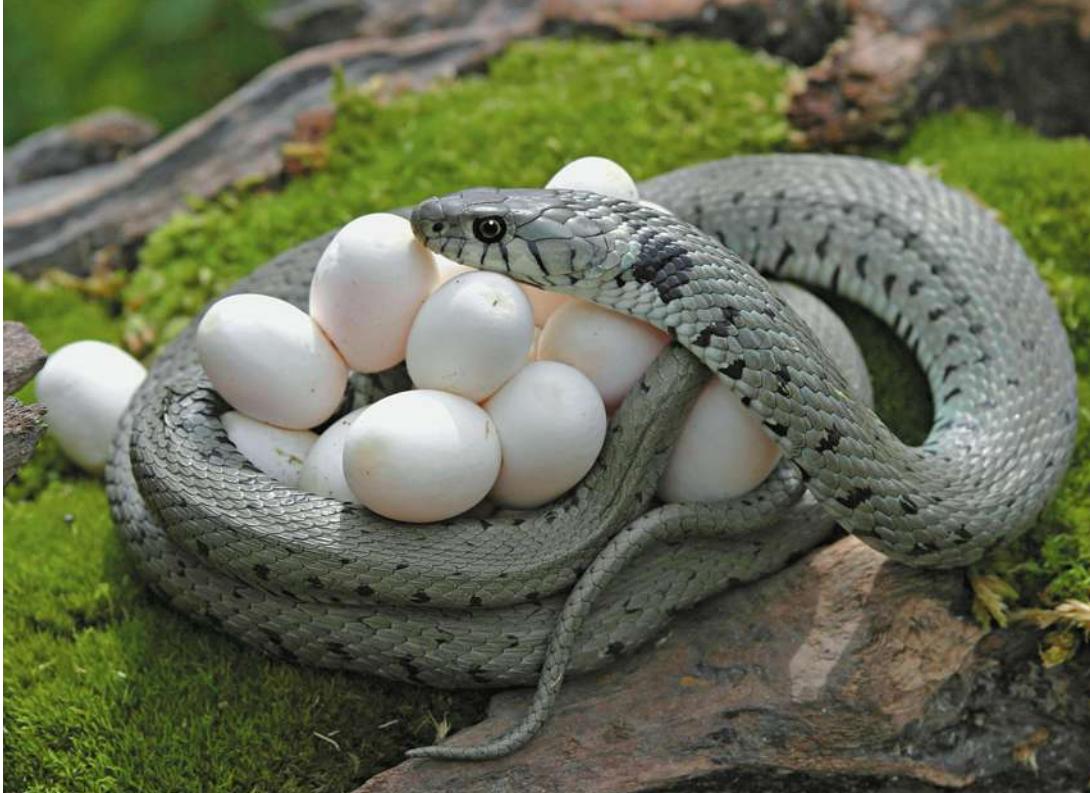
Grass snake (Natrix natrix) with eggs Shelled eggs facilitated the colonization of drier terrestrial environments by deuterostomes.
Investigating Life: Which Came First, the Chicken or the Egg?
When people ponder the chicken and egg problem, it is supposedly a riddle without an answer. The first chicken must have hatched from an egg, but then didn’t another chicken have to lay that egg? But if you understand evolutionary biology, then the answer to the question of whether the chicken or the egg came first is obvious, and it isn’t even close. Shelled eggs originated hundreds of millions of years before the first chicken walked on Earth.
The lineage of birds that we now know as chickens is only a few million years old. If we followed that lineage back through time, the birds in it would look less like modern chickens with each preceding generation. But all birds lay shelled eggs (a phenomenon called oviparity, or “egg birth”), so we can logically infer that eggs existed long before the first chicken did. Birds are the only living group of dinosaurs, but fossil eggs for many groups of extinct dinosaurs have been discovered. The closest living relatives of birds are the crocodilians, and they also lay shelled eggs, as do turtles. Many (but not all) lizards and snakes also lay shelled eggs, and so do the earliest branching lineages of mammals, including the echidnas and duck-billed platypus. Other mammals modify the shelled egg into structures that allow the embryo to develop within the mother, so that the young are born after “hatching” inside the mother (viviparity, or “live birth”).
By comparing reproductive biology across species, biologists can trace the origin of the shelled egg to the origin of amniotes. Amniotes include all living mammals and reptiles (including birds). The group derives its name from the amnion, one of four membranes that surround the embryo within the shelled egg of amniotes.
Most amphibians also lay eggs, but their eggs have no shell. The soft, jellylike coating of amphibian eggs can easily dry, threatening the developing embryo. So amphibian eggs need to be deposited in water, or at least in moist places where desiccation is not a problem. This limitation kept the earliest terrestrial tetrapods from fully exploiting drier terrestrial environments. The shelled egg was thus an important evolutionary innovation that resulted in a great terrestrial explosion of the amniotes.
QA What are the advantages and disadvantages of egg laying versus live birth? (Find the answer on page 723.)
Deuterostomes Include Echinoderms, Hemichordates, and Chordates
Learning Objectives
- 31.1.1 Summarize the developmental and molecular characteristics that distinguish deuterostomes.
- 31.1.2 Identify the major deuterostome clades and give examples of each.
It may surprise you to learn that both you and a sea urchin are deuterostomes. Adult sea stars, sea urchins, and sea cucumbers—the most familiar echinoderms—look so different from adult vertebrates (fishes, frogs, lizards, birds, and mammals) that it may be difficult to believe all these animals are closely related. The evidence that all deuterostomes share a common ancestor that is not shared with the protostomes includes early developmental patterns and phylogenetic analysis of gene sequences, factors that are not apparent in the forms of the adult animals.
Deuterostomes share early developmental patterns
Historically, the deuterostomes were distinguished by three early developmental patterns:
- Radial cleavage
- Development of the blastopore into the anus and formation of the mouth at the opposite end of the embryo from the blastopore (the pattern that gives the deuterostomes their name)
- Development of a coelom from mesodermal pockets that bud off from the cavity of the gastrula rather than by splitting of the mesoderm, as occurs among protostomes
These distinctions, however, are not the strongest evidence for the monophyly of the deuterostomes. Radial cleavage is not exclusive to deuterostomes, and it is now thought to be the ancestral condition for all bilaterians. In fact, some of the groups now known to be protostomes were once thought to be deuterostomes because their developmental patterns are similar to those of echinoderms and chordates. The development of the blastopore into an anus does characterize the deuterostomes, but it may be the ancestral condition for bilaterians rather than a derived feature of deuterostomes. Today the strongest support for the shared evolutionary relationships of the deuterostomes comes from phylogenetic analyses of DNA sequences of many different genes.
There are three major deuterostome clades
All deuterostomes are triploblastic, coelomate animals (see Figure 29.6C). Skeletal elements, where present, are internal rather than external. Some species have segmented bodies, but the segments are less obvious than those of annelids and arthropods. Although there are far fewer species of deuterostomes than of protostomes (see Table 29.1), we have a special interest in deuterostomes because we are members of that clade. The deuterostomes are also of interest because they include many large animals that strongly influence the characteristics of ecosystems. Many deuterostome species have been intensively studied in all fields of biology. Complex social behaviors are well developed among some deuterostomes (especially among the vertebrates).
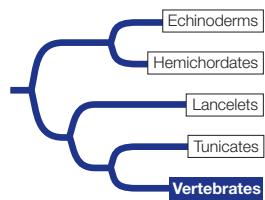
The major groups of living deuterostomes comprise three distinct clades (Figure 31.1):
- Echinoderms: sea stars (starfishes), sea urchins, and their relatives
- Hemichordates: acorn worms and pterobranchs
- Chordates: tunicates, lancelets, and vertebrates
In addition, some recent genomic analyses suggest that two poorly known groups, the xenoturbellids and the acoels, may also be deuterostomes, although the exact position of these groups among animals remains controversial.
Animation 31.1 An Overview of the Deuterostomes
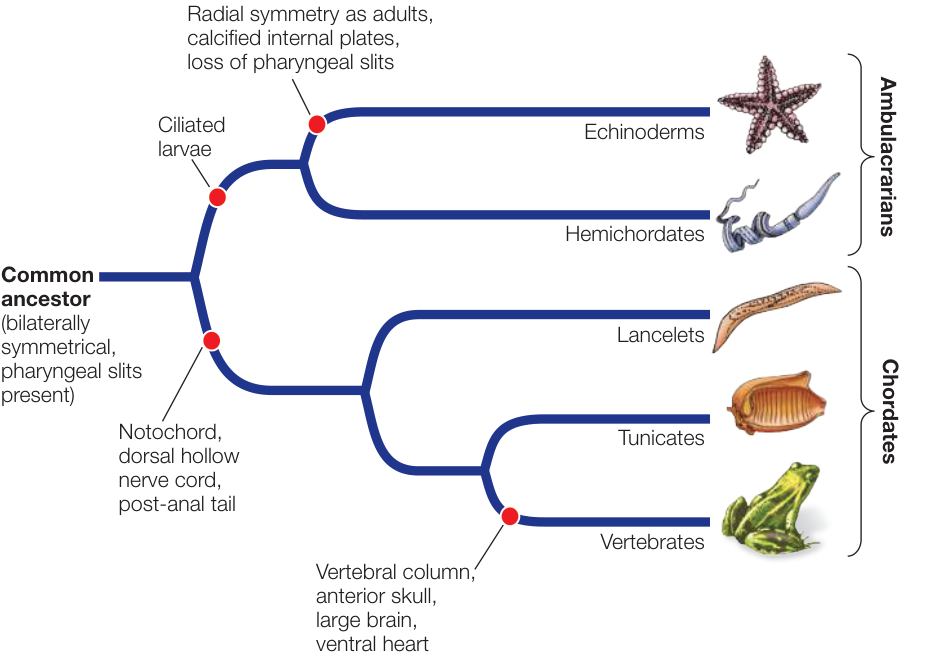
Figure 31.1 Phylogeny of the Deuterostomes The three principal groups of deuterostomes are the echinoderms, the hemichordates, and the chordates, the last of which includes the lancelets, tunicates, and vertebrates. The echinoderms and the vertebrates contain most of the described species. Activity 31.1 Deuterostome Phylogeny
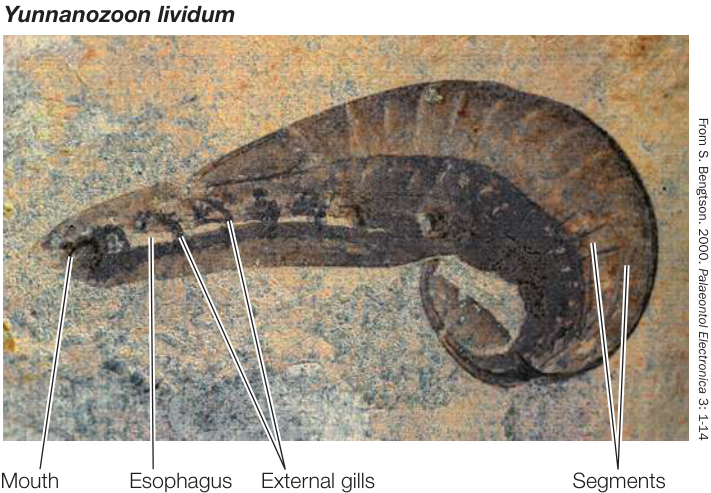
Figure 31.2 Ancestral Deuterostomes Had External Gills The extinct yunnanozoans may be ancestral deuterostomes. This fossil, which dates from the Cambrian, shows the six pairs of external gills and segmented posterior body that characterized these animals.
Fossils shed light on deuterostome ancestors
Scientists are learning much about the ancestors of modern deuterostomes from fossils discovered in 520-million-year-old rocks in China. Some of these early deuterostomes had skeletons similar to those of echinoderms, but unlike modern adult echinoderms, they had bilateral symmetry and a pharynx with slits through which water flowed. Another early deuterostome group, the yunnanozoans, was discovered in China’s Yunnan Province. The well-preserved fossils reveal animals that had a large mouth, six pairs of external gills, and a segmented posterior body section bearing a light cuticle (Figure 31.2). The features of these fossil animals, together with findings from phylogenetic analyses of living species, show that the earliest deuterostomes were bilaterally symmetrical, segmented animals with pharyngeal slits. The adult forms of the living echinoderms with their unique symmetry (in which the body parts are arranged along five radial axes) evolved much later. Other deuterostomes retained the ancestral bilateral symmetry.
Recap and Assess
The three major clades of deuterostomes are the echinoderms, the hemichordates, and the chordates. The common ancestry of these groups is supported by early developmental similarities and by phylogenetic analyses of DNA sequences.
- What three developmental traits do all deuterostomes have in common? Why are some of these traits no longer considered to be strong evidence for the monophyly of deuterostomes?
- What evidence provides strong support for the monophyly of deuterostomes?
- What are the three major groups of deuterostomes? Place each of the following in the appropriate group: humans, acorn worms, rattlesnakes, tunas, sea squirts, and sea stars.
We begin our survey of the deuterostomes with the echinoderms and hemichordates, the most distant of our relatives among the deuterostomes.
Echinoderms and Hemichordates Are Restricted to Marine Environments
Learning Objectives
31.2.1 Compare the body plans of larval and adult echinoderms.
31.2.2 Summarize the ways that various echinoderms use their tube feet to feed.
31.2.3 Contrast the ways that echinoderms and hemichordates feed.
About 13,000 species of echinoderms in 23 major groups have been described from their fossil remains. They are probably only a small fraction of the echinoderm species that have ever lived. Only 6 of the 23 major groups known from fossils are represented by species that survive today; many clades were lost during the periodic mass extinctions that have occurred throughout Earth’s history. All of the 7,500 extant species of echinoderms and 120 species of hemichordates live in marine environments.
The echinoderms and hemichordates (together known as ambulacrarians) have a bilaterally symmetrical, ciliated larva (Figure 31.3A). Adult hemichordates are also bilaterally symmetrical. Echinoderms, however, undergo a radical change in form as they develop into adults (Figure 31.3B), changing from a bilaterally symmetrical larva into an adult with pentaradial symmetry (symmetry in five or multiples of five). As is typical of animals with radial symmetry, echinoderms have no head, and most species move equally well in many directions. Rather than having an anterior–posterior (head–tail) and dorsal–ventral (back–belly) body organization, most echinoderms have an oral side containing the mouth and an opposite aboral side containing the anus.
Some recent genomic analyses suggest that two groups of small, highly reduced, soft-bodied marine organisms, the xenoturbellids and the acoels, may be the sister group of the ambulacrarians, although other studies suggest that they are the sister group of all the other bilaterians. The five known species of xenoturbellids are wormlike organisms up to 20 centimeters long that feed on or parasitize marine mollusks. They have a very simple body plan, with almost no well-defined organ systems. The mostly tiny (<2 mm) acoels are also highly reduced, wormlike organisms that live as plankton, between grains of sediment, or on other organisms such as corals (Figure 31.4). They are among the simplest of bilaterian animals, with no gut, circulatory system, respiratory system, or excretory system. They feed through a mouth and form a vacuole around tiny food items. They are hermaphrodites, and their sperm form between the epidermis and digestive structure. There are about 400 known species of acoels.
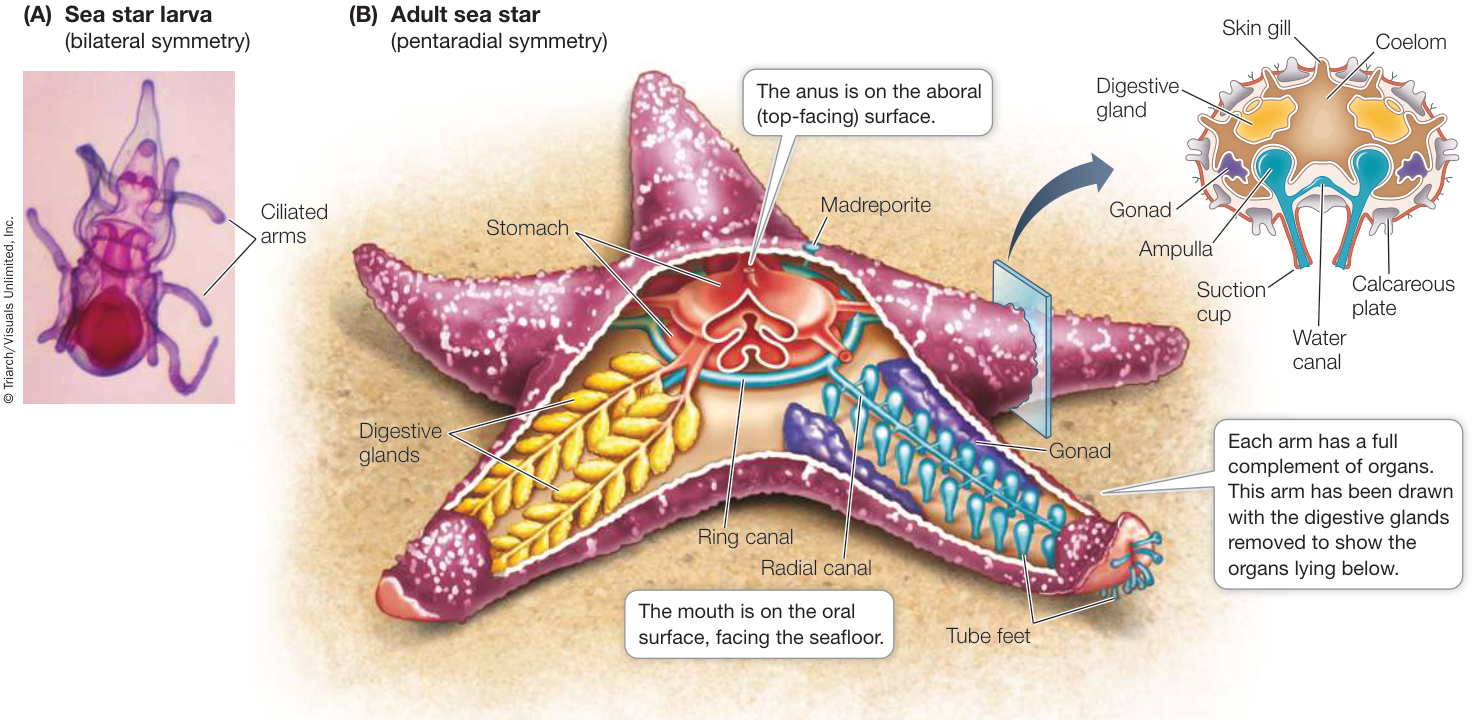
Figure 31.3 Echinoderms Are Bilaterally Symmetrical as Larvae but Radially Symmetrical as Adults (A) The ciliated larva of a sea star has bilateral symmetry. Hemichordates have a similar larval form. (B) An adult sea star displays the pentaradial symmetry of adult echinoderms. The canals and tube feet of the water vascular system, as well as the calcified internal skeleton, are shown in this diagram. The body’s orientation is oral–aboral rather than anterior–posterior.
Echinoderms have unique structural features
In addition to pentaradial symmetry, adult echinoderms have two unique structural features. One is a system of calcified internal plates covered by thin layers of skin and some muscles. The calcified plates of most echinoderms are thick, and they fuse inside the entire body, forming an internal skeleton. The other unique feature of this group is a water vascular system, a network of water-filled canals leading to extensions called tube feet (see Figure 31.3B). This system functions in gas exchange, locomotion, and feeding. Seawater enters the system through a perforated structure called a madreporite. A calcified canal leads from the madreporite to the ring canal, which surrounds the esophagus (the tube leading from the mouth to the stomach). Radial canals branch off from the ring canal, extending through the arms (in species that have arms) and connecting with the tube feet. These structural innovations have been modified in many ways, resulting in a striking array of very different animals.
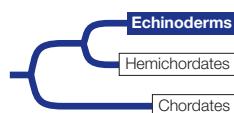
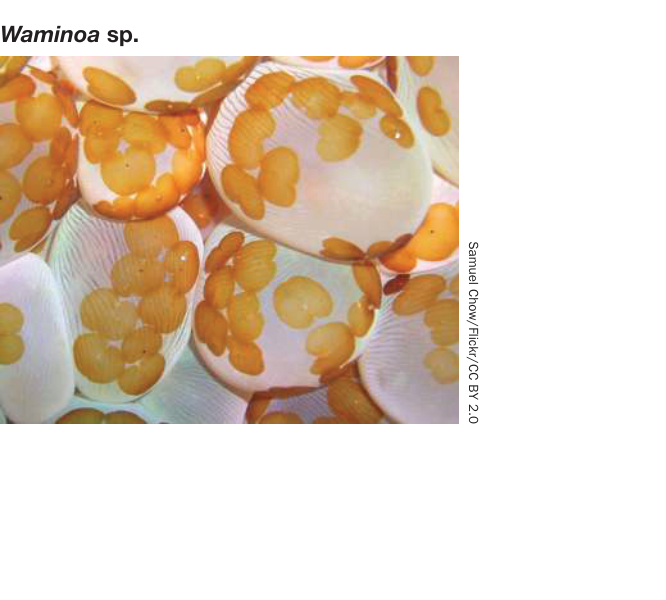
Figure 31.4 Highly Reduced Acoels May Be Relatives of the Ambulacrarians Acoels (yellow) are seen here living on bubble coral (white). Acoels (“without coelom”) feed by enveloping food particles in a vacuole within which nutrients are digested. These hermaphroditic animals can reproduce rapidly and may become problematic in saltwater aquariums.
Members of one major extant echinoderm clade, the crinoids (sea lilies and feather stars), were more abundant and species-rich 500–300 million years ago than they are today. There are some 80 described living sea lily species, most of which are sessile organisms attached to the substrate by a stalk. Feather stars (Figure 31.5A) grasp the substrate with specialized flexible appendages that allow for limited movement. About 600 living species of feather stars have been described.
Although some crinoids are sessile, most surviving echinoderms are motile. The two main groups of motile echinoderms are the echinozoans (sea urchins and sea cucumbers) and the asterozoans (sea stars and brittle stars). Sea urchins are hemispherical in shape and lack arms (Figure 31.5B). They are covered with spines that are attached to the underlying skeleton with ball-and-socket joints. These joints enable the spines to be moved so they can converge toward a point that has been touched. The spines, which vary among species in size and shape, can be used for locomotion; a few produce toxic substances. They provide effective protection for the urchin, as many a scuba diver has found out the hard way. Sand dollars are flattened, disc-shaped relatives of sea urchins.
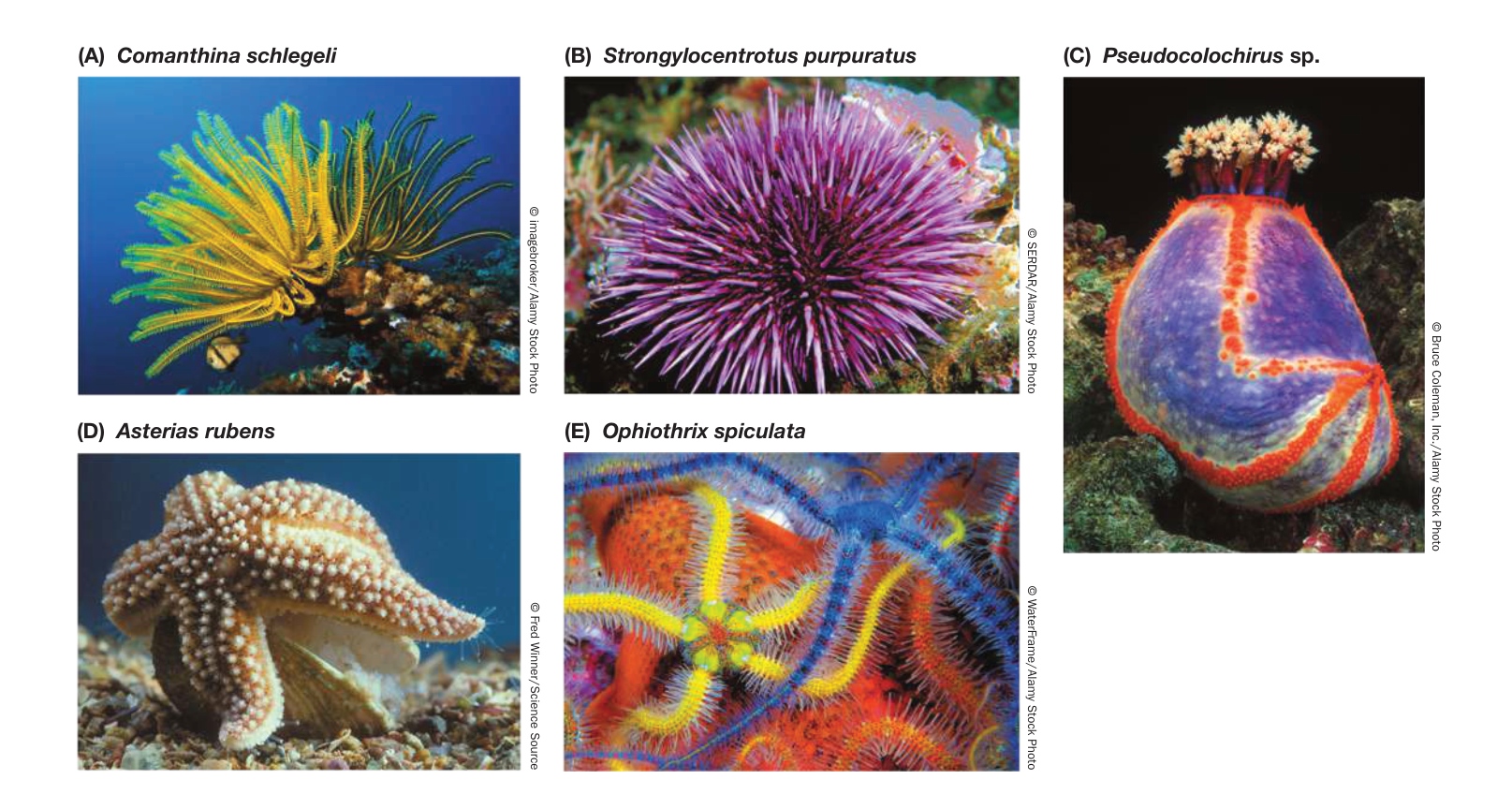
Figure 31.5 Echinoderm Diversity (A) The flexible arms of this variable bushy feather star (a crinoid) are clearly visible. (B) Sea urchins are important grazers on algae in the intertidal zones of the world’s oceans. (C) This sea cucumber has expelled a portion of its viscera as a sticky defense against a potential predator. (D) Sea stars are important predators on bivalve mollusks such as mussels and clams. Suction tips on its tube feet allow a sea star to grasp both shells of a bivalve and pull them open. (E) The arms of a brittle star are composed of hard but jointed plates.
Sea cucumbers also lack arms, and their bodies are oriented in an atypical manner for an echinoderm (Figure 31.5C). The mouth is anterior and the anus is posterior (front and rear), in contrast to the oral–aboral (top and bottom) orientation of other echinoderms. Sea cucumbers can use most of their tube feet to move, but they use them primarily for attaching to the substrate.
Sea stars, popularly called starfishes, are the most familiar echinoderms (Figure 31.5D). Their gonads and digestive organs are located in the arms, as seen in Figure 31.3B. Their tube feet serve as organs of locomotion, gas exchange, and attachment. Each tube foot of a sea star consists of an internal ampulla connected by a muscular tube to an external suction cup that can stick to the substrate. The tube foot is moved by expansion and contraction of the circular and longitudinal muscles of the tube. Brittle stars are similar in structure to sea stars, but their flexible arms are composed of jointed, hard plates (Figure 31.5E), their gonads and viscera are contained in the central disc, and their tube feet lack suction cups or ampullae.
Echinoderms use their tube feet in a great variety of ways to capture prey. Sea lilies, for example, feed by orienting their arms in passing water currents. Food particles then strike and stick to the tube feet, which are covered with mucus-secreting glands. The tube feet transfer these particles to grooves in the arms, where ciliary action carries the food to the mouth.
Most sea urchins capture phytoplankton with their tube feet or scrape algae from rocks with a complex rasping structure. Sea cucumbers capture food with their anterior tube feet, which are modified into large, feathery, sticky tentacles that can be protruded from the mouth. Periodically a sea cucumber withdraws the tentacles, wipes off the material that has adhered to them, and digests it.
Many sea stars use their tube feet to capture large prey such as polychaetes, gastropod and bivalve mollusks, small crustaceans such as crabs, and fishes. With hundreds of tube feet acting simultaneously, a sea star can grasp a bivalve in its arms, anchor the arms with its tube feet, and by steady contraction of the muscles in its arms, gradually exhaust the muscles the bivalve uses to keep its shell closed (see Figure 31.5D). To feed on the bivalve, the sea star can push its stomach out through its mouth and then through the narrow space between the two halves of the bivalve’s shell. The sea star’s stomach then secretes enzymes that digest the prey.
Most of the 2,000 species of brittle stars ingest particles from the upper layers of sediments and assimilate the organic material from them, although some species filter suspended food particles from the water, and others capture small animals.
Hemichordates are wormlike marine deuterostomes
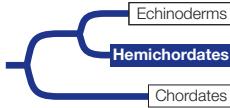
Hemichordates—acorn worms and pterobranchs—have a bilaterally symmetrical, wormlike body organized in three major parts: a proboscis, a collar (which bears the mouth), and a trunk (which contains the other body parts). The 90 known species of acorn worms range up to 2 meters long (Figure 31.6A). They live in burrows in muddy and sandy marine sediments. The digestive tract of an acorn worm consists of a mouth behind which are a muscular pharynx and an intestine. The pharynx opens to the outside through several pharyngeal slits through which water can exit. Highly vascularized tissue surrounding the pharyngeal slits serves as a gas exchange
(B)
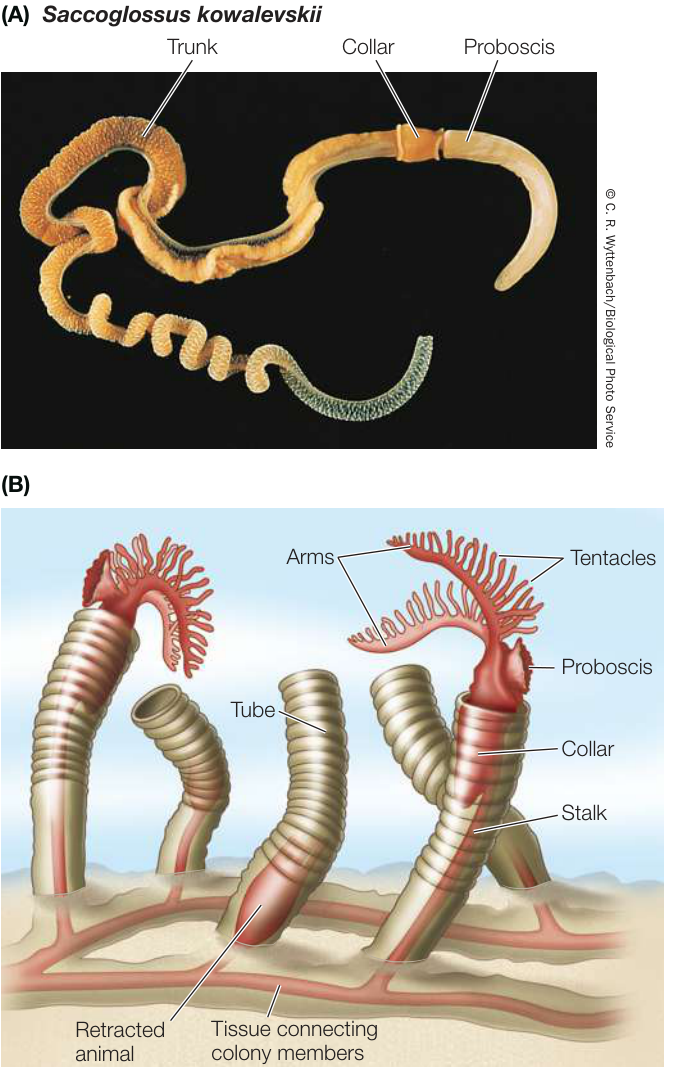
Figure 31.6 Hemichordates (A) The proboscis of an acorn worm is modified for burrowing. (B) Some pterobranch species form colonies.
apparatus. Acorn worms respire by pumping water into the mouth and out through the pharyngeal slits. They capture prey with the large proboscis, which is coated with sticky mucus to which small organisms in the sediment stick. The mucus and its attached prey are conveyed by cilia to the mouth. In the esophagus, the food-laden mucus is compacted into a ropelike mass that is moved through the digestive tract by ciliary action.
The 30 living species of pterobranchs are sedentary marine animals up to 12 millimeters long that live in a tube secreted by the proboscis. Some species are solitary; others form colonies of individuals joined together (Figure 31.6B). Behind the proboscis is a collar with anywhere from one to nine pairs of arms. The arms bear long tentacles that capture prey and function in gas exchange.
Recap and Assess
Adult echinoderms are characterized by pentaradial symmetry, an internal skeleton of calcified plates, and a unique water vascular system. Hemichordates have a bilaterally symmetrical body divided into three parts: proboscis, collar, and trunk. Both groups are restricted to marine environments.
- How does the body form of echinoderm larvae differ from that of echinoderm adults?
- Describe some of the ways that echinoderms use their tube feet to obtain food, and contrast this with the feeding mechanism of hemichordates.
Having described the deuterostome groups that are most distantly related to us, we next turn our attention to the unique features that evolved in the chordates, a clade dominated by the vertebrates.
More Than Half of Chordates Are Also Aquatic
Learning Objectives
- 31.3.1 Identify chordates and vertebrates, and distinguish them from other animals.
- 31.3.2 Compare and contrast hagfishes and lampreys, and explain why hagfishes are not considered vertebrates by all biologists.
- 31.3.3 Describe how changes in appendages, jaws, teeth, and swim bladders led to new foraging opportunities for vertebrates.
There are three principal chordate clades: the lancelets (also called cephalochordates), the tunicates (also called urochordates), and the vertebrates (see Figure 31.1). Like the echinoderms and hemichordates that we discussed in Key Concept 31.1, all lancelets and tunicates are marine. The earliest vertebrates also diversified in marine environments, and then moved into fresh waters. From there, the tetrapods (four-legged vertebrates and their descendants) invaded terrestrial environments. Today fishes make up a little more than half of vertebrate species. Note that we use the word “fishes” to refer to all the aquatic vertebrates that are not tetrapods. (Also note that the plural “fishes” is used to refer to multiple species of fishes, whereas the plural “fish” is used to refer to many individuals of the same species of fish.) Fishes are not a monophyletic group of vertebrates (some fishes are more closely related to tetrapods than they are to other groups of fishes), which is why we do not recognize fishes as a formal taxon.
As you have seen, it is not obvious from examining adult animals that echinoderms, hemichordates, and chordates share a common ancestor. The evolutionary relationships among some chordate groups are not immediately apparent either. The features that reveal all of these evolutionary relationships are seen primarily in the larvae—in other words, it is during the early developmental stages that these evolutionary relationships are evident. Adult chordates vary greatly in form, but all chordates display the following derived structures at some stage in their development (Figure 31.7):
- A dorsal hollow nerve cord
- A tail that extends beyond the anus
- A dorsal supporting rod, the notochord
The notochord is the most distinctive derived chordate trait. It is composed of a core of large cells with turgid fluid-filled vacuoles, which make it rigid but flexible. In the tunicates the notochord is lost during metamorphosis to the adult stage. In most vertebrate species it is replaced during development by skeletal structures that provide support for the body.
The pharyngeal slits found in the common ancestor of deuterostomes are present at some developmental stage in all chordates but are often lost or greatly modified in adults. In chordates, the pharyngeal slits are separated and supported by structural elements called pharyngeal arches. In tunicates and lancelets, the pharynx functions as a straining device to filter small food particles. In fishes and larval amphibians, some of the pharyngeal arches develop into gill arches, which support the respiratory gills and are often used as feeding structures as well. Developmentally, some pharyngeal arches also develop into elements of the vertebrate jaw, as well as parts of the tongue, larynx, trachea, and middle ear of tetrapods. Some of the pharyngeal slits are modified in tetrapods to form the eustachian tube and middle ear chamber.
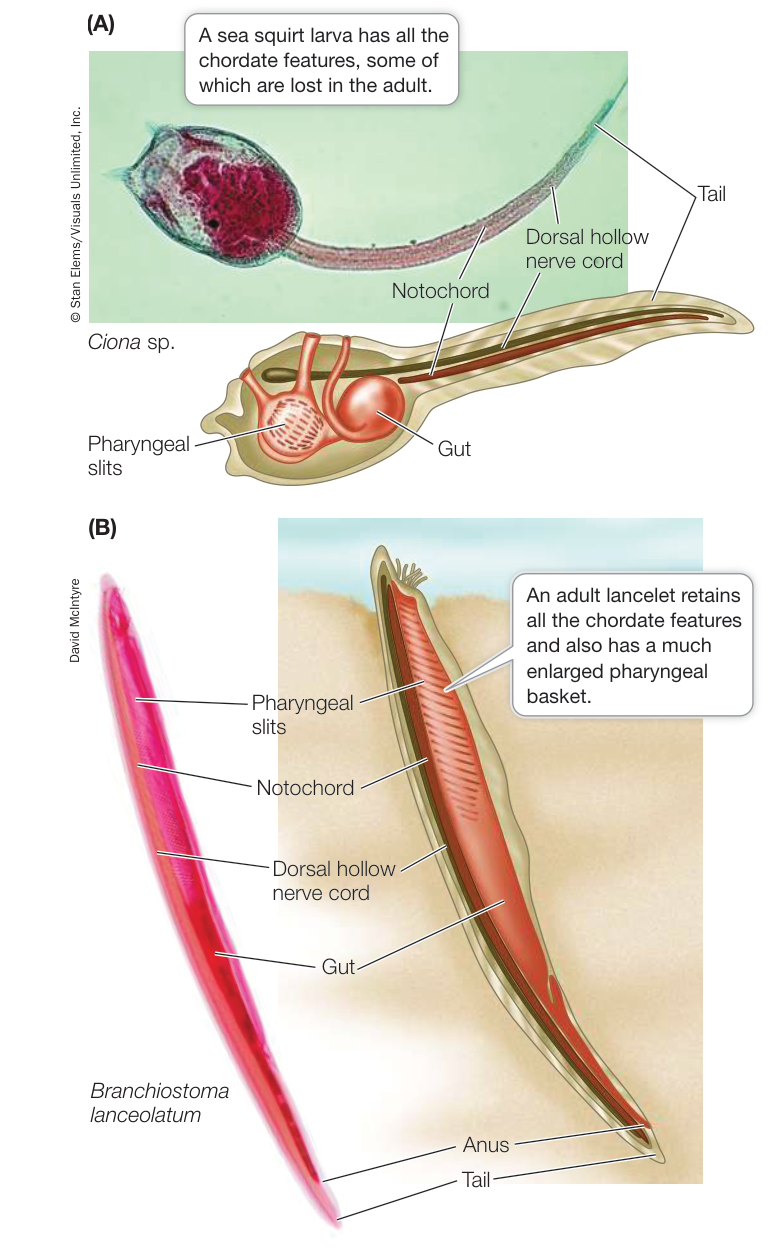
Figure 31.7 Key Features May Be Most Apparent in Early Development (A) The sea squirt larva (but not the adult) has all three key features of chordates: a dorsal hollow nerve cord, a post-anal tail, and a notochord. (B) All three chordate synapomorphies are retained in the adult lancelet.
Adults of most lancelets and tunicates are sessile
The 35 species of lancelets are small animals that rarely exceed 5 centimeters in length. The notochord, which provides body support, extends the entire length of the body throughout the animal’s life (see Figure 31.7B). Lancelets are found in shallow marine and brackish waters worldwide. Most of the time they lie covered in sand with their head protruding above the sediment, but they can swim. The pharynx has been enlarged and modified to form a structure called a pharyngeal basket, with which the lancelet filters prey from the water. During the reproductive season, the gonads of males and females enlarge greatly. At spawning, the walls of the gonads rupture, releasing eggs and sperm into the water column, where fertilization takes place.
All members of the three major tunicate groups—the sea squirts, thaliaceans, and larvaceans—are marine animals. More than 90% of the 2,800 known species of tunicates are sea squirts (also called ascidians). Individual sea squirts range in length from less than 1 millimeter to 60 centimeters. Some sea squirts form colonies by asexual budding from a single founder. Colonies may measure several meters across. The baglike body of an adult sea squirt is enclosed in a tough tunic, which is the basis for the name “tunicate” (Figure 31.8A). The tunic is composed of proteins and a complex polysaccharide secreted by epidermal cells. The sea squirt pharynx is enlarged into a pharyngeal basket that filters prey from the water passing through it.
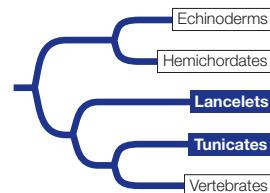
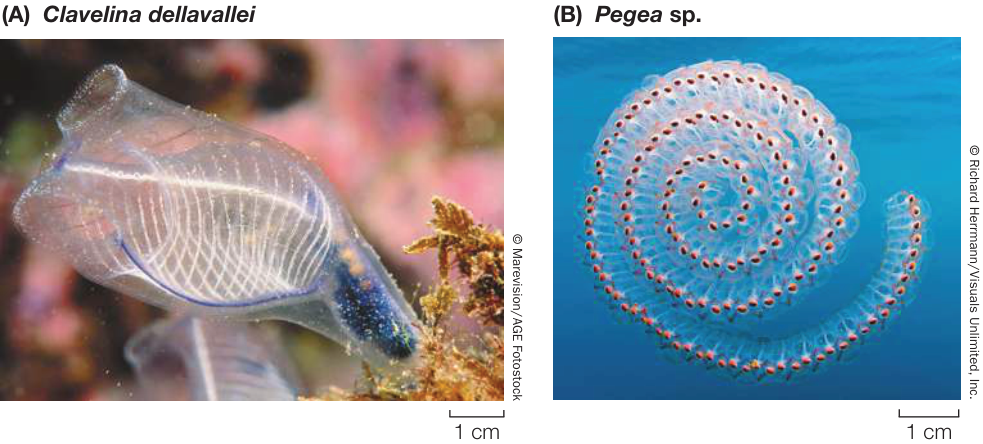
Figure 31.8 Adult Tunicates (A) The transparent tunic and the pharyngeal basket are clearly visible in this sea squirt. (B) A chainlike colony of thaliaceans (salps) floats in tropical waters.
In addition to its pharyngeal slits, a sea squirt larva has a dorsal hollow nerve cord and a notochord that is restricted mostly to the tail region (see Figure 31.7A). Bands of muscle surround the notochord, which provide support for the body. After a short time swimming in the plankton, the larvae of most species settle on the seafloor and transform into sessile adults. The swimming, tadpolelike larvae suggest a close evolutionary relationship between tunicates and vertebrates (see Figure 20.6).
Thaliaceans (salps and their relatives) are tunicates that can live singly or in chainlike colonies up to several meters long (Figure 31.8B). They float in tropical and subtropical oceans at depths down to 1,500 meters. Larvaceans are solitary planktonic animals that retain the notochord and dorsal hollow nerve cord throughout their lives. Most larvaceans are less than 5 millimeters long, but some species that live near the bottom of deep ocean waters build delicate casings of mucus that may be more than a meter wide. They snare sinking organic particles (their primary food source) with elaborate filters built into their mucus “houses.” When the old “house” gets clogged with excess debris, the animal builds a new one.
A dorsal supporting structure replaces the notochord in vertebrates
In one chordate group, the vertebrates, a new dorsal supporting structure evolved. This group takes its name from the jointed, dorsal vertebral column that typically replaces the notochord during early development as the primary supporting structure. The individual elements in the vertebral column are called vertebrae. Four other key features characterize the vertebrates as well (Figure 31.9):
- An anterior skull enclosing a large brain
- A rigid internal skeleton supported by the vertebral column
- Internal organs suspended in a coelom
- A well-developed circulatory system, driven by contractions of a ventral heart
These structural features can support large, active animals. The internal skeleton provides support for an extensive muscular system, which receives oxygen from the circulatory system and is controlled by the central nervous system. The evolution of these features allowed many vertebrates to become large, active predators, which in turn allowed the vertebrates to diversify widely (Figure 31.10).
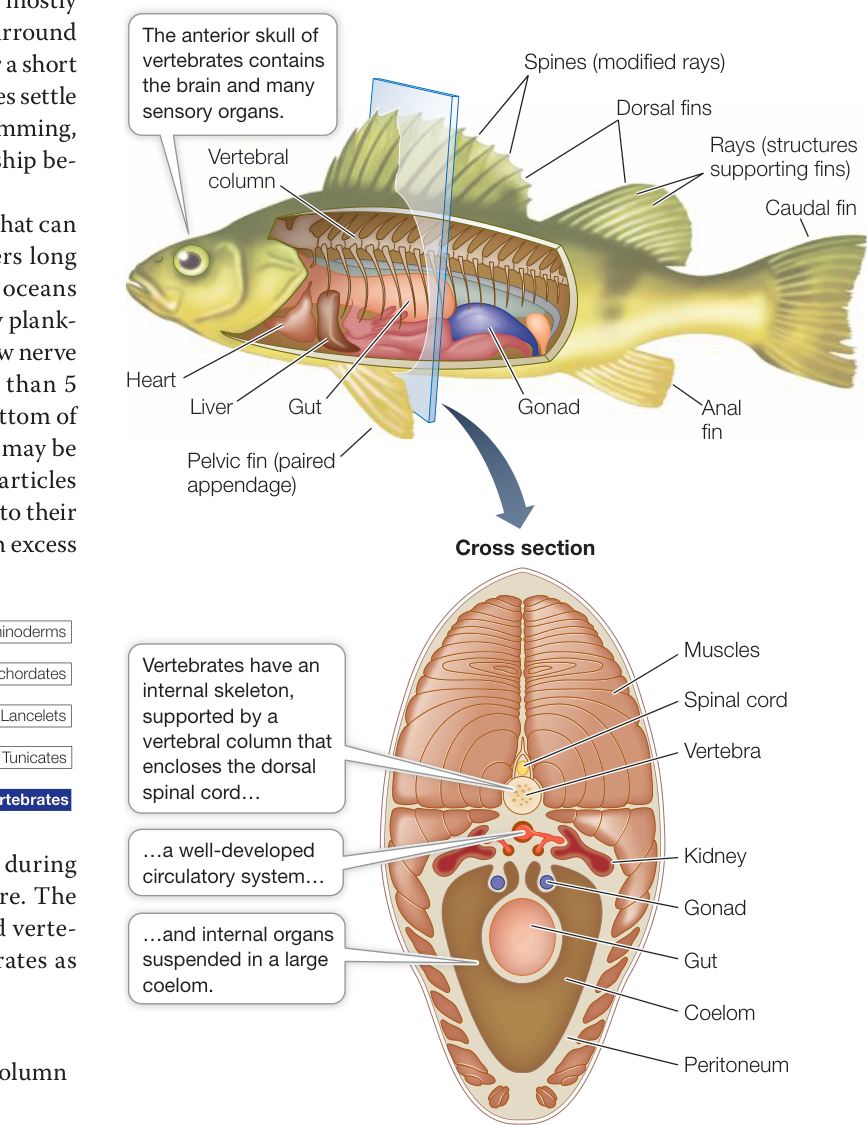
Figure 31.9 The Vertebrate Body Plan A ray-finned fish is used here to illustrate some of the structural elements common to all vertebrates. In addition to the paired pelvic fins, these fishes have paired pectoral fins on the sides of the body (not seen in this cutaway view).
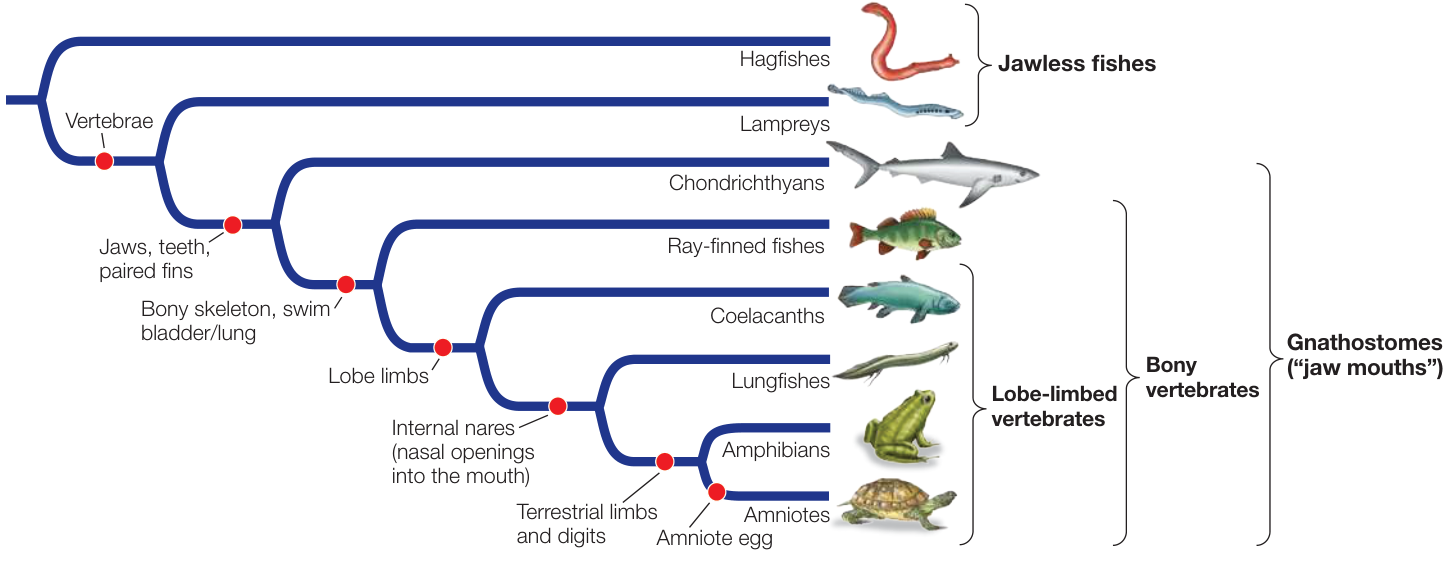
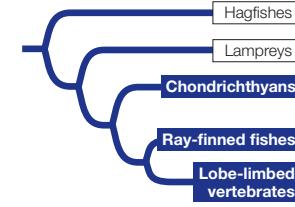
Figure 31.10 Phylogeny of the Living Vertebrates This phylogenetic tree shows the evolution of some of the key innovations among the major groups of vertebrates. Note that several recent analyses favor a closer relationship of hagfishes to lampreys (which together form the taxon cyclostomes). If the cyclostomes are a monophyletic group, then hagfishes may have secondarily lost some distinctive features of the other vertebrates, including vertebrae.
All of the nonvertebrate deuterostomes live in marine environments. The lineage that led to the vertebrates is also thought to have evolved in the oceans, although probably in an estuarine environment (where fresh water meets salt water). The first vertebrates appeared in the Cambrian; since then they have radiated into marine, freshwater, terrestrial, and aerial environments worldwide. There are about 71,000 species of living vertebrates.
The phylogenetic relationships of jawless fishes are uncertain
The hagfishes are thought by some biologists to be the sister group of the remaining vertebrates (see Figure 31.10). Hagfishes (Figure 31.11A)
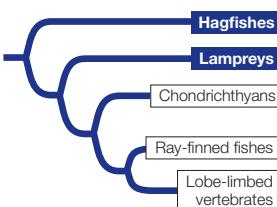
have a weak circulatory system with three small accessory hearts (rather than a single, large heart); a partial cranium, or skull (containing a brain with no cerebrum or cerebellum, two main regions that characterize the brains of other vertebrates); and no jaws or stomach. They also lack separate, jointed vertebrae and have a skeleton composed of a firm but pliable material called cartilage. Thus some biologists do not consider hagfishes to be vertebrates and instead use the term “craniates” to refer collectively to the hagfishes and the vertebrates. Recent analyses of gene sequences and recently discovered fossils suggest, however, that hagfishes may be the sister group of the lampreys (Figure 31.11B); in this phylogenetic arrangement, the hagfishes and the lampreys are collectively called the cyclostomes (“circle mouths”). If in fact the hagfishes and lampreys do form a monophyletic group, then hagfishes must have secondarily lost many of the major vertebrate morphological features during their evolution.
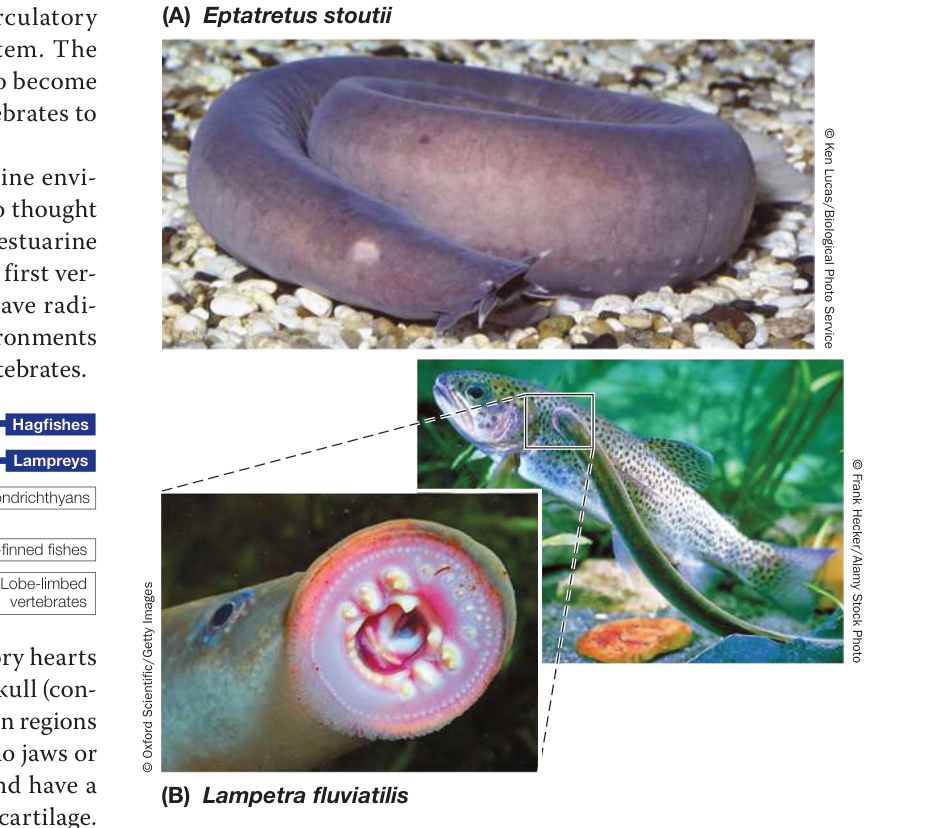
Figure 31.11 Modern Jawless Fishes (A) Hagfishes burrow in the ocean mud, from which they extract small prey. They also scavenge on dead or dying fishes. Hagfishes have degenerate eyes, which has led to their being called (inaccurately) “blind eels.” (B) Many species of lampreys are ectoparasites that attach to the bodies of living fishes and use their large, jawless mouth to suck blood and flesh. This species lives in freshwater rivers, but some lampreys can live in marine environments.
The 80 known species of hagfishes are unusual marine animals that produce copious quantities of mucus as a defense. They are virtually blind and rely largely on the four pairs of sensory tentacles around the mouth to detect food. Although they have no jaws, hagfishes have a tonguelike structure equipped with tooth-like rasps that they use to tear apart dead organisms and to capture their principal prey, polychaete worms. Hagfishes have direct development (no larvae), and individuals may actually change sex from year to year (from male to female and vice versa).
Although the lampreys and hagfishes may look superficially similar (with elongated eel-like bodies and no paired fins), they differ greatly in their biology. Lampreys have a complete skull and distinct and separate (although rudimentary) vertebrae, all cartilaginous rather than bony. Lampreys undergo a complete metamorphosis from filter-feeding larvae, known as ammocoetes, which are morphologically similar to adult lancelets. The adults of many species of lampreys are parasitic, although several lineages of lampreys evolved to become nonfeeding as adults. These nonfeeding adults survive for only a few weeks after metamorphosis—just long enough to breed. In the species that are parasitic as adults, the round mouth is a rasping and sucking organ that is used to attach to prey and rasp at the flesh (see Figure 31.11B).
The nearly 50 species of lampreys either live permanently in fresh water or are anadromous—meaning they live in coastal salt water and move into fresh water to breed. Some species of lampreys are critically endangered because of recent habitat changes and losses.
Jaws and teeth improved feeding efficiency
Many kinds of jawless fishes were found in the seas, estuaries, and fresh waters of the Devonian, but hagfishes and lampreys are the only jawless fishes that survived beyond the Devonian. Late in the Ordovician, some fishes evolved jaws via modifications of the skeletal arches that supported the gills (Figure 31.12A). Those fishes and their descendants are referred to as gnathostomes (Greek, “jaw mouths”). Jaws greatly improved feeding efficiency, as an animal with jaws can grasp, subdue, and swallow large prey. Jawed fishes rapidly diversified during the Devonian, eventually replacing the jawless fishes in dominance of the seas.
The earliest jaws were simple, but the evolution of teeth made feeding even more efficient (Figure 31.12B). In predators, teeth function crucially both in grasping and in breaking up prey. In both predators and herbivores, teeth enable an animal to chew both soft and hard body parts of their food organisms. Chewing also aids chemical digestion and improves an animal’s ability to extract nutrients from its food. Vertebrates are remarkable in the diversity of their jaws and teeth, and in their physiological adaptations for digestion of a wide variety of food items.
Connect the Concepts The many physiological adaptations of vertebrates for digesting plants and animals are described in detail in Chapter 49.
Fins and swim bladders improved stability and control over locomotion
Most jawed fishes have a pair of pectoral fins just behind the gill slits and a pair of pelvic fins anterior to the anus (see Figures 31.9 and 31.13A). These paired fins stabilize the fish’s position in water
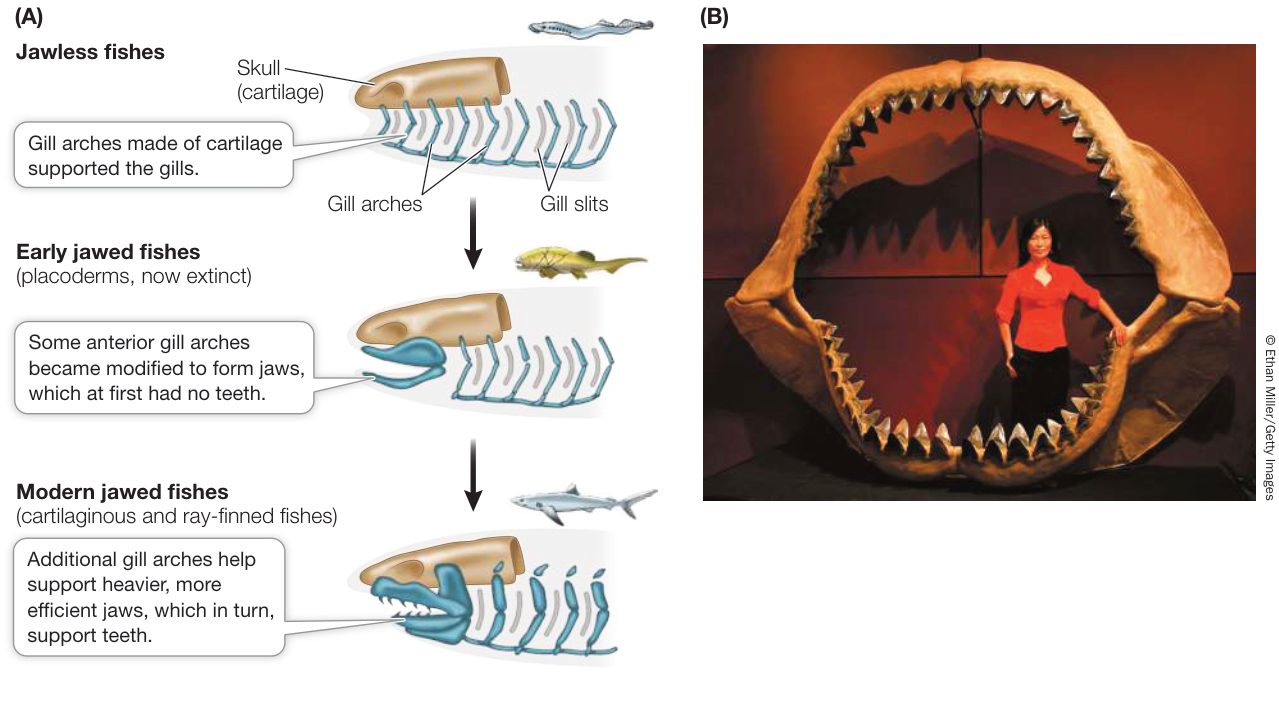
Figure 31.12 Jaws and Teeth Increased Feeding Efficiency (A) These diagrams illustrate one probable scenario for the evolution of jaws from the anterior gill arches of jawless fishes. (B) Jaws of the extinct giant shark Carcharodon megalodon display the teeth that indicate an extreme predatory lifestyle.
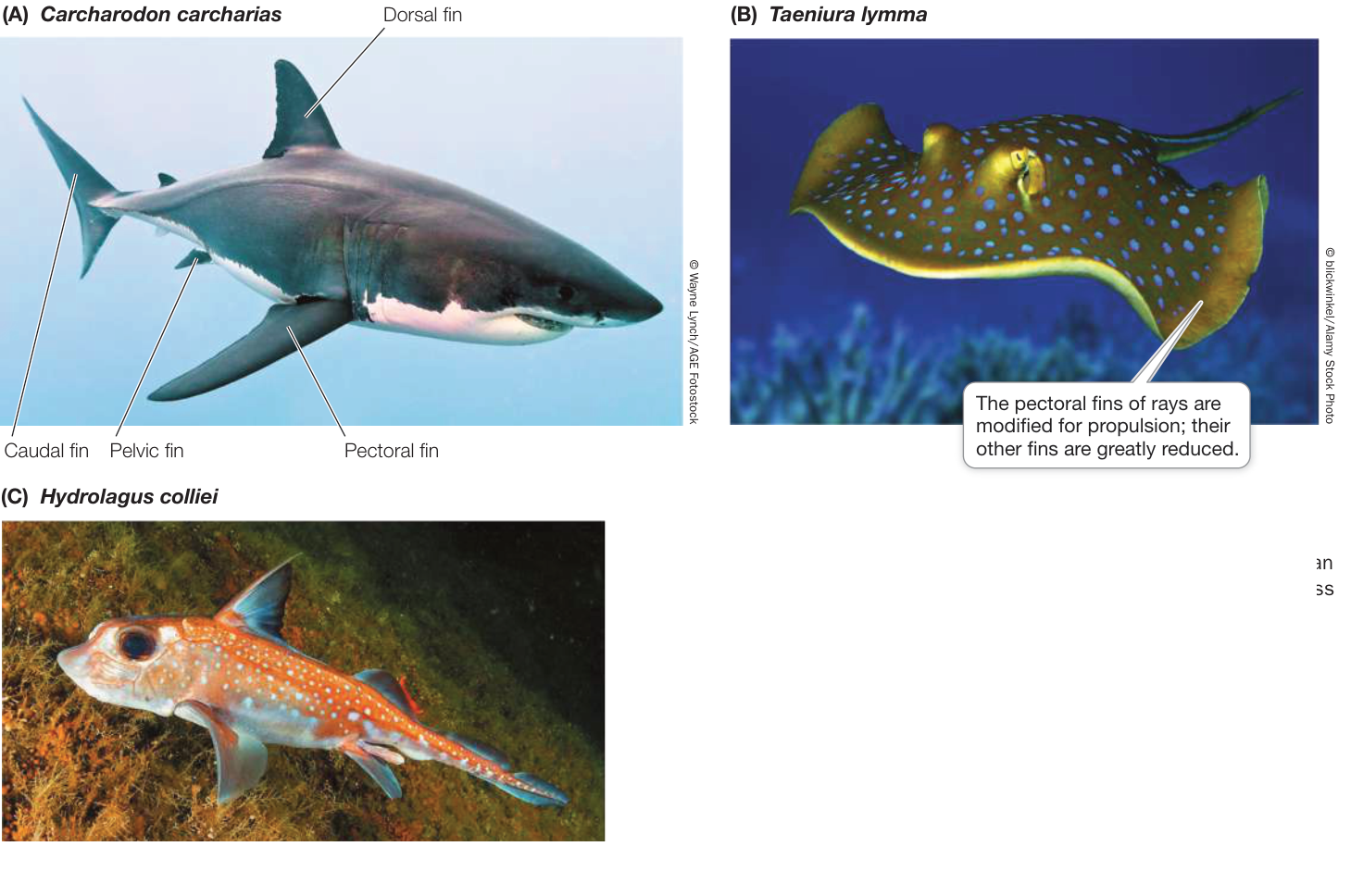
Figure 31.13 Chondrichthyans (A) Most sharks are active marine predators, as epitoxized by the great white shark seen here. (B) Skates and rays, represented here by a blue spotted fantail ray, feed on the ocean bottom. (C) A chimaera, or ratfish. Many of these deep-sea fishes possess modified dorsal fins that contain toxins.
(and in some cases, help propel it). Median dorsal and anal fins also stabilize the fish, or may be used for propulsion in some species. In many fishes, the caudal (tail) fin helps propel the animal and enables it to turn rapidly.
Several groups of jawed fishes became abundant during the Devonian. Among them were the chondrichthyans—sharks, skates, and rays (about 1,000 living species) and chimaeras (40 living species). Like hagfishes and lampreys, these fishes have a skeleton composed entirely of cartilage. Their skin is flexible and leathery, sometimes bearing scales that give it the consistency of sandpaper. Sharks move forward by means of lateral (side-to-side) undulations of the body and caudal fin (Figure 31.13A). Skates and rays propel themselves by means of vertical undulating movements of their greatly enlarged pectoral fins (Figure 31.13B).
Most sharks are predators, but some feed by straining plankton from the water. Most skates and rays live on the ocean floor, where they feed on mollusks and other animals buried in the sediments. Nearly all chondrichthyans live in the oceans, but a few are estuarine or migrate into lakes and rivers. One group of rays is found in river systems of South America. The less familiar chimaeras (Figure 31.13C) live in deep-sea or cold waters.
One lineage of aquatic gnathostomes gave rise to the bony vertebrates, which soon split into two main lineages—the ray-finned fishes and the lobe-limbed vertebrates. Bony vertebrates have internal skeletons of calcified, rigid bone rather than flexible cartilage. In early bony vertebrates, gas-filled sacs supplemented the gas exchange function of the gills by giving the animals access to atmospheric oxygen. These features enabled these fishes to live where oxygen was periodically in short supply, as it often is in freshwater environments. In the ray-finned fishes, these lunglike sacs evolved into swim bladders, which are organs of buoyancy. By adjusting the amount of gas in its swim bladder, a ray-finned fish can control the depth at which it remains suspended in the water while expending very little energy to maintain its position.
The outer body surface of most species of ray-finned fishes is covered with thin, flat, lightweight scales that provide protection or enhance movement through the water. The gills open into a single chamber covered by a hard flap, called an operculum. Movement of the operculum increases the flow of water over the gills, where gas exchange takes place.
Ray-finned fishes began to diversify during the Mesozoic and continued to radiate extensively throughout the Paleogene and Neogene. Today there are about 35,000 known living species, encompassing a remarkable variety of sizes, shapes, and lifestyles (Figure 31.14). The smallest are less than 1 centimeter long; the largest weigh as much as 900 kilograms. Ray-finned fishes exploit nearly all types of aquatic food sources. In the oceans they filter plankton from the water, rasp algae from rocks, eat corals and other soft-bodied colonial animals, dig animals from soft sediments, and prey on virtually all kinds of other fishes. In fresh water they eat plankton, devour insects, eat fruits that fall into the water, and prey on other aquatic vertebrates and, occasionally, terrestrial vertebrates. Many ray-finned fishes are solitary, but in open water others form large aggregations called schools. Many species perform complicated behaviors to maintain schools, build nests, court mates, and care for their young.
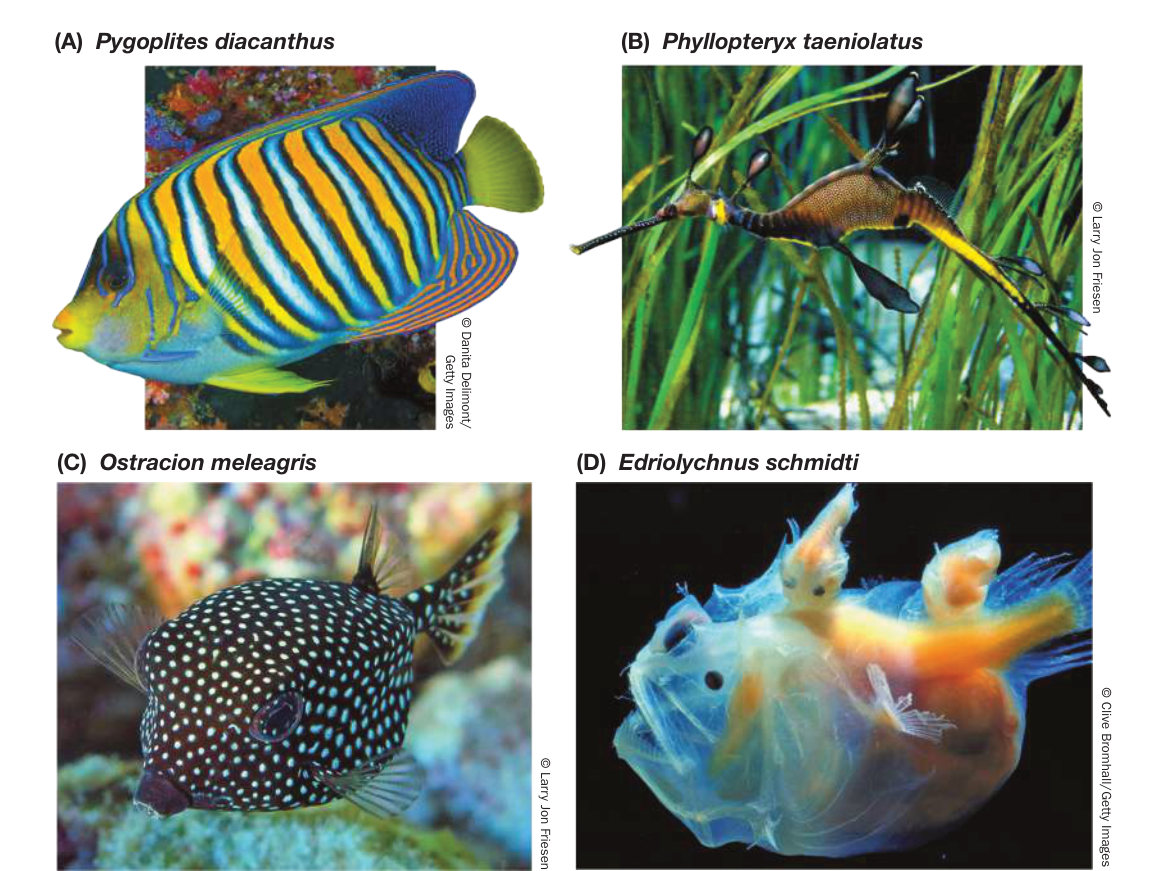
Figure 31.14 Diversity among the Ray-Finned Fishes (A) The brightly colored regal angelfish lives around Indo-Pacific coral reefs. Its deep, laterally compressed body and enlarged dorsal and anal fins increase its apparent size. (B) This slow-moving weedy seadragon relies on its highly modified body and fins to provide camouflage in swaying seaweed. (C) This spotted boxfish is a member of another large ray-fin clade, the serranids, which also includes the sea basses and groupers. (D) Deep-sea angler-fishes live below the level of light penetration. The large fish shown here is a female; the two smaller fish are males, which fuse to the female for life.
Although ray-finned fishes can readily control their position in open water using their fins and swim bladder, their eggs tend to sink. Some species produce small eggs that are buoyant enough to complete their development in open water, but many marine fishes move to food-rich shallow waters to lay their eggs. That is why coastal waters and estuaries are so important in the life cycles of many marine fishes. Some ray-finned fishes, such as salmon, are anadromous, moving from the ocean to the fresh waters in which they breed.
Recap and Assess
Chordates are characterized by a dorsal hollow nerve chord, a post-anal tail, and a dorsal supporting rod called a notochord at some point during the life cycle. Specialized structures for support (a vertebral column), locomotion (such as fins), and feeding (jaws and teeth) evolved among aquatic vertebrates.
- Describe the synapomorphies that characterize the chordates and the vertebrates, respectively.
- How do the hagfishes differ from the lampreys in morphology? Why do some biologists contend that hagfishes are not vertebrates?
- The body plan of most vertebrates is based on four appendages. What are the varied forms that these appendages take, and how are they used? In which lineages have two or more of these appendages been lost?
In the lobe-limbed vertebrates, the gas-filled sacs that gave rise to swim bladders in ray-finned fishes became specialized for another purpose: breathing air. That adaptation set the stage for the vertebrates to move onto the land.
31.4 Tetrapods Diversified Rapidly in Terrestrial Environments
Learning Objectives
- 31.4.1 Explain how features of amphibians can make them especially vulnerable to environmental change.
- 31.4.2 Summarize the evidence for the phylogenetic position of birds among the reptiles.
- 31.4.3 Describe how a mass extinction affected the diversification of mammals.
- 31.4.4 Trace the evolution of endothermy, hair, and feathers across the phylogeny of amniotes.
The evolution of lunglike sacs in fishes set the stage for the vertebrate invasion of the land. Some early ray-finned fishes probably used those sacs to supplement their gills when oxygen levels in the water were low, as many groups of ray-finned fishes do today. But with their unjointed fins, those fishes could only flop around when out of water. Changes in the structure of the fins first allowed lobe-limbed vertebrates to support themselves better in shallow water, and later to move better on land.
Tetrapods Diversified Rapidly in Terrestrial Environments
Jointed limbs enhanced support and locomotion on land
In the lobe-limbed vertebrates, the paired pelvic and pectoral fins developed into more muscular fins that were joined to the body by a single enlarged bone. The modern representatives of these lobe-limbed vertebrates include the coelacanths, lungfishes, and tetrapods.
The coelacanths flourished from the Devonian until about 65 million years ago, when they were thought to have become extinct. However, in 1938 a commercial fisherman caught a living coelacanth off South Africa. Since that time, hundreds of individuals of this extraordinary fish, Latimeria chalumnae, have been collected (Figure 31.15A). A second species, L. menadoensis, was discovered in 1998 off the Indonesian island of Sulawesi. Latimeria, a predator of other fishes, reaches a length of about 1.8 meters and weighs up to 82 kilograms. Its skeleton is composed mostly of cartilage, not bone. The cartilaginous skeleton is a derived feature in this clade because it had bony ancestors.
Lungfishes were important predators in shallow-water habitats in the Devonian, but most lineages died out. The six surviving species live in stagnant swamps and muddy waters in South America, Africa, and Australia (Figure 31.15B). Lungfishes have lungs derived from the lunglike sacs of their ancestors as well as gills. When ponds dry up, individuals of most species can burrow deep into the mud and survive for many months in an inactive state while breathing air.
It is believed that some early aquatic lobe-limbed vertebrates began to use terrestrial food sources, became more fully adapted to life on land, and eventually evolved to become ancestral tetrapods (“four legs”). How was this transition from an animal that swam in water to one that walked on land accomplished? Early in 2006, scientists reported the discovery of a Devonian fossil lobe-limbed vertebrate, since then named Tiktaalik, which possessed appendages intermediate between the fins of fishes and the limbs of terrestrial tetrapods (Figure 31.15C). It appears that limbs capable of propping up a large fish and making the front-to-rear movements necessary for walking evolved while these animals still lived in water. These limbs appear to have functioned in holding the animals upright in shallow water, perhaps even allowing them to hold their head above the water’s surface. These same structures were then co-opted for movement on land, at first probably for foraging on brief trips out of water.
Among the lobe-limbed vertebrates, limbs capable of movement on land evolved from the short, muscular fins of aquatic ancestors (Figure 31.16). The resulting four terrestrial limbs give the tetrapods their name. The basic skeletal elements of those limbs can be traced through major changes in limb form and function among the terrestrial vertebrates.
An early split in the tetrapod tree (see Figure 31.10) led to two main groups of terrestrial vertebrates: amphibians, most of which remained tied to moist environments, and the amniotes, many of which adapted to much drier conditions.
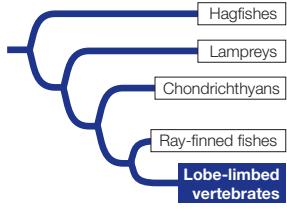
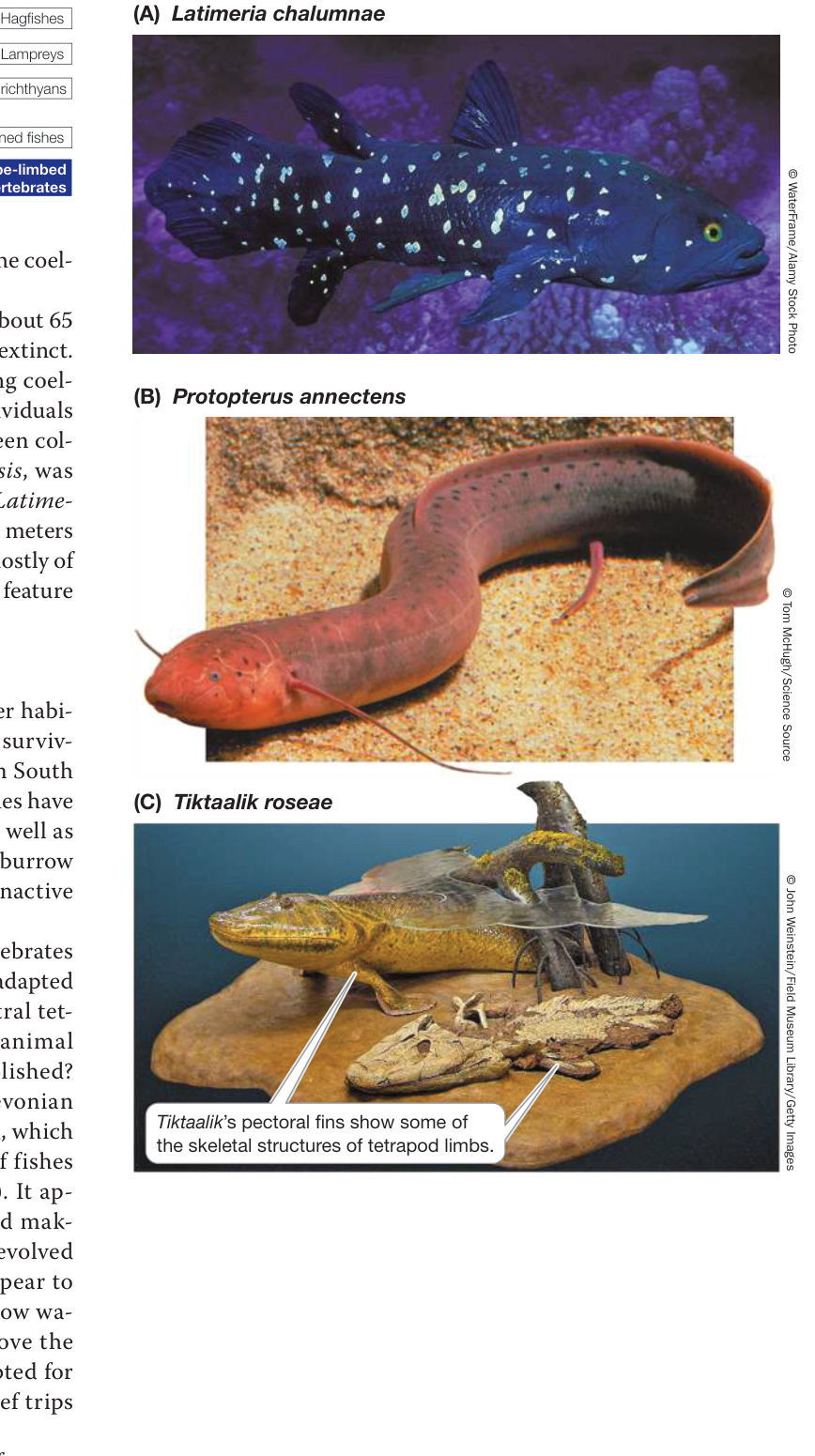
Figure 31.15 The Closest Relatives of Tetrapods (A) The African coelacanth, discovered in deep waters of the Indian Ocean off the coast of South Africa, represents one of two surviving species of a group that was once thought to be extinct. (B) All surviving lungfish species, such as this African lungfish, live in the Southern Hemisphere. (C) Tiktaalik, a fossil lobe-limbed vertebrate from the Devonian, is believed to represent a transitional species intermediate between the finned fishes and the limbed tetrapods.
Amphibians adapted to life on land
Most modern amphibians are confined to moist environments because they lose water rapidly through the skin when exposed to dry air. In addition, their eggs are enclosed within delicate gelatinous envelopes that cannot prevent water loss in dry conditions. In some amphibian species, adults live mostly on land but return to fresh water to lay and fertilize their eggs (Figure 31.17). The fertilized eggs give rise to larvae that live in water until they undergo metamorphosis to become terrestrial adults. However, many amphibians (especially those in tropical and subtropical areas) have evolved a wide variety of additional reproductive modes and types of parental care. Internal fertilization, for example, evolved several times among amphibian species. Many species develop directly into adultlike forms from fertilized eggs laid on land or carried by the parents. Other species of amphibians are entirely aquatic, never leaving the water at any stage of their lives, and many of these species retain a larval-like morphology.
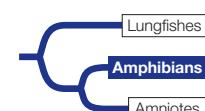
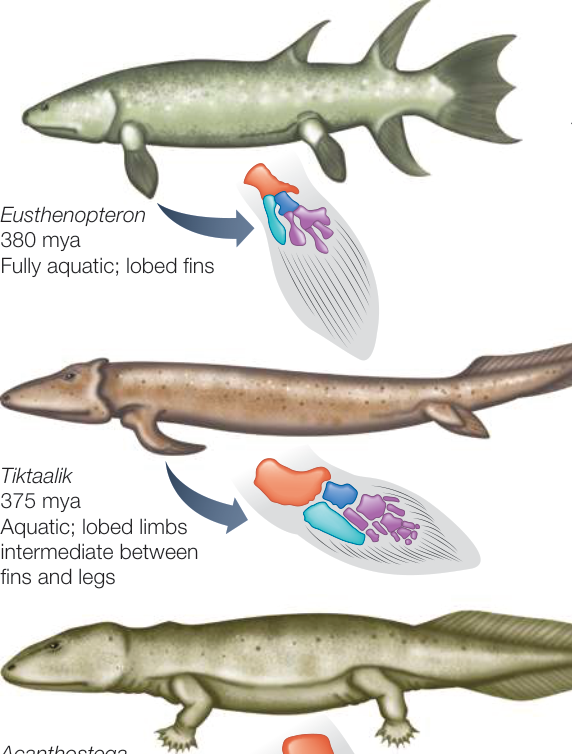
Figure 31.16 Tetrapod Limbs Are Modified Fins The major skeletal elements of the tetrapod limb were already present in aquatic lobe-limbed fishes some 380 million years ago (mya). The relative sizes and positions of these elements changed as lobe-limbed vertebrates moved to a terrestrial environment, where limbs were needed to support and move the animal’s body on land. (After I. Schneider and N. H. Shubin. 2013. Trends Genet 29: 419–426; M. C. Davis. 2013. Integr Comp Biol 53: 224–232.)
The more than 8,000 known species of amphibians living today belong to three major groups: the wormlike, limbless, tropical, burrowing, or aquatic caecilians (Figure 31.18A), the tail-less frogs and toads (collectively called anurans) (Figure 31.18B), and the tailed salamanders (Figure 31.18C,D).
Anurans are most diverse in wet tropical and warm temperate regions, although a few are found at very high latitudes. There are far more anurans than any other amphibians, with well over 7,000 described species and more being discovered every year. Some anurans have tough skins and other adaptations that enable them to live for long periods in deserts, whereas others live in moist terrestrial and arboreal environments. Some species are completely aquatic as adults. All anurans have a short vertebral column and a pelvic region that is modified for leaping, hopping, or propelling the body through water by kicking the hind legs.
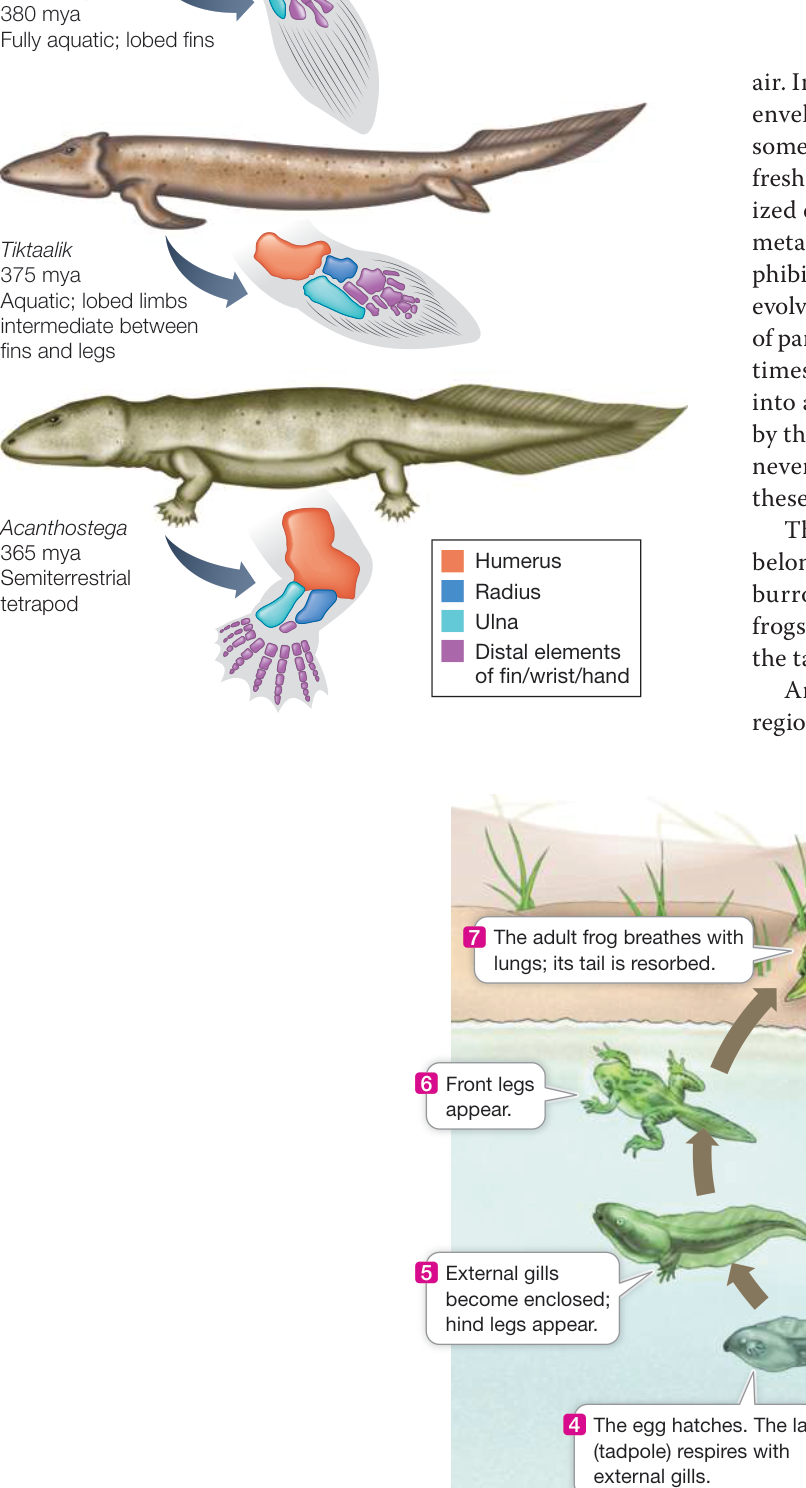
Figure 31.17 In and Out of the Water Many amphibian species have life cycles like the one diagrammed here, in which the early stages take place in water and the aquatic tadpole transforms into a terrestrial adult through metamorphosis. Some species of amphibians, however, have direct development (with no aquatic larval stage), and others are aquatic throughout life. Q: What is a potential advantage of maintaining an aquatic tadpole stage, even though the adults are terrestrial? Animation 31.2 Life Cycle of a Frog
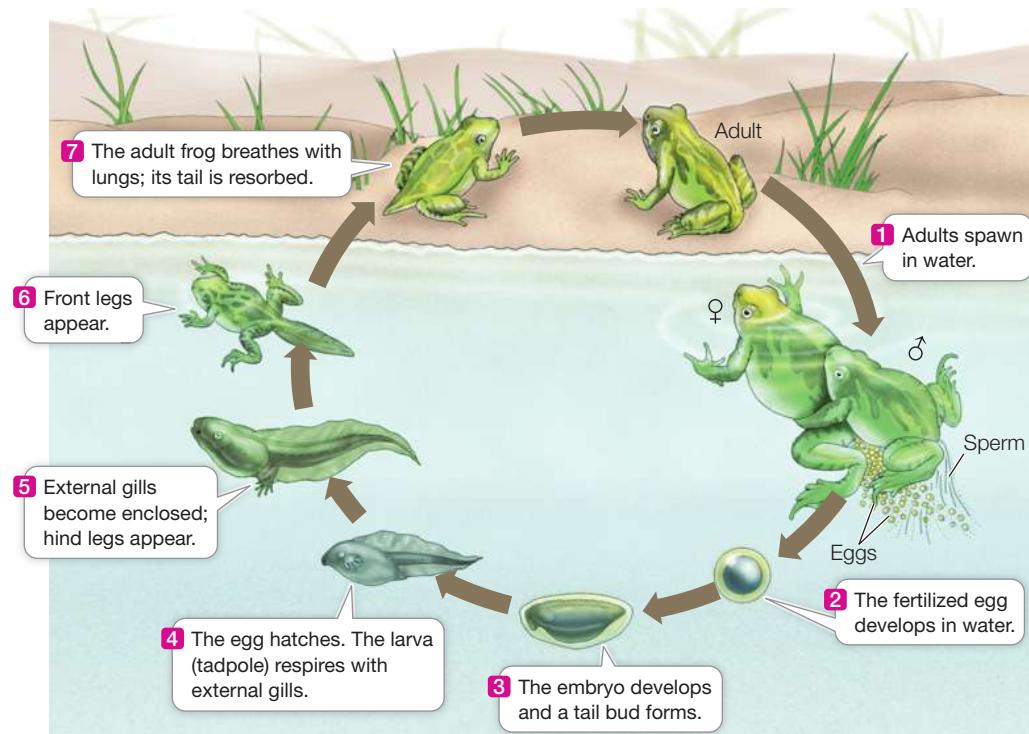
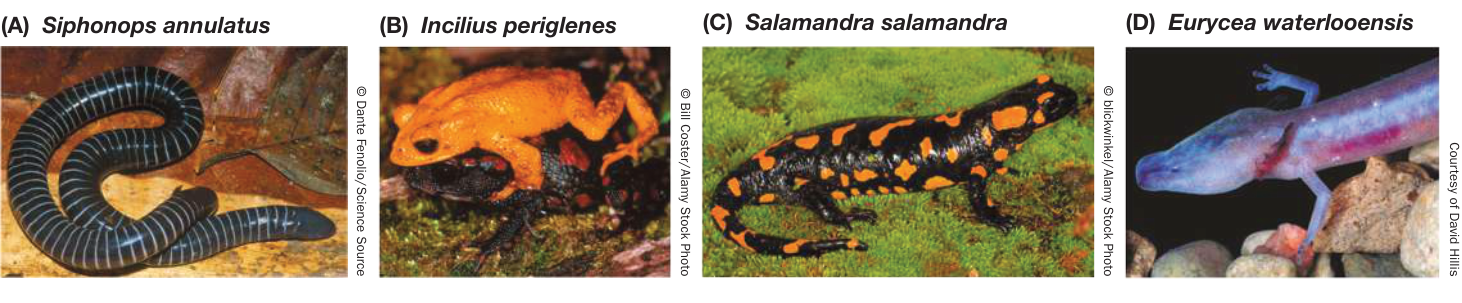
Figure 31.18 Diversity among the Amphibians (A) Burrowing caecilians superficially look more like worms than like amphibians. They have internal fertilization, and many species are viviparous. (B) A golden toad pair in Costa Rica; the male is on top. This is one of many amphibian species that has been lost to extinction in the past few decades. (C) A European fire salamander. (D) This Austin blind salamander’s life cycle is completely aquatic; it has no terrestrial stage. The eyes of this cave dweller are greatly reduced.
The more than 700 described species of salamanders are most diverse in temperate regions of the Northern Hemisphere and in cool, moist environments in the mountains of Central America, although a few species penetrate into tropical regions. Many salamanders live in rotting logs or moist soil. One major group has lost the lungs, and these species exchange gases entirely through the skin and mouth lining—body parts that all amphibians use, in addition to their lungs, for gas exchange. A completely aquatic lifestyle has evolved several times among the salamanders (see Figure 31.18D). These aquatic species have arisen through a developmental process known as neoteny, or the retention of juvenile traits (in this case, gills) by delayed somatic development. Most species of salamanders have internal fertilization, which is usually achieved through the transfer of a small, jellylike, sperm-embedded capsule called a spermatophore.
Many amphibians have complex social behaviors. Most male anurans utter loud, species-specific calls to attract females of their own species (and sometimes to defend breeding territories), and they compete for access to females that arrive at the breeding sites. Many amphibians lay large numbers of eggs, which they abandon once they are deposited and fertilized. Other amphibians lay only a few eggs, which are fertilized and then cared for. A few species of frogs, salamanders, and caecilians are viviparous, meaning they give birth to well-developed young that have received nutrition from the female during gestation.
Amphibians are the focus of much attention today because populations of many species are declining rapidly, especially in mountainous regions of western North America, Central and South America, and northeastern Australia. Worldwide, about one-third of amphibian species are now threatened with extinction or have disappeared completely in the last few decades. Scientists are investigating several hypotheses to account for these amphibian declines.
Connect the Concepts One of the major factors associated with amphibian declines is the global spread of a pathogenic chytrid fungus, as discussed in Key Concept 28.2.
Amniotes colonized dry environments
Several key innovations for conserving water contributed to the ability of the amniotes to exploit a wide range of terrestrial habitats. The amniote egg (which gives the group its name) is relatively impermeable to water and allows the embryo to develop in a contained aqueous environment (Figure 31.19A). Its leathery or brittle, calcium-impregnated shell retards evaporation of the fluids inside but permits passage of oxygen and carbon dioxide. The amniote egg also stores large quantities of food in the form of yolk, allowing the embryo to attain a relatively advanced state of development before it hatches. Within the shell are extraembryonic membranes that protect the embryo from desiccation and assist it with gas exchange and excretion of nitrogenous waste products of metabolism.
As we described in the opening of this chapter, modifications of the amniote egg in several different groups of amniotes allowed the embryo to develop inside (and exchange nutrients and wastes with) its mother’s body (Figure 31.19B). For example, in most mammals the egg lost its shell entirely while the functions of the extraembryonic membranes were retained and expanded, giving rise to viviparity. Viviparity appears to have evolved many times among lizards and snakes. In Investigating Life: Have Shelled Eggs Re-Evolved among Viviparous Reptile Lineages?, we explore the possibility that shelled eggs may have re-evolved in some lizards and snakes.
Other innovations evolved in the organs of terrestrial adults. A tough, impermeable skin, covered with scales or modifications of scales such as hair or feathers, greatly reduced water loss. Adaptations of the kidneys (the vertebrate excretory organs) allowed amniotes to excrete concentrated urine, ridding the body of nitrogenous wastes without losing a large amount of water in the process (see Chapter 50).
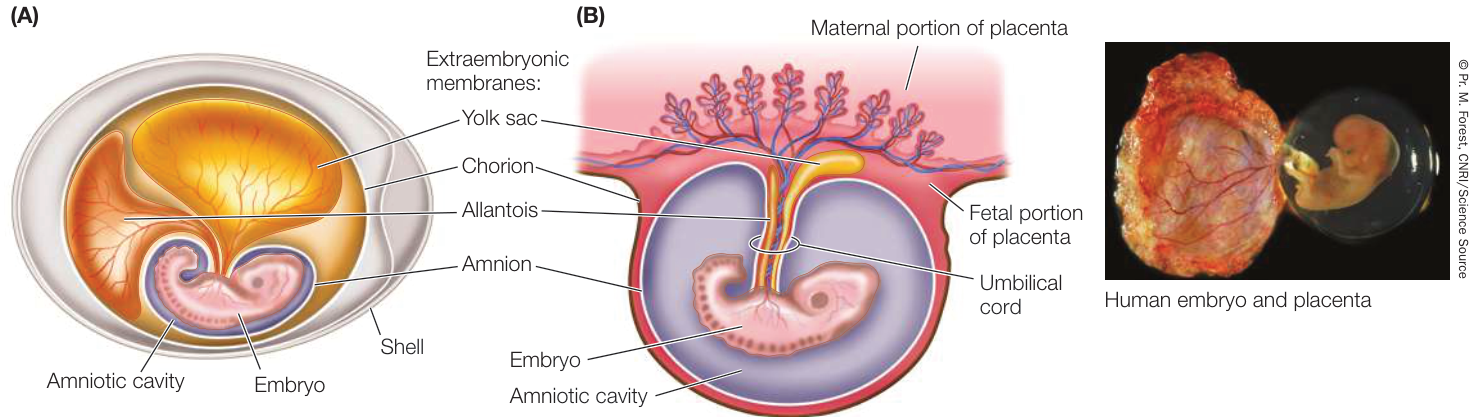
Figure 31.19 The Amniote Egg (A) The evolution of the amniote egg, with its water-retaining shell, four extraembryonic membranes, and embryo-nourishing yolk, was a major step in adaptation to the terrestrial environment. A chicken egg is shown here. (B) In most mammals, the developing embryo is retained inside the mother’s body, with which the embryo exchanges nutrients and wastes via the placenta.
Q: How were the various membranes in the amniote egg modified in mammals to support viviparity?
Activity 31.2 The Amniote Egg
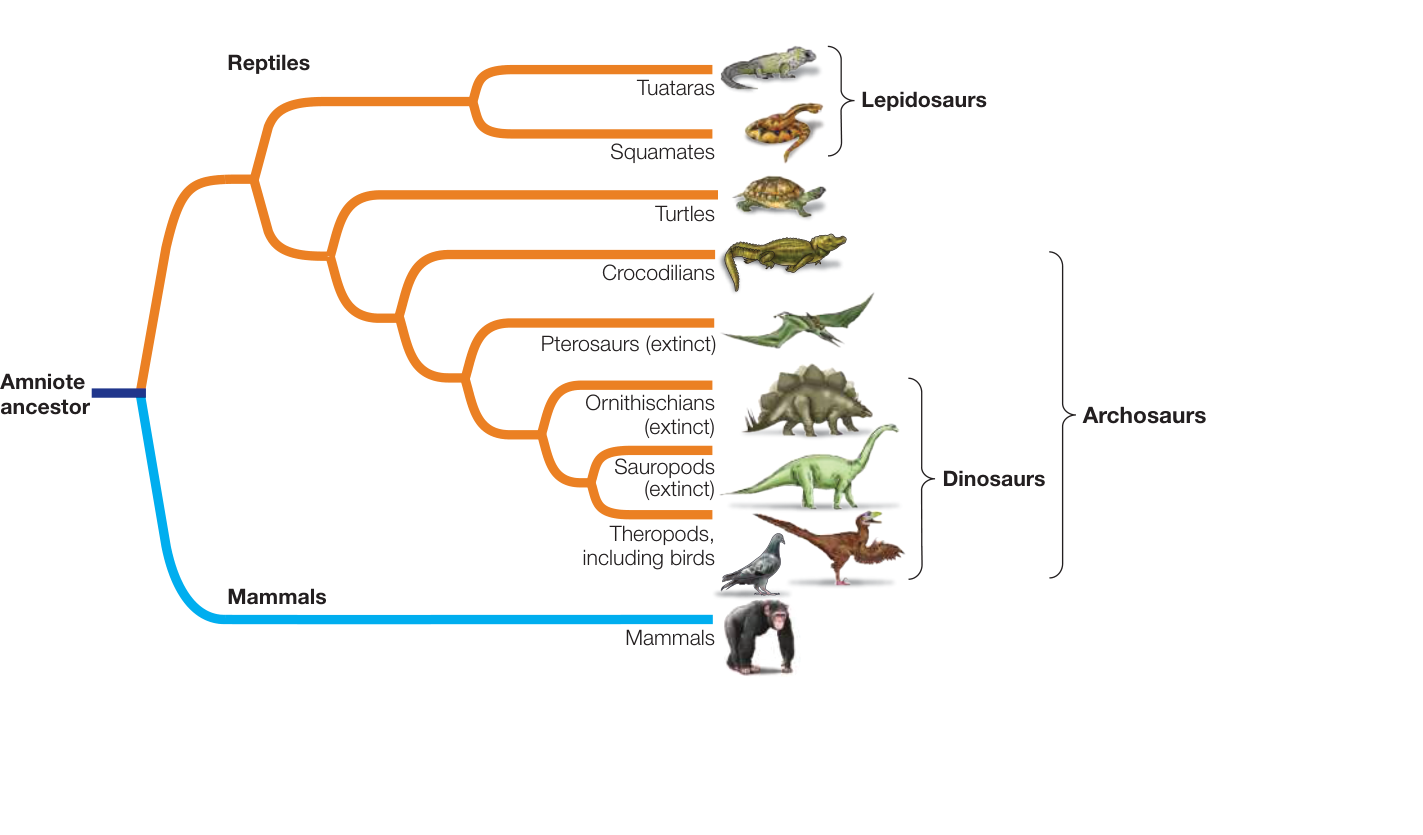
Figure 31.20 Phylogeny of Amniotes This tree of amniote relationships shows the primary split between mammals and reptiles. The reptile portion of the tree shows that one lineage led to the lepidosaurs (snakes, lizards, and tuataras), another to the turtles, and a third to the archosaurs (the crocodilians, several extinct groups, and the birds).
Investigating Life: Have Shelled Eggs Re-Evolved among Viviparous Reptile Lineages?
Experiment
Original Papers: R. A. Pyron and F. T. Burbrink. 2014. Early origin of viviparity and multiple reversions to oviparity in squamate reptiles. Ecol Lett 17: 13–21.
A. M. Wright et al. 2015. Which came first: The lizard or the egg? Robustness in phylogenetic reconstruction of ancestral states. J Exp Zool B (Mol Dev Evol) 324B: 504–516.
The shelled amniote egg is a complex structure, and the transition from oviparity to viviparity requires extensive changes in reproductive morphology and physiology. For example, oviparous species have uterine shell glands that secrete calcium for eggshell construction. These shell glands are modified in viviparous species to provide calcium to the developing embryo. Viviparity is thought to have evolved from oviparity more than 100 times among lizards and snakes, but biologists wondered if the process can be reversed: does egg laying ever re-evolve in live-bearing lineages?
QUESTION Can complex traits such as shelled eggs re-evolve once they have been lost?
METHOD
- Reconstruct the phylogeny of lizards and snakes (squamates).
- Collect data on the reproductive mode of more than 8,000 species of lizards and snakes.
- Reconstruct the evolution of transitions between oviparity and viviparity on the phylogeny.
RESULTS The number of reversals from viviparity to oviparity depends on the model of character change, but there is support for the re-evolution of egg laying from live birth in one group of lizards and in two groups of snakes.
CONCLUSION Although transitions from oviparity to viviparity are much more common than the reverse, egg laying may have re-evolved in a few lineages of squamates.
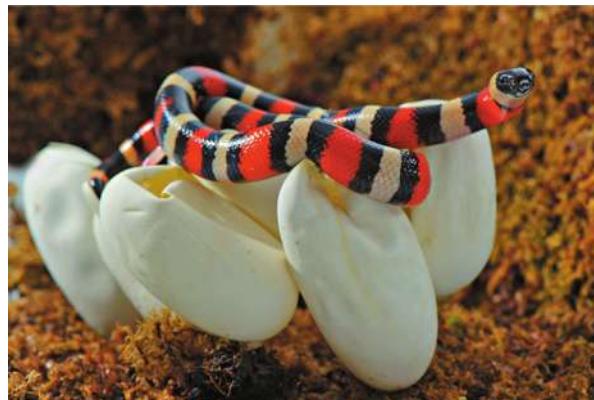
Oviparous: Pueblan milk snake (Lampropeltis polyzona campbelli)
© FLPA/Alamy Stock Photo
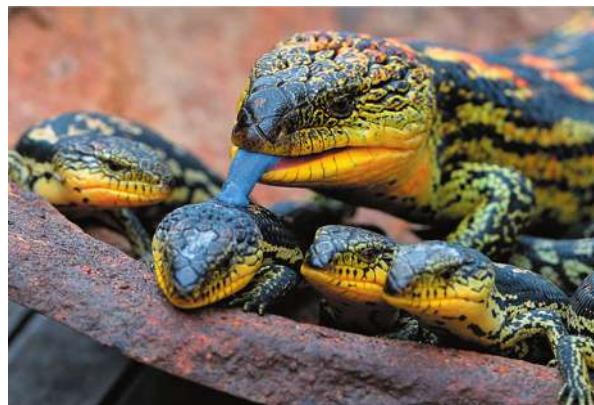
Viviparous: Blotched blue-tongue lizard (Tiliqua nigrolutea)
© Sareed Khan/APP/Getty Images
Work with the Data
Original Paper: A. M. Fenwick et al. 2012. The serpent and the egg: Unidirectional evolution of reproductive mode in vipers? J Zool Syst Evol Res 50: 59–66. The tree below shows a small portion of the phylogeny and reproductive data collected for squamates, from the New World pit vipers. Use this data sample to answer the questions.
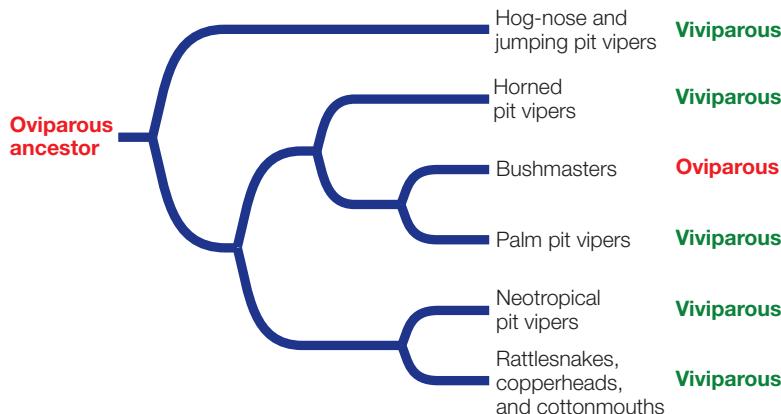
QUESTIONS
- Starting with a root state of oviparity, plot the minimum number of changes between oviparity and viviparity (in either direction) that is necessary to explain the distribution of reproductive states on the tree. What is the minimum number of changes required on this tree? Does that number include any reversals to oviparity?
- Assume that the only changes that can occur are changes from oviparity to viviparity (do not allow any changes in the opposite direction). How many additional transitions in reproductive mode are necessary under this assumption compared with the result you obtained in Question 1?
During the Carboniferous, the amniotes split into two major groups: the reptiles and the lineage that eventually led to the mammals (Figure 31.20).
Reptiles adapted to life in many habitats
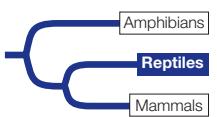
The lineage leading to modern reptiles began to diverge from other amniotes more than 300 million years ago. More than 19,000 species of reptiles exist today, more than half of which are birds. Birds are the only living representatives of the otherwise extinct dinosaurs, the dominant terrestrial vertebrates of the Mesozoic.
The lepidosaurs constitute the second most species-rich clade of living reptiles. This group is composed of the squamates (lizards, snakes, and amphisbaenians—the last a group of mostly legless, wormlike, burrowing reptiles with greatly reduced eyes) and the tuataras, which superficially resemble lizards but differ from them in possessing more rigid skulls and other anatomical features. Many species related to the tuataras lived during the Mesozoic, but today only a single species survives (Figure 31.21A), and is restricted to a few islands off New Zealand.
The skin of a lepidosaur is covered with horny scales that greatly reduce loss of water from the body surface. These scales, however, make the skin unavailable as an organ of gas exchange. Gases are exchanged almost entirely via the lungs, which are proportionally much larger in surface area than those of amphibians.
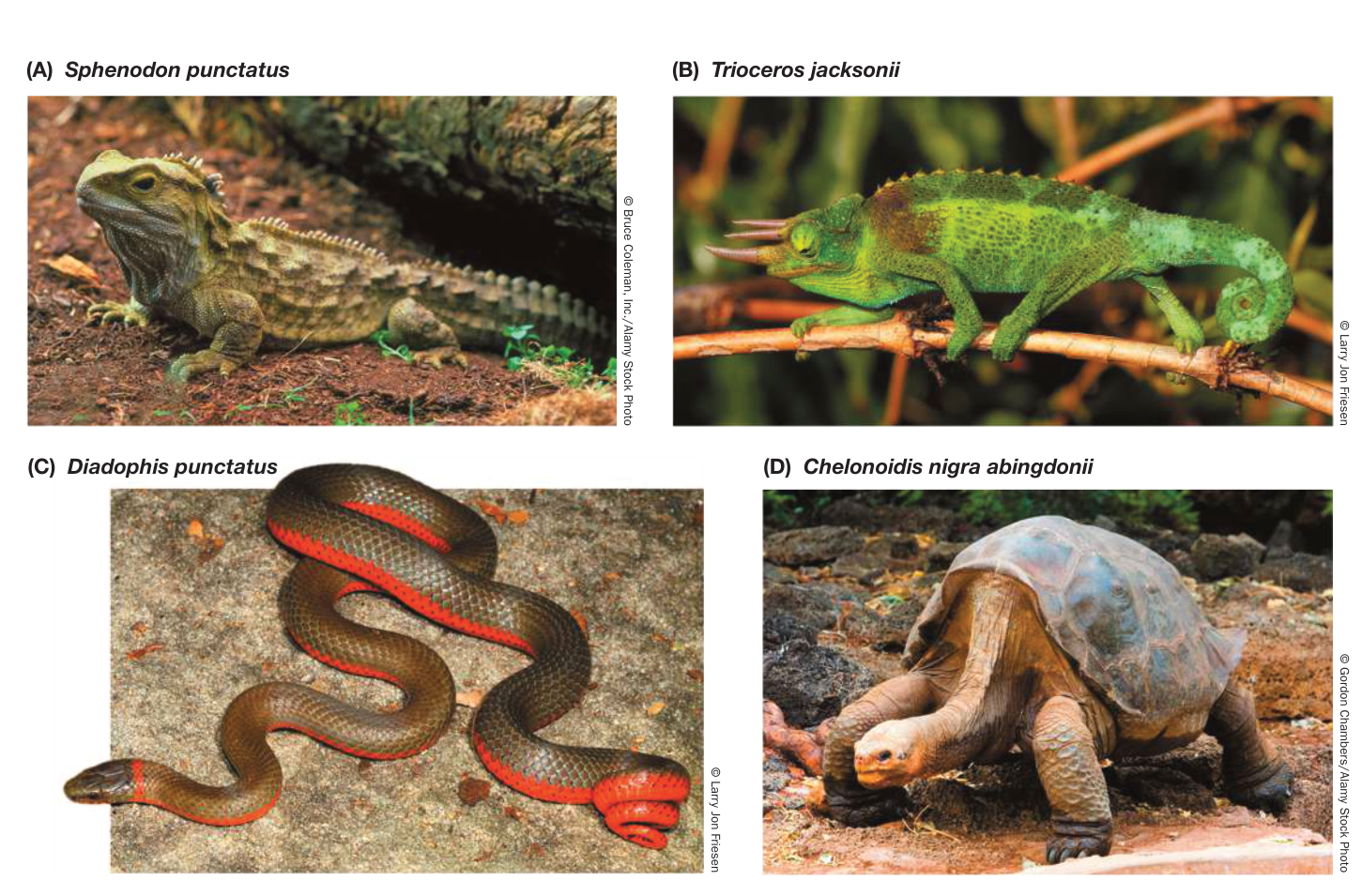
Figure 31.21 Reptilian Diversity (A) This tuatara represents the only surviving species in its lineage. (B) The Jackson’s chameleon is native to eastern Africa but was introduced to Hawaii in 1972. (C) The ringneck snake of North America is harmless to humans. It coils its tail to reveal a bright orange underbelly, which distracts potential predators from the vital head region. (D) Galápagos tortoises (there are several closely related species) are the largest turtles and among the largest reptiles. They have been documented to live for more than 100 years in the wild.
A lepidosaur forces air into and out of its lungs by bellows-like movements of its ribs. The three-chambered lepidosaur heart partially separates oxygenated blood from the lungs from deoxygenated blood returning from the body. With this type of heart, lepidosaurs can generate high blood pressure and can sustain a relatively high metabolism.
Most lizards are insectivores, although some are herbivores and a few prey on other vertebrates. Most lizards walk on four limbs (Figure 31.21B), although limblessness has evolved repeatedly among the lizards, especially in burrowing and grassland species. The largest lizard is the predaceous Komodo dragon (Varanus komodoensis) of the East Indies, which grows as long as 3 meters and can weigh more than 150 kilograms.
The major group of limbless squamates is the snakes (Figure 31.21C). All snakes are carnivores, and many can swallow objects much larger than themselves. Several snake groups possess venom glands and the ability to inject venom rapidly into their prey.
The turtles comprise a reptilian group that has changed relatively little in basic body form since the early Mesozoic. In these reptiles, dorsal and ventral bony plates form a shell into which the head and limbs can be withdrawn in many species (Figure
31.21D). The dorsal shell is a modification of the ribs. It is notable that pectoral girdles are inside the ribs of turtles, making them unlike any other vertebrates. Most turtles live in aquatic environments, but several groups, such as tortoises and box turtles, are terrestrial. Sea turtles spend their entire lives at sea except when they come ashore to lay eggs. Human exploitation of sea turtles and their eggs has resulted in worldwide declines of these species, all of which are now endangered. A few species of turtles are strict herbivores or carnivores, but most species are omnivores that eat a variety of aquatic and terrestrial plants and animals.
Crocodilians and birds share their ancestry with the dinosaurs
Another reptilian clade, the archosaurs, includes the crocodilians, pterosaurs, non-avian dinosaurs, and birds. Only the crocodilians and birds are represented by living species today. Modern crocodilians—crocodiles, caimans, gharials, and alligators—are confined to tropical and warm temperate environments (Figure 31.22A). All crocodilians are carnivorous; they eat vertebrates of all kinds, including large mammals. Crocodilians spend much of their time in water, but they lay their eggs in nests they build on land or on floating piles of vegetation. The eggs are warmed by heat generated by decaying organic matter that the female places in the nest. The female provides other forms of parental care as well: typically she guards the eggs until they hatch, and in some species she continues to guard and communicate with her offspring after they hatch.
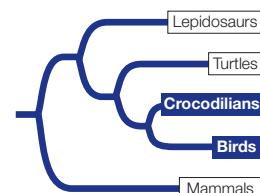
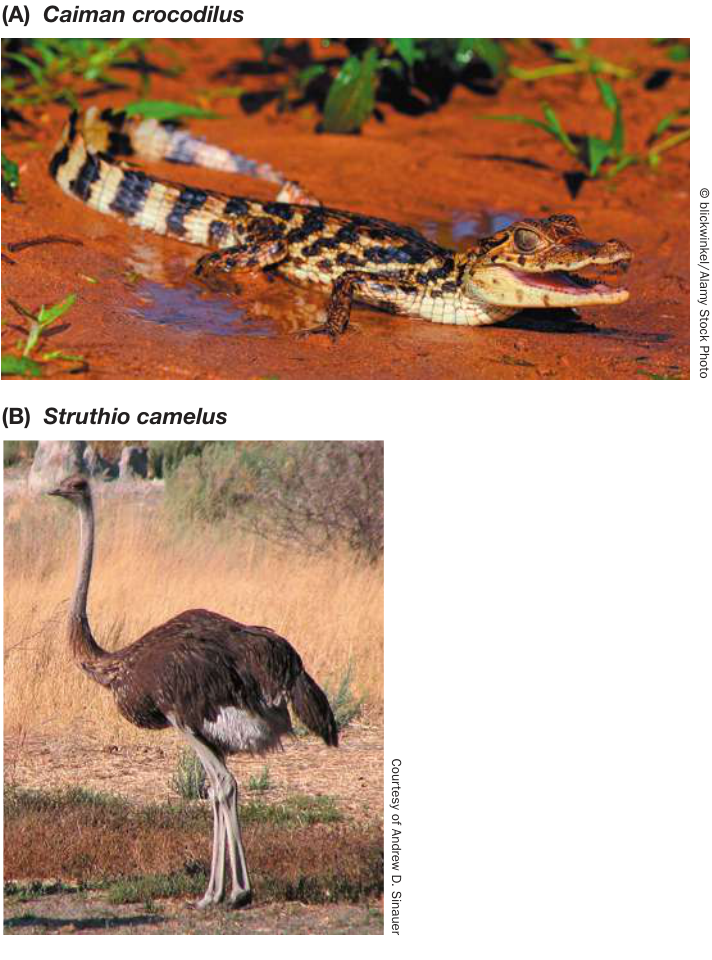
Figure 31.22 Archosaurs The two surviving groups of archosaurs are very different. (A) The crocodilians live in tropical and warm temperate climates. The spectacled caiman is the most common crocodilian throughout much of tropical Central and South America. (B) Birds are the other living archosaur group. This Common Ostrich is a palaeognath, a group that includes several flightless and weakly flying birds of the Southern Hemisphere. Flightless members of this early-diverging group lack the sternum keel structure that anchors the flight muscles of other bird groups.
Dinosaurs rose to prominence about 215 million years ago and dominated terrestrial environments for about 150 million years. However, only one group of dinosaurs, the birds, survived the mass extinction at the end of the Cretaceous. During the Mesozoic, most terrestrial animals more than a meter long were dinosaurs. Many were agile and could run rapidly; they had special muscles that enabled the lungs to be filled and emptied while the limbs moved. We can infer the existence of such muscles in dinosaurs from the structure of the vertebral column in fossils. Some of the largest dinosaurs weighed as much as 70,000 kilograms.
Biologists have long accepted the phylogenetic position of birds among the reptiles, although birds clearly have many unique, derived morphological features. In addition to the strong morphological evidence for this placement, fossil and molecular data emerging over the last few decades have provided definitive supporting evidence. Birds are a specialized group of theropods, a clade of predatory dinosaurs that shared such traits as a bipedal stance, hollow bones, a furcula (“wishbone”), elongated metatarsals with three-fingered feet, elongated forelimbs with three fingers, and a pelvis that points backward. Modern birds are endothermic, meaning that they regulate their body temperature by producing and retaining metabolic heat, rather than by absorbing heat from their external environment (see Key Concept 38.4). Although we cannot directly assess this physiological trait in extinct species, many fossil theropods share morphological traits that suggest they may have been endothermic as well.
The living bird species fall into two major groups that diverged about 90–80 million years ago from a flying ancestor. The few modern descendants of one lineage include a group of secondarily flightless and weakly flying birds, some of which are very large. This group, called the palaeognaths, includes the South and Central American tinamous and several large flightless birds of the southern continents—the rheas, Emu (Dromaius novaehollandiae), kiwis, cassowaries, and the world’s largest birds, the ostriches (Figure 31.22B). The second lineage, the neognaths, has left a much larger number of descendants, most of which have retained the ability to fly.
Feathers allowed birds to fly
Fossil theropods discovered in early Cretaceous deposits in Liaoning Province, in northeastern China, show that the scales of some small predatory dinosaurs were highly modified to form feathers. Initially these feathers were simply a body covering that probably provided insulation and enhanced coloration. But the feathers of some later dinosaurs, such as Microraptor gui, were structurally similar to those of modern birds (Figure 31.23A).
Another theropod that was even more closely related to modern birds, Archaeopteryx, lived about 150 million years ago. Archaeopteryx had teeth (unlike modern birds), but it was covered with feathers that are virtually identical to those of birds (Figure 31.23B). It also had well-developed wings, a long tail, and a furcula to which some of the flight muscles were probably attached. Archaeopteryx had clawed fingers on its forelimbs, but it also had typical perching bird claws on its hindlimbs. It probably lived in trees and shrubs and used the fingers to assist it in clambering over branches. It probably glided or flew weakly. The descendants of Archaeopteryx and similar Mesozoic theropods were the modern birds, most of which are accomplished fliers.
The evolution and specialization of feathers were a major force for diversification. Feathers are lightweight, but they are strong and structurally complex (Figure 31.24). The stiff central shaft of the flight feathers on a bird’s wings arises from the skin of the forelimbs to create the flying surfaces. Other strong feathers sprout like a fan from the shortened tail and serve as stabilizers during flight. The feathers that cover the body, along with an underlying layer of down feathers, provide birds with insulation that helps them survive in virtually all of Earth’s climates.
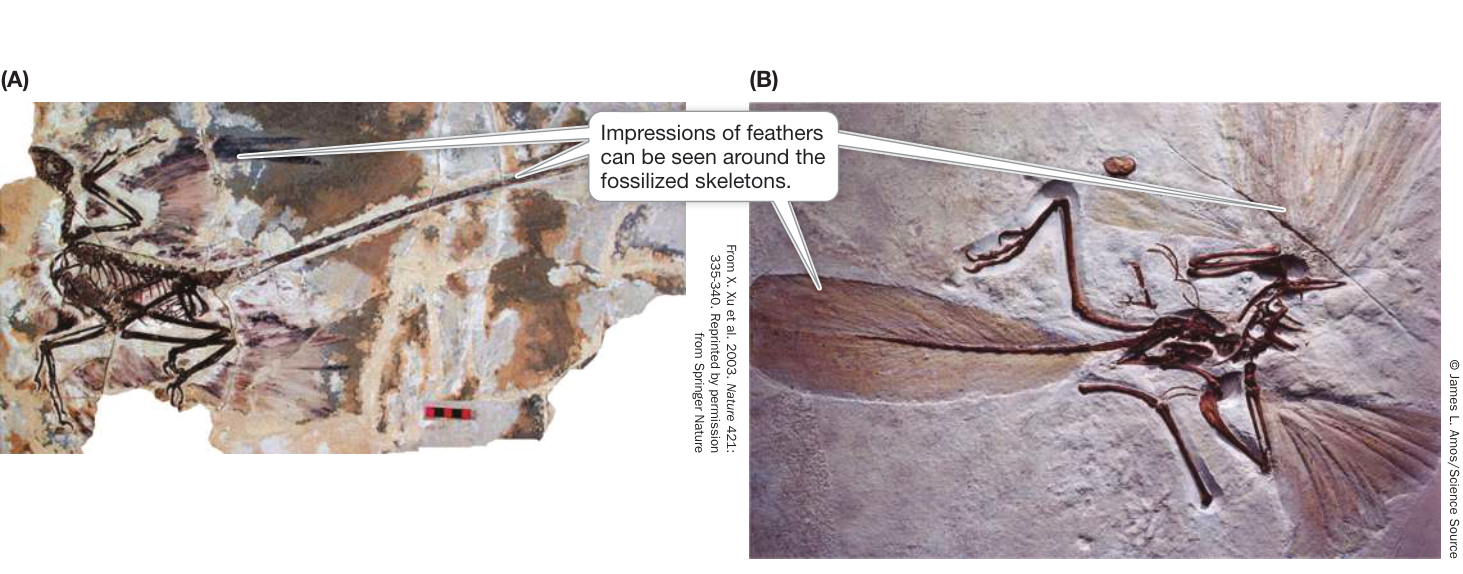
Figure 31.23 Mesozoic Bird Relatives Fossils support the evolution of birds from other theropods. (A) Microraptor gui was a feathered theropod from the early Cretaceous (about 140 mya). (B) Archaeopteryx was even more closely related to modern birds.
The bones of theropod dinosaurs, including birds, are hollow with internal struts that increase their strength. Hollow bones would have made early theropods lighter and more mobile; later they facilitated the evolution of flight. The sternum (breastbone) of flying birds forms a large, vertical keel to which the flight muscles are attached.
Flight is metabolically expensive. A flying bird consumes energy at a rate about 15–20 times faster than a running lizard of the same weight. Because birds have such high metabolic rates, they generate large amounts of heat. They control the rate of heat loss using their feathers, which may be held close to the body or elevated to alter the amount of insulation they provide. The lungs of birds allow air to flow through unidirectionally rather than pumping air in and out (see Key Concept 47.2). This flow-through structure of the lungs increases the efficiency of gas exchange and thereby supports a high metabolic rate.
There are about 10,000 species of living birds, which range in size from the 150-kilogram ostriches to a tiny hummingbird weighing only 2 grams (Figure 31.25). The teeth so prominent among other dinosaurs were secondarily lost in the ancestral birds, but birds nonetheless eat almost all types of animal and plant material. Insects and fruits are the most important dietary items for terrestrial species. Birds also eat seeds, nectar and pollen, leaves and buds, carrion, and other vertebrates. By eating the fruits and seeds of plants, birds serve as major agents of seed dispersal.
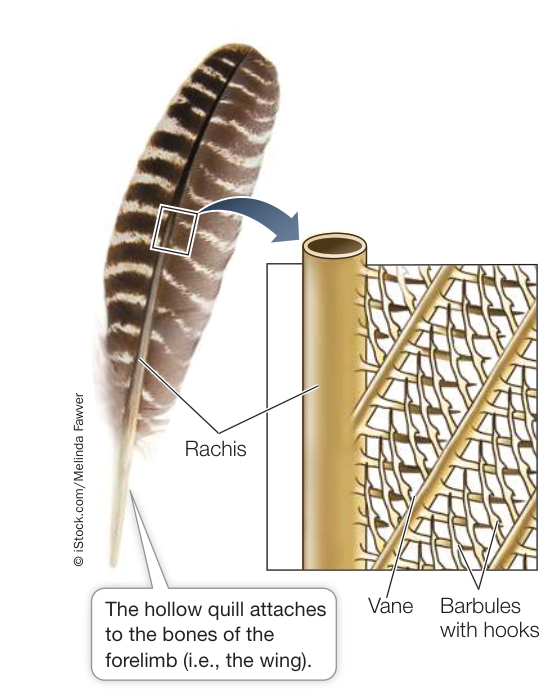
Figure 31.24 Feather Anatomy The flight feathers of birds are attached to the wing’s skin by the hollow portion, or quill, of a stiff central shaft. The rachis is the solid portion of the shaft from which radiate fine branches (vanes) with interlocking hooks and barbules. Overall, this structure represents a major evolutionary innovation: a strong, lightweight surface that enables flight.
Mammals radiated after the extinction of non-avian dinosaurs
Small and medium-sized mammals coexisted with the large dinosaurs throughout most of the Mesozoic, and most of the major groups of mammals that are alive today arose in the Cretaceous. After the non-avian dinosaurs disappeared during the mass extinction at the end of the Cretaceous, mammals increased dramatically in numbers, diversity, and size. Today mammals range in size from tiny shrews and bats weighing only about 2 grams to the blue whale (Balaenoptera musculus), the largest animal on Earth, which measures up to 32 meters long and can weigh as much as 160,000 kilograms. Mammals have far fewer, but more highly differentiated, teeth than do fishes, amphibians, or reptiles. Differences among mammals in the number, type, and arrangement of teeth reflect their varied diets (see Figure 49.6).
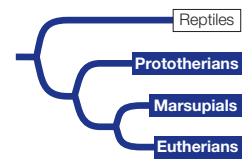
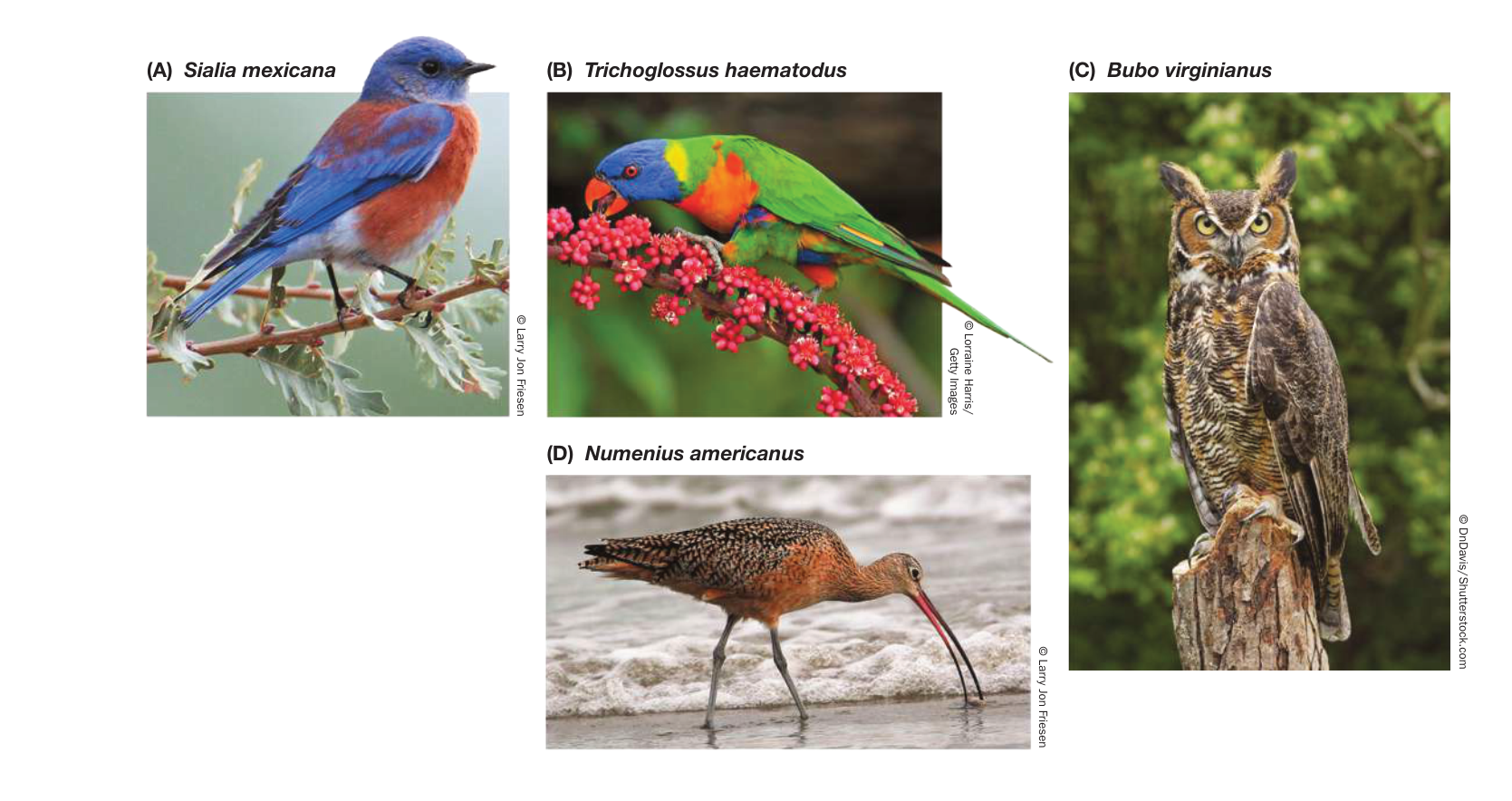
Figure 31.25 Diversity among the Birds (A) Perching, or passeriform, birds such as this Western Bluebird constitute the most species-rich of all bird groups. (B) Some 375 species of parrots, macaws, parakeets, and lorikeets such as the one shown here are another large bird group. (C) The Great Horned Owl is a nighttime predator that can find prey using its sensitive auditory “sonar” system. (D) The Long-billed Curlew of North America is one of many species of wading birds.
Four key features distinguish the mammals:
- Sweat glands, which secrete sweat that evaporates and thereby cools an animal
- Mammary glands, which in females secrete a nutritive fluid (milk) on which newborn individuals feed
- Hair, which provides a protective and insulating covering
- A four-chambered heart that completely separates the oxygenated blood coming from the lungs from the deoxygenated blood returning from the body (this last characteristic is convergent with the archosaurs, including modern birds and crocodilians)
Mammalian eggs are fertilized within the female’s body, and in nearly all mammalian groups the resulting embryos undergo a period of development inside the female’s body in an organ called the uterus. In the uterus, the embryo is contained in an amniotic sac that is homologous with one of the four membranes found in the amniote egg (see Figure 31.19). The embryo is connected to the wall of the uterus by an organ called a placenta. The placenta allows for nutrient and gas exchange, as well as waste elimination from the developing embryo, via the female’s circulatory system. Most mammals develop a covering of hair (fur), which is luxuriant in some species but has been greatly reduced in others, including cetaceans (whales and dolphins) and humans. Thick layers of insulating fat (blubber) replace hair as a heat-retention mechanism in the cetaceans. Humans learned to use clothing for this purpose when they dispersed from warm tropical areas.
The approximately 5,700 species of living mammals are divided into two primary groups: the prototherians and the therians (Table 31.1). Members of the therian clade are further divided into the marsupials and the eutherians.
PROTOTHERIANS Only five species of living prototherians are known, and they are found only in Australia and New Guinea. These mammals, the duck-billed platypus and four species of echidnas, differ from other mammals in laying shelled eggs and having sprawling legs (Figure 31.26). Prototherians supply milk for their
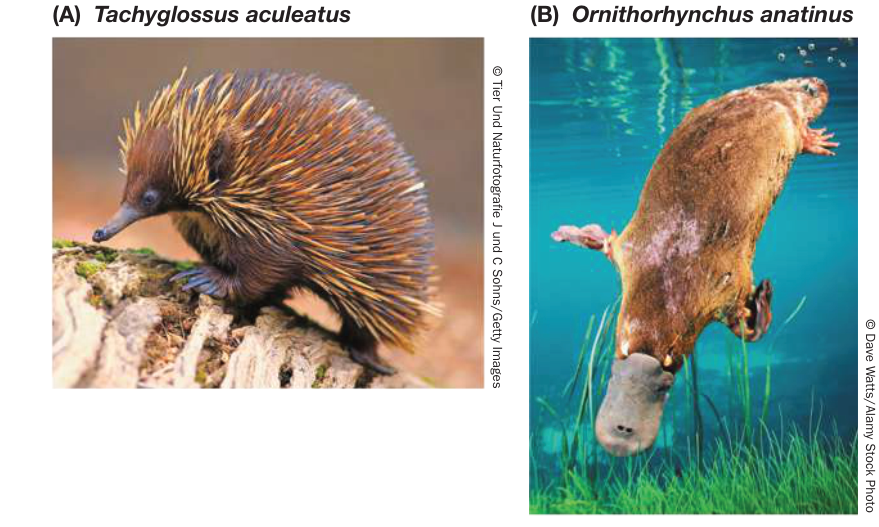
Figure 31.26 Prototherians (A) The short-beaked echidna is one of four surviving species of echidnas. (B) The duck-billed platypus lives in freshwater streams in eastern Australia.
Table 31.1 Major Groups of Living Mammals
| Group | Number of described species | Examples |
|---|---|---|
| PROTOTHERIANS | ||
| Monotremes (Monotremata) | 5 | Echidnas, duck-billed platypus |
| THERIANS | ||
| MARSUPIALS | ||
| Diprotodonts (Diprotodontia) | 146 | Kangaroos, wallabies, possums, koala, wombats |
| New World opossums (Didelphimorphia) | 93 | Opossums |
| Carnivorous marsupials (Dasyuromorphia) | 75 | Quolls, dunnarts, numbat, Tasmanian devil |
| Omnivorous marsupials (Peramelemorphia) | 24 | Bandicoots and bilbies |
| Shrew opossums (Paucituberculata) | 7 | Andean rat opossums |
| Marsupial moles (Notoryctemorphia) | 2 | Southern and northern marsupial moles |
| Microbiothere (Microbiotherea) | 1 | Monito del monte |
| EUTHERIANS | ||
| Rodents (Rodentia) | 2,337 | Rats, mice, squirrels, woodchucks, ground squirrels, beavers, capybara |
| Bats (Chiroptera) | 1,171 | Fruit bats, echolocating bats |
| Even-toed hoofed mammals and cetaceans (Cetartiodactyla) | 469 | Deer, sheep, goats, cattle, antelopes, giraffes, camels, swine, hippopotamuses, whales, dolphins |
| Shrews, moles, and relatives (Soricomorpha) | 428 | Shrews, moles, solenodons |
| Primates (Primates) | 396 | Lemurs, monkeys, apes, humans |
| Carnivores (Carnivora) | 284 | Wolves, dogs, bears, cats, weasels, pinnipeds (seals, sea lions, walruses) |
| Rabbits and relatives (Lagomorpha) | 92 | Rabbits, hares, pikas |
| African insectivores (Afrosoricida) | 50 | Tenrecs, golden moles |
| Spiny insectivores (Erinaceomorpha) | 24 | Hedgehogs |
| Armadillos (Cingulata) | 21 | Armadillos |
| Tree shrews (Scandentia) | 20 | Tree shrews |
| Odd-toed hoofed mammals (Perissodactyla) | 16 | Horses, zebras, tapirs, rhinoceroses |
| Long-nosed insectivores (Macroscelidea) | 15 | Elephant shrews |
| Anteaters and sloths (Pilosa) | 10 | Anteaters, tamanduas, sloths |
| Pangolins (Pholidota) | 8 | Asian and African pangolins |
| Hyraxes and relatives (Hyracoidea) | 5 | Hyraxes, dassies |
| Sirenians (Sirenia) | 4 | Manatees, dugongs |
| Elephants (Proboscidea) | 3 | African and Indian elephants |
| Colugos (Dermoptera) | 2 | Flying lemurs |
| Aardvark (Tubulidentata) | 1 | Aardvark |
young, but they have no nipples on their mammary glands; the milk simply oozes out and is lapped off the fur by the offspring.
MARSUPIALS Females of most marsupial species have a ventral pouch in which they carry and feed their offspring (see Figure 31.27A). Gestation (pregnancy) in marsupials is brief; the young are born tiny but with well-developed forelimbs, with which they climb to the pouch. They attach to a nipple but cannot suck. The mother ejects milk into the tiny offspring until it grows large enough to suckle. Once her offspring have left the uterus, a female marsupial may become sexually receptive again. She can then carry fertilized eggs that are capable of initiating development to replace the offspring in her pouch should something happen to them.
At one time marsupials were found on all continents, but the approximately 350 living species are now restricted to Australasia (Figure 31.27A,B) and the Americas (especially South America) (Figure 31.27C). Of the seven major groups of marsupials shown in Table 31.1, only the New World opossums, the shrew opossums, and the diminutive monito del monte are found in the Americas. Only one species, the Virginia opossum, is found in North America north of Mexico. Marsupials radiated to become herbivores, insectivores, and carnivores, but no marsupials live in the oceans. None can fly, although some arboreal (tree-dwelling) marsupials are gliders. The largest living marsupials are the kangaroos of Australia, which can weigh up to 90 kilograms. Much larger marsupials existed in Australia until humans exterminated them soon after reaching that continent about 45,000 years ago.
EUTHERIANS The majority of mammals are eutherians (“true” therians). Eutherians are sometimes called placental mammals, but this name is inappropriate because marsupials also have placentas, although they are not as well developed as in eutherians. Eutherians are more developed at birth than are marsupials; no external pouch houses them after they are born.
The more than 5,300 species of living eutherians are divided into 20 major groups (see Table 31.1). The relationships of these groups to one another have been difficult to determine because most of the major groups diverged within a short time during an explosive adaptive radiation. Modern genomic analyses have elucidated these relationships, however (Figure 31.28). These studies have revealed that the major early splits in eutherian lineages are closely associated with the breakup of the continents during the Mesozoic (see Figure 23.14), after which the major groups of mammals radiated independently in Laurasia, Africa, and South America. The reconnection of South America and North America via the Isthmus of Panama about 3 million years ago resulted in a huge faunal exchange between those continents, which is particularly evident among the mammals. South American groups such as armadillos moved north into North America, and Laurasian groups such as carnivores and odd-and even-toed hoofed animals moved south into South America.
Eutherians are extremely varied in their form and ecology (Figure 31.29). The extinction of the non-avian dinosaurs at the end of the Cretaceous may have made it possible for eutherians to diversify and radiate into a large range of ecological niches.
Many eutherian species grew large, and some assumed the roles of dominant terrestrial predators previously occupied by the large dinosaurs. Among these predators, social hunting behavior evolved in several species, including members of the carnivore and primate clades.
The two most diverse groups of eutherians are the rodents and the bats, which together account for about two-thirds of the species. Rodents are traditionally defined by the unique morphology of their teeth, which are adapted for gnawing through substances such as wood. The bats probably owe much of their success to the evolution of flight, which allows them to exploit a variety of food sources and colonize remote locations with relative ease.
Grazing and browsing by members of several eutherian groups helped transform the terrestrial landscape. Herds of grazing herbivores fed on open grasslands, whereas browsers fed on shrubs and trees. The effects of these herbivores on plant life favored the evolution of the spines, tough leaves, and difficult-to-eat growth forms found in many plants. In turn, adaptations in the teeth and digestive systems of many herbivore lineages allowed these species to consume many plants despite such defenses—a striking example of coevolution. A large animal can survive on food of lower quality than a small animal can, and large size evolved in several groups of grazing and browsing mammals (see Figure 31.29C). The evolution of large herbivores, in turn, favored the evolution of large carnivores able to attack and overpower them.
Several lineages of terrestrial eutherians subsequently returned to the aquatic environments their ancestors had left behind (see Figure 31.29D). The completely aquatic cetaceans—whales and dolphins—evolved from even-toed hoofed ancestors (cetaceans are closely related to the hippopotamuses). The seals, sea lions, and walruses also returned to the marine environment, and their limbs became modified into flippers. Weasel-like otters retain their limbs but have also returned to aquatic environments, colonizing both fresh and salt water. The manatees and dugongs colonized estuaries and shallow seas.
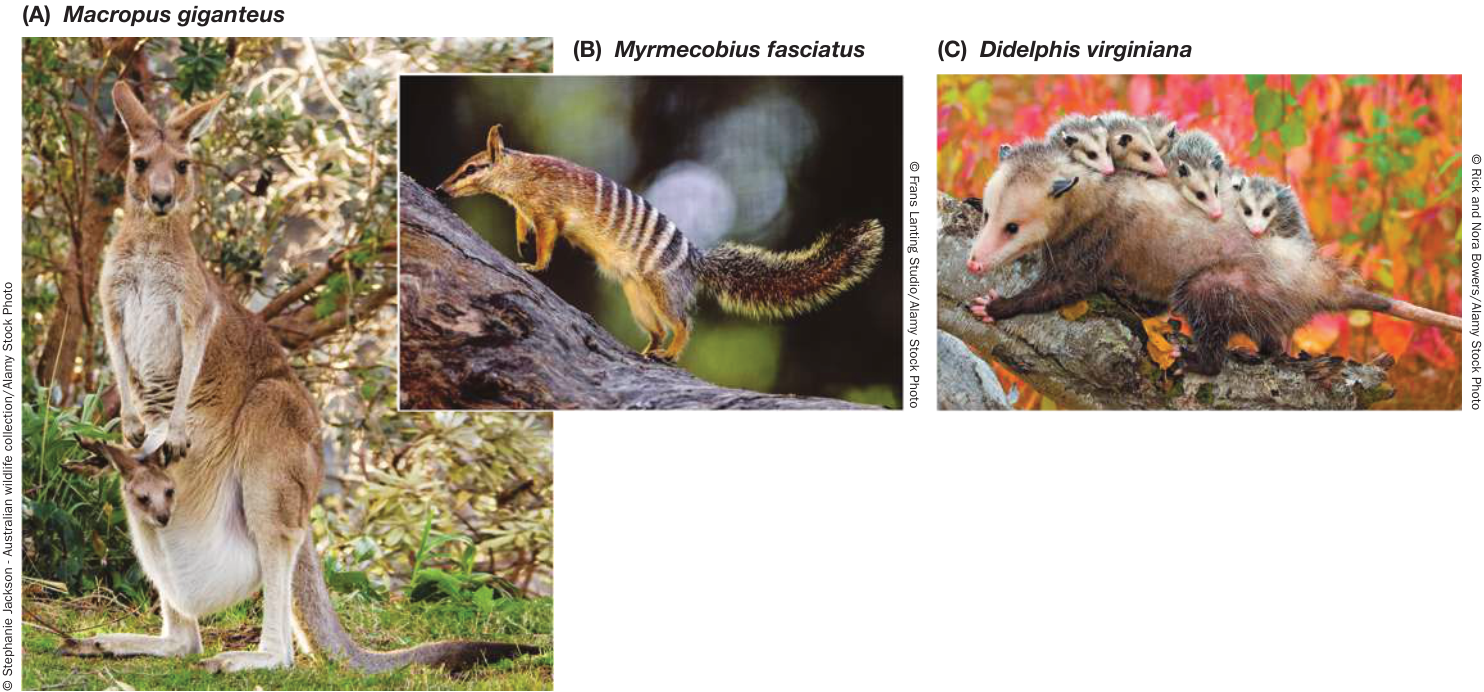
Figure 31.27 Diversity among the Marsupials (A) Australia’s eastern gray kangaroo is among the largest living marsupials. This female carries her young offspring in the characteristic marsupial pouch. (B) The diet of the banded anteater of western Australia consists almost entirely of termites. (C) The Virginia opossum is the only marsupial found north of Mexico.
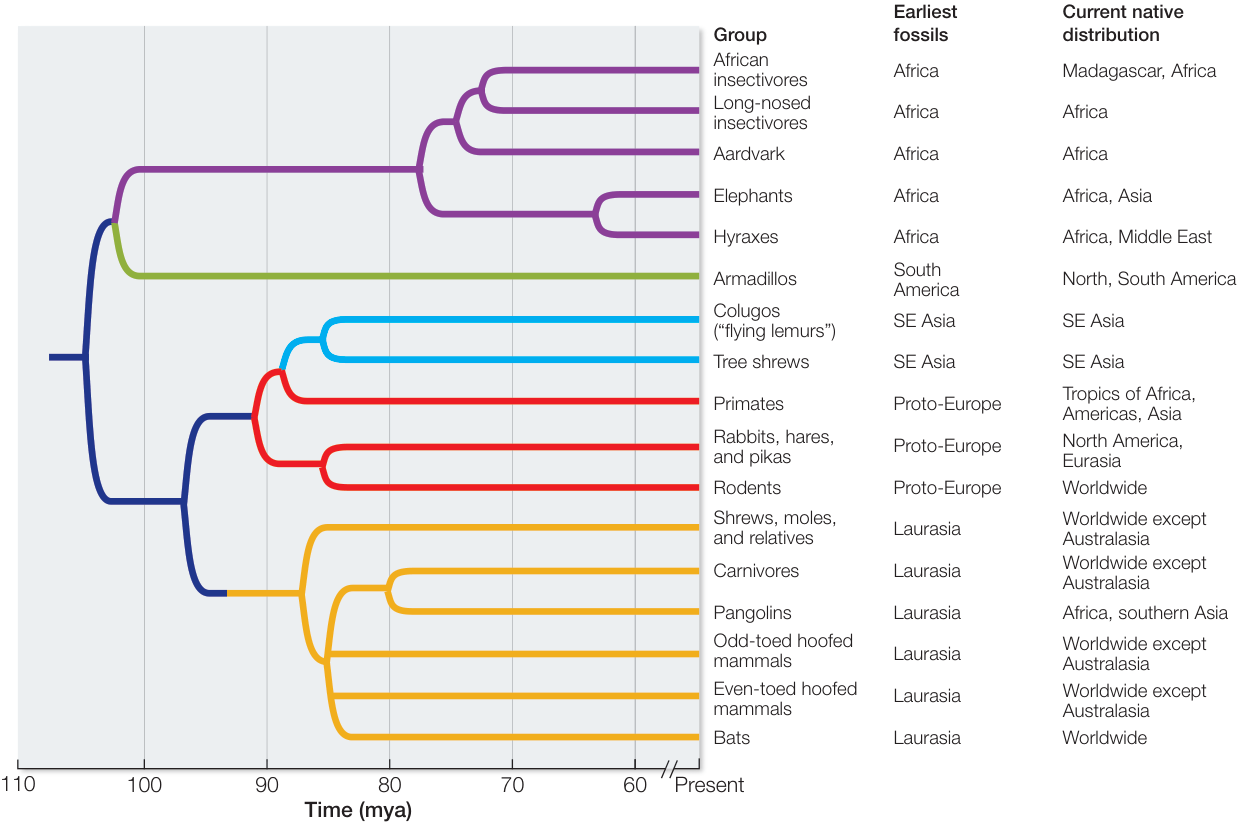
Figure 31.28 Major Groups of Eutherians Diversified as the Continents Drifted Apart This phylogenetic tree shows the relationships among most of the major terrestrial eutherian groups, the location of the earliest fossils found for each group (also indicated in the color distinctions of the various branches), and the current distributions of the groups. The major splits in eutherian evolution correspond in large degree to the tectonic history of the major continents (see Figures 23.14 and 52.14).
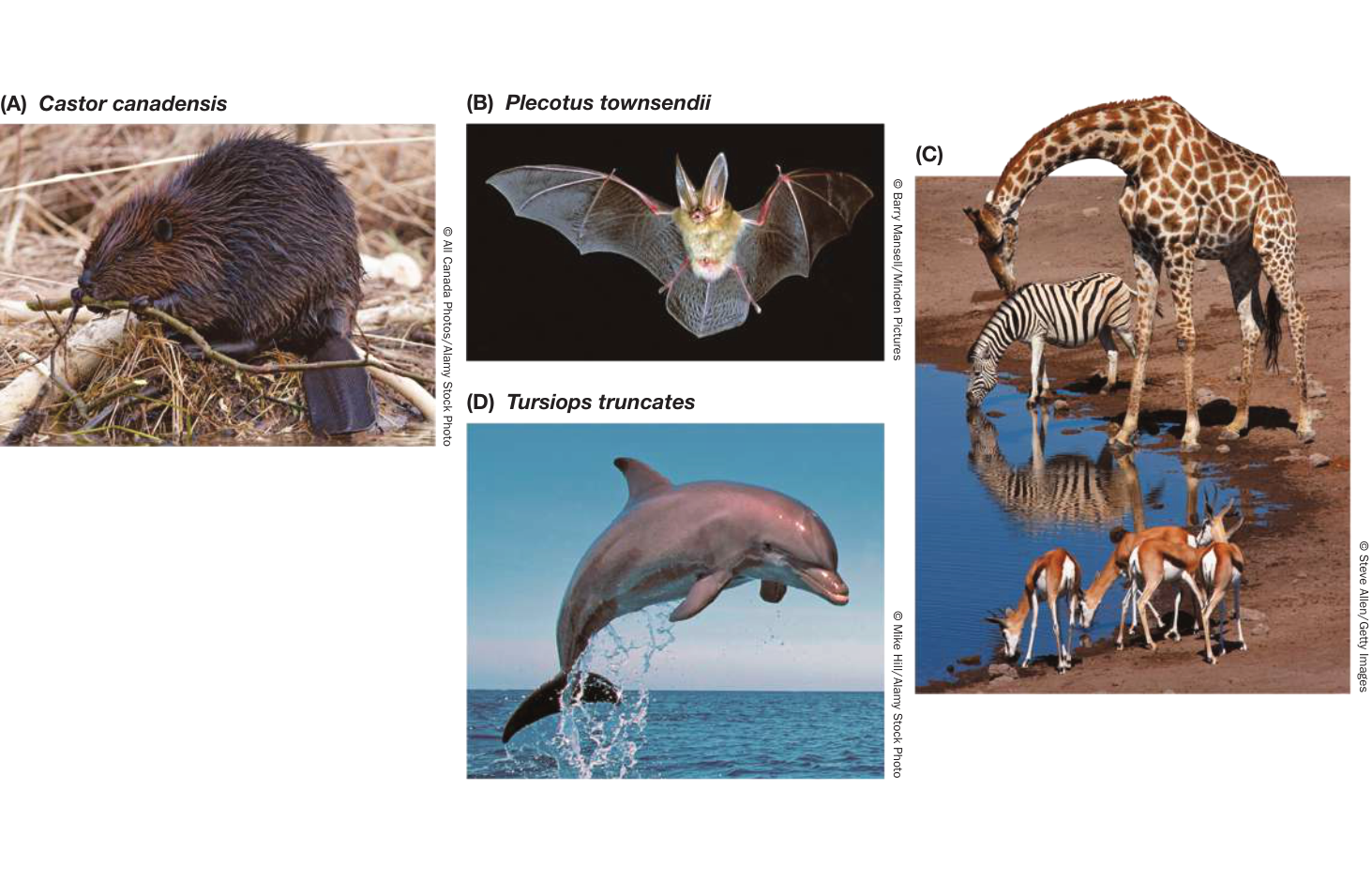
Figure 31.29 Diversity among the Eutherians (A) The North American beaver exhibits the gnawing teeth that characterize rodents. Almost half of all eutherians are rodents. (B) Flight evolved in the ancestor of bats. This Townsend’s big-eared bat uses its enlarged ears to detect insect prey by echo-location. (C) Large hoofed mammals such as giraffes, zebras, and springbooks are major herbivores of grasslands and savannas. (D) Bottle-nosed dolphins are cetaceans, a cetartiodactyl group that returned to the marine environment.
Recap and Assess
The initial vertebrate colonization of dry land was facilitated by the evolution of lunglike sacs and jointed limbs. The amniotes also evolved impermeable body coverings, efficient kidneys, and the amniote egg, which resists desiccation.
- Amphibians have survived and prospered for millions of years, but today many species are disappearing and populations of others are in serious decline. What features of their life histories might make amphibians especially vulnerable to the kinds of environmental changes now happening on Earth?
- How has the diversification of mammals been influenced by mass extinction events and continental drift?
- In the not-too-distant past, the idea that birds were reptiles met with skepticism. Explain how fossils, morphology, and molecular evidence now support the position of birds among the reptiles.
- Consider the phylogeny of the amniotes and the evolution of endothermy, hair, and feathers. Which of these traits likely evolved convergently in more than one lineage? What is a likely functional relationship among these traits? What are some reasons why many paleontologists think that several extinct theropods were endothermic?
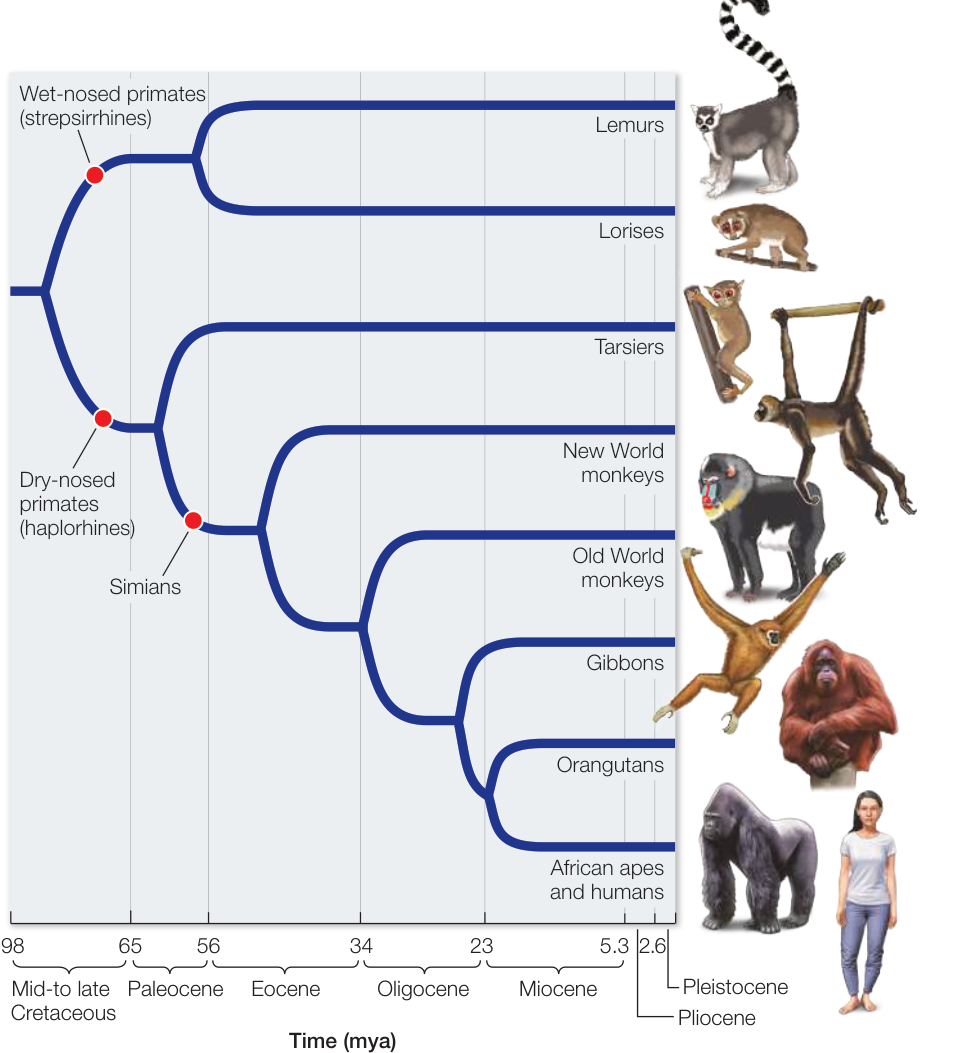
Figure 31.30 Phylogeny of the Primates The phylogeny of primates is among the best studied of any major group of mammals. This tree is based on evidence from many genes, morphology, and fossils.
The biology of one eutherian group—the primates—has been the subject of extensive research. The behavior, ecology, physiology, and molecular biology of the primates are of special interest to us because this lineage includes humans.
Humans Evolved among the Primates
Learning Objectives
31.5.1 Summarize the diversity within the primates. 31.5.2 Articulate the relationship between bigger brains, smaller jaws, and neoteny.
One lineage of small, arboreal, insectivorous eutherians underwent extensive evolutionary radiation to become the primates (Figure 31.30). Grasping limbs with opposable digits, an adaptation to arboreal life, is one of the major features that distinguish primates from other mammals.
Two major lineages of primates split late in the Cretaceous
About 90 million years ago, late in the Cretaceous, the primates split into two clades: the wet-nosed primates (strepsirrhines) and the dry-nosed primates (haplorhines). Wet-nosed primates—lemurs, lorises, and galagos—once lived on all continents, but today they are restricted to Africa, Madagascar, and tropical Asia. All mainland wet-nosed primate species are arboreal and nocturnal. On the island of Madagascar, however, the site of a remarkable radiation of lemurs, there are also diurnal and terrestrial species (Figure 31.31). Tarsiers were once considered a part of this lineage as well, although today we know that they are more closely related to simians—monkeys and apes—than to lemurs, lorises, and galagos.
The second primate lineage, the dry-nosed primates—tarsiers, New World monkeys, Old World monkeys, and apes—began to diversify shortly after the mass extinction event at the end of the Cretaceous, in Africa or Asia. New World monkeys diverged from Old World monkeys and apes slightly later, but early enough that they may have originated in Africa and reached South America when those two continents were still close to each other. New
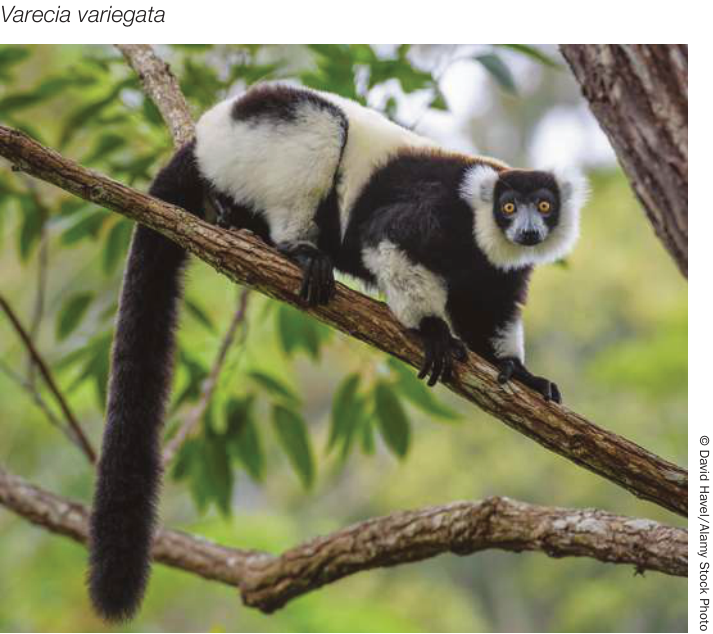
Figure 31.31 A Wet-Nosed Primate The black-and-white ruffed lemur is one of the many lemur species found in Madagascar, where it is part of a unique assemblage of endemic plants and animals. Lemurs live in groups of up to a dozen animals and defend their territories.
World monkeys now live only in South and Central America, and all of them are arboreal (Figure 31.32A). Many of them have a long, prehensile tail with which they can grasp branches. Many Old World monkeys are arboreal as well, but several species are terrestrial (Figure 31.32B). No Old World monkey has a prehensile tail.
About 35 million years ago, a lineage that led to the modern apes separated from the Old World monkeys. Between 22 and 5.5 million years ago, dozens of species of apes lived in Europe, Asia, and Africa. The Asian apes—gibbons and orangutans (Figure 31.33A,B)—descended from two of these ape lineages. Orangutans are the closest living sister group of the modern African apes: gorillas (Figure 31.33C), chimpanzees (Figure 31.33D), and humans.
Bipedal locomotion evolved in human ancestors
About 6 million years ago in Africa, a lineage split occurred that would lead to the chimpanzees on the one hand and to the hominin clade, which includes modern humans and their extinct close relatives, on the other.
The earliest protohominins, known as ardipithecines, had distinct morphological adaptations for bipedal locomotion (walking on two legs). Bipedal locomotion frees the forelimbs to manipulate objects and to carry them while walking. It also elevates the eyes, enabling the animal to see over tall vegetation to spot predators and prey. Bipedal locomotion is also energetically more economical than quadrupedal locomotion (walking on four legs). All three advantages were probably important for the ardipithecines and their descendants, the australopithecines (Figure 31.34).
The first australopithecine skull was found in South Africa in 1924. Since then australopithecine fossils have been found at many sites in Africa. The most complete fossil skeleton yet found was discovered in Ethiopia in 1974. The skeleton, approximately 3.5 million years old, was that of a young female who has since become known to the world as “Lucy.” Lucy was assigned to the species Australopithecus afarensis. Fossil remains of more than 100 A. afarensis individuals have since been discovered, and there have been recent discoveries of fossils of other australopithecine species that lived in Africa 5–4 million years ago.
Experts disagree over how many species are represented by australopithecine fossils, but it is clear that multiple species of hominins lived together over much of eastern Africa several million years ago. A lineage of larger species (weighing about 40 kg) is represented by Paranthropus robustus and P. boisei, both of which died out between 1 and 1.5 million years ago. A lineage of smaller australopithecines gave rise to the genus Homo.
Early members of the genus Homo lived contemporaneously with Paranthropus in Africa for about a million years. Some 2-million-year-old fossils of an extinct species called H. habilis were discovered in the Olduvai Gorge, Tanzania. Other fossils of H. habilis have been found in Kenya and Ethiopia. Associated with these fossils were tools that these early hominins used to obtain food.
Another extinct hominin species, Homo erectus, arose in Africa about 1.6 million years ago. Soon thereafter it had spread as far as eastern Asia, becoming the first hominin to leave Africa. Members of H. erectus were nearly as large as modern people, but their brains were smaller and they had comparatively thick skulls. The cranium, which had thick, bony walls, may have been an adaptation to protect the brain, ears, and eyes from impacts caused by a fall or a blow from
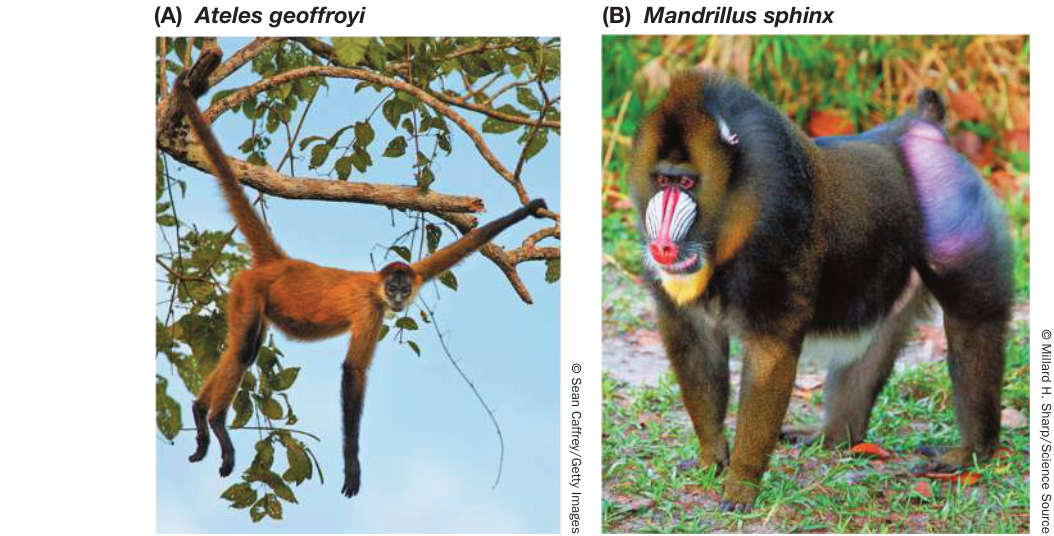
Figure 31.32 Monkeys (A) The spider monkeys of Central America are typical of the New World monkeys, all of which are arboreal. Note the prehensile (gripping) tail. (B) Although many Old World monkeys are arboreal, none has a prehensile tail. Many Old World monkey species, like this mandrill, are thoroughly terrestrial.
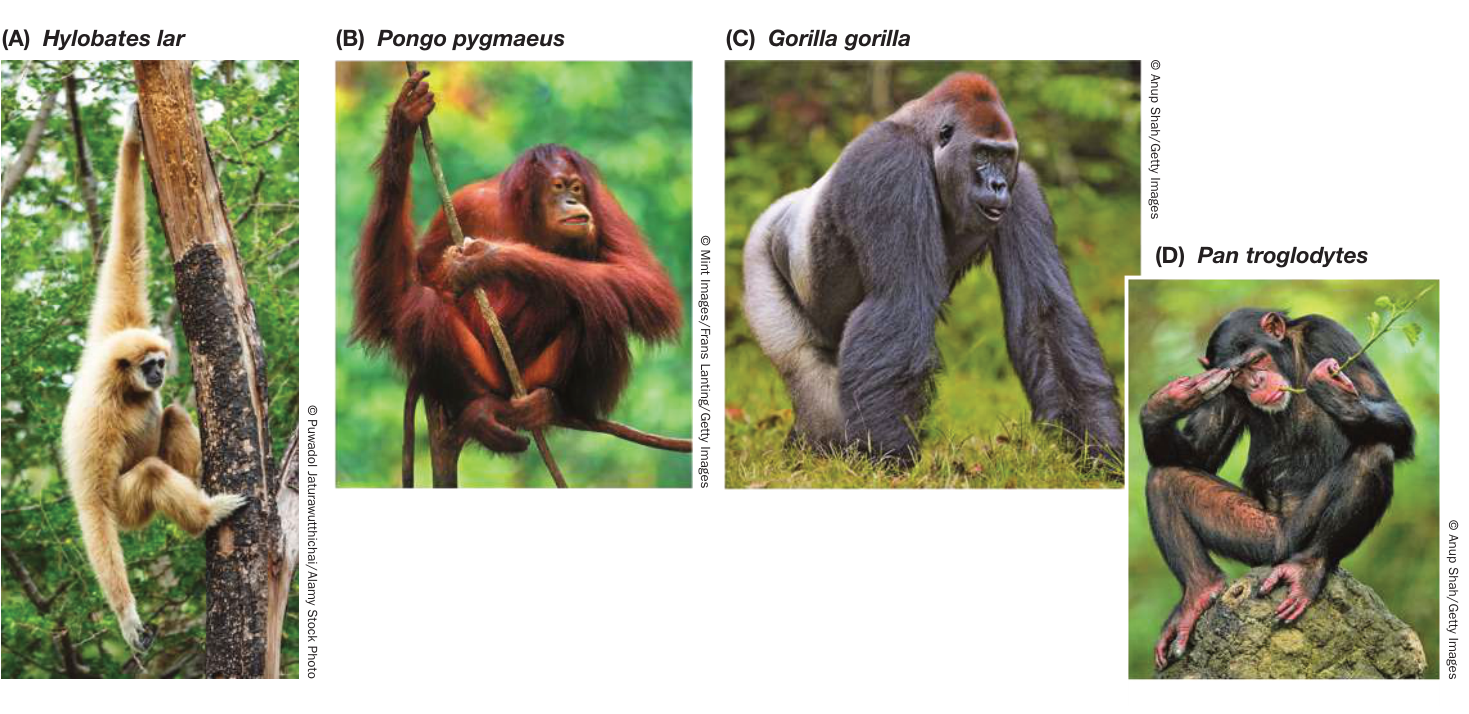
Figure 31.33 Apes (A) The several genera of gibbons are all smaller in size than the other apes. Gibbons are found throughout Southeast Asia. (B) Orangutans are also native to Asia, living in the forests of Sumatra and Borneo. (C) Gorillas—the largest apes—are restricted to humid African forests. This male is a lowland gorilla. (D) Chimpanzees, our closest relatives, are found in forested regions of Africa.
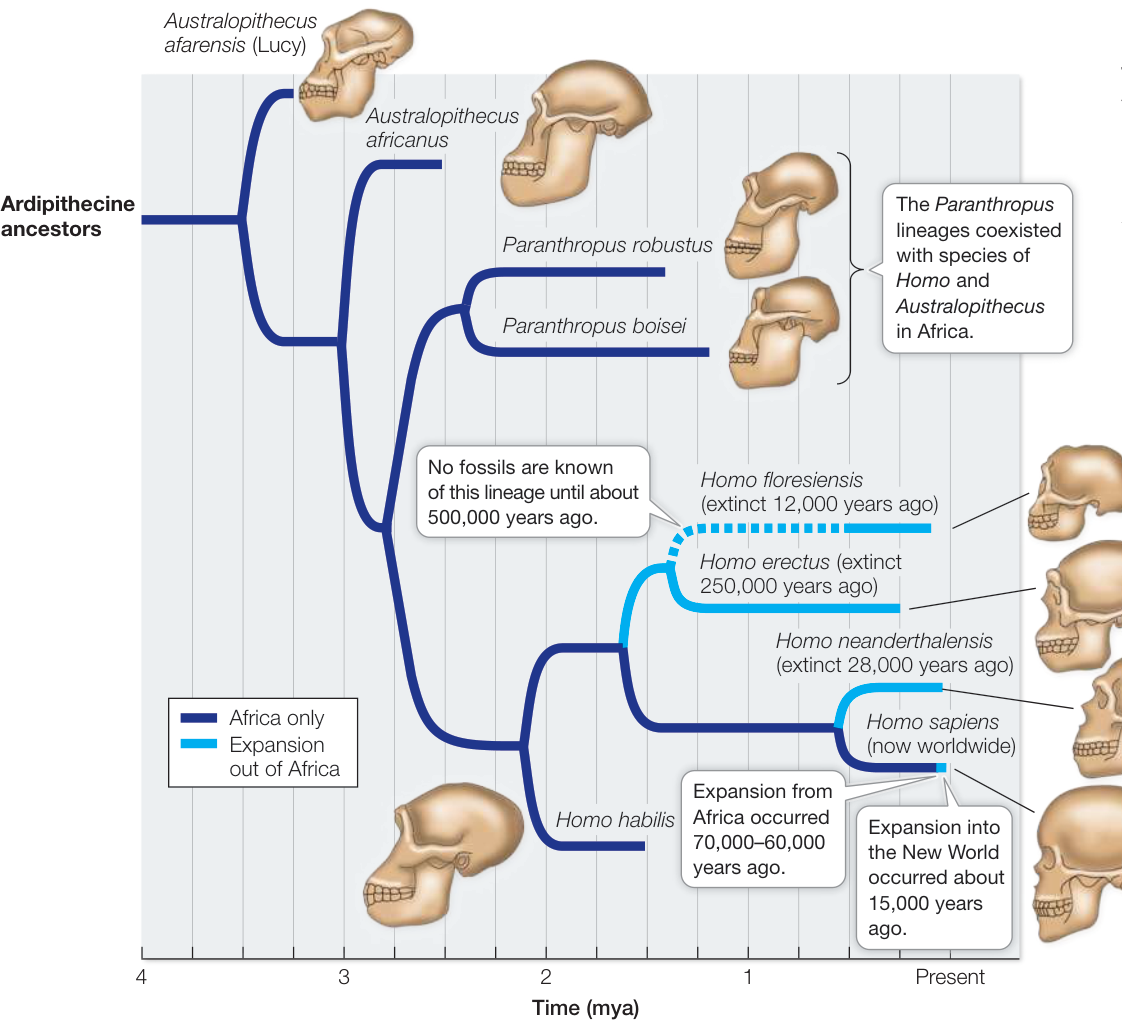
Figure 31.34 A Phylogenetic Tree of Hominins At times in the past, more than one hominin species lived on Earth at the same time. Originating in Africa, hominins spread to Europe and Asia multiple times. All but one of those species are now extinct, but that one species, modern Homo sapiens, has colonized nearly every corner of the planet.
Several species of Homo co-existed in Africa, Asia, and Europe until recently.
a blunt object. What would have been the source of such blows? Fighting with other H. erectus individuals is a possible answer.
Homo erectus used fire for cooking and for hunting large animals, and made characteristic stone tools that have been found in many parts of Africa and Asia. Populations of H. erectus survived until at least 250,000 years ago, although more recent fossils may also be attributable to this species. In 2004 some 18,000-year-old fossil remains of a small Homo were found on the island of Flores in Indonesia. Since then, numerous additional fossils of this diminutive hominin have been found on Flores, dating from about 500,000 to 12,000 years ago, when a major volcanic eruption on Flores likely led to their extinction. Many anthropologists think that this small species, named H. floresiensis, was most closely related to H. erectus.
Human brains became larger as jaws became smaller
In another hominin lineage that diverged from H. erectus and H. floresiensis, the brain increased rapidly in size, and the jaw muscles, which were large and powerful in earlier hominins, dramatically decreased in size. These two changes were simultaneous, which suggests that they might have been developmentally linked. These changes are another example of evolution by neoteny (which, you may recall from our discussion of amphibians, is the retention of juvenile traits through delayed somatic development). Human and chimpanzee skulls are similar in shape at birth, but chimpanzee skulls undergo a dramatic change in shape as the animals mature (Figure 31.35). In particular, the jaw grows considerably in relation to the brain case. As human skulls grow, relative proportions much closer to those of the juvenile skull are retained, which results in a large brain case and small jaw compared with those of chimpanzees. A mutation in a regulatory gene that is expressed only in the head may have removed a barrier that had previously prevented this remodeling of the human cranium.
The striking enlargement of the brain relative to body size in the hominin lineage was probably favored by an increasingly complex social life. Any features that allowed group members to communicate more effectively with one another would have been valuable in cooperative hunting and gathering as well as for improving one’s status in the complex social interactions that must have characterized early human societies, just as they do ours today.
Several Homo species coexisted during the mid-Pleistocene, from about 1.5 million to about 250,000 years ago. All were skilled hunters of large mammals, but plants were important components of their diets as well. During this period another distinctly human trait emerged: rituals and a concept of life after death. Deceased individuals were buried with tools and clothing, supplies for their presumed existence in the next world.
One species, Homo neanderthalensis, was widespread in Europe and Asia between about 500,000 and 28,000 years ago. Neanderthals were short, stocky, and powerfully built. Their massive skull housed a brain somewhat larger than our own. They manufactured a variety of tools and hunted large mammals, which they probably ambushed and subdued in close combat. A closely related lineage, the Denisovans, is known from less complete fossils, primarily from Asian caves.
Recently, biologists have been able to extract DNA from the bones of Neanderthals and Denisovans, and have compared the genomes of these species with those of modern humans. Early modern humans (H. sapiens) expanded out of Africa between 70,000 and 60,000 years ago. Then, about 35,000 years ago, H. sapiens moved into the range of H. neanderthalensis in Europe and western Asia, and into the range of the Denisovans in eastern Asia. Neanderthals abruptly disappeared about 28,000 years ago. Many anthropologists believe that Neanderthals and Denisovans were exterminated by those early modern humans. But comparisons of Neanderthal, Denisovan, and modern human genomes indicate that there was some limited interbreeding among these groups while they occupied the same range. In humans with Eurasian ancestry, 1%–4% of the genes in their genomes may be derived from Neanderthal ancestors. The genomes of some modern native people of Southeast Asia, Melanesia, and Australia contain even higher proportions of Denisovan genes. So all three of these lineages contributed in some degree to modern humans.
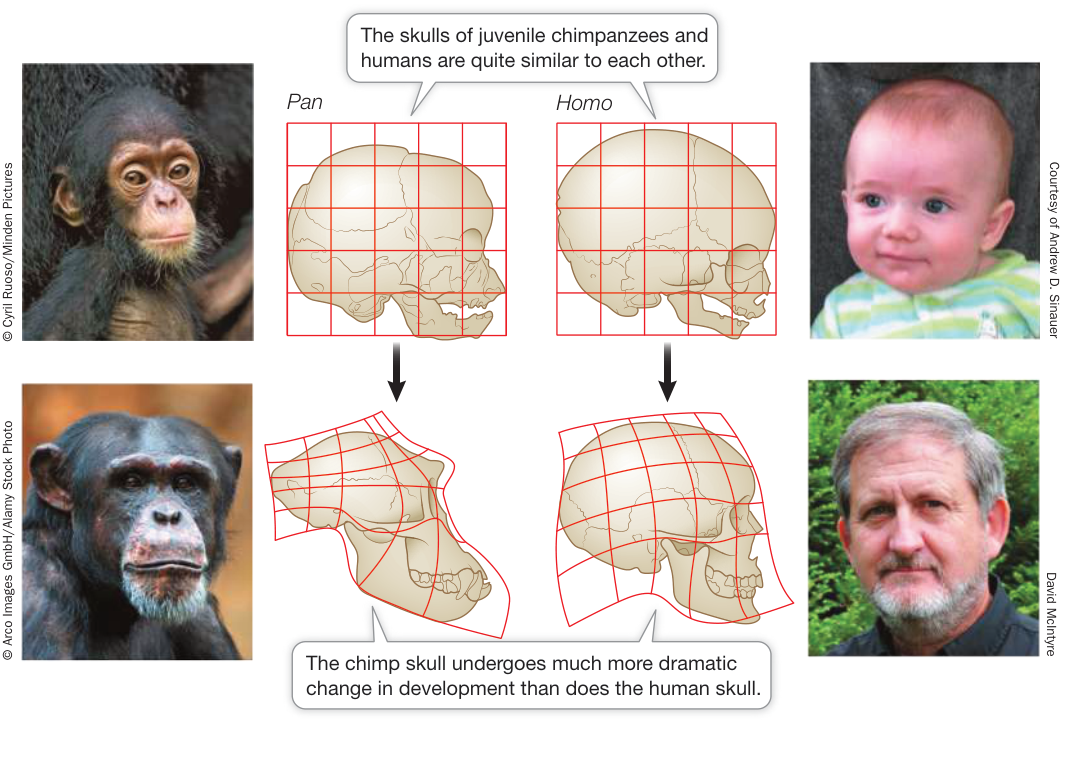
Figure 31.35 Neoteny in the Evolution of Humans The skulls and heads of juvenile chimpanzees and humans start out relatively similar in shape. The grid over the skulls shows how the various bony elements change in their relative proportions over the course of maturation. The adult human skull retains a shape closer to its juvenile shape, resulting in a brain that is much larger relative to other parts of the skull (notably the jaw).
Early modern humans made and used a variety of sophisticated tools. They created the remarkable paintings of large mammals, many of them showing scenes of hunting, found in European caves. The animals they depicted were characteristic of the cold steppes and grasslands that occupied much of Europe during periods of glacial expansion. Early modern humans also spread across Asia, reaching North America about 15,000 years ago (although some scholars argue for an even earlier date of arrival in the Americas). Within a few thousand years, they had spread southward through North America to the southern tip of South America.
Humans developed complex language and culture
As our ancestors evolved larger brains, their behavioral capabilities increased, especially the capacity for language. Most animal communication consists of a limited number of signals, which refer mostly to immediate circumstances and are each used in a specific context. Human language is far richer in its symbolic character than other animal vocalizations. Our words can refer to past and future times and to distant places. We are capable of learning thousands of words, many of them referring to abstract concepts. We can rearrange words to form sentences with complex meanings.
The expanded mental abilities of humans enabled the development of a complex culture, in which knowledge and traditions are passed along from one generation to the next by teaching and observation. Cultures can change rapidly because genetic changes are not necessary for a cultural trait to spread through a population. Cultural norms, however, are not transferred automatically and must be deliberately taught to each generation.
Cultural transmission greatly facilitated the domestication of plants and animals and the resultant conversion of most human societies from ones in which food was obtained by hunting and gathering to ones in which pastoralism (herding large animals) and agriculture provided most of the food. The development of agriculture led to an increasingly sedentary life, the growth of cities, greatly expanded food supplies, rapid increases in the human population, and the appearance of occupational specializations, such as artisans, shamans, and teachers.
Recap and Assess
Grasping limbs with opposable digits distinguish primates from other mammals. Bipedal locomotion and large brains evolved in the primate ancestors that led to humans, which facilitated the development of complex language and culture.
- Describe the differences between Old World and New World monkeys.
- Explain how neoteny resulted in the development of humans with relatively large brains and small jaws.

Activity 32.3 Deuterostome Classification

Activity 32.4 The Major Groups of Organisms
Investigating Life: QA What are the advantages and disadvantages of egg laying versus live birth?
Oviparity and viviparity involve some trade-offs of parental resources. In egg-laying species, all the nutrition for the developing embryo is supplied in the yolk. This means there is no continuing drain of parental resources as the embryo develops. One advantage of oviparity is that a female can often produce more offspring (since she devotes fewer resources to each one). Clutch size is often larger in oviparous species of lizards and snakes than in closely related viviparous species, although there are exceptions. Because each offspring in oviparous species receives a smaller parental investment compared with offspring of viviparous species, hatchlings tend to be smaller than the offspring of viviparous species.
Why is it sometimes advantageous for a species to commit more resources to fewer offspring? Developing embryos are retained in females in viviparous species, so females can control the temperature of development by behavioral thermoregulation. In high elevation and other cool environments, for example, females can bask in the sun during the day, and then retreat to cover at night. In addition, sometimes survival of offspring may depend on larger size and more parental investment. For example, in areas with short growing seasons and relatively cold temperatures, producing a few large offspring may yield significantly more descendants than producing a large number of small offspring that are less likely to survive. In contrast, in a favorable environment with abundant resources, producing many smaller offspring is likely to produce the most descendants. Indeed, there is a correlation between reproductive mode and elevational range in many groups of squamates, with oviparous species occurring at lower elevations and viviparous species at higher elevations.
Future directions
It is comparatively easy, from evolutionary and physiological points of view, for viviparity to evolve from oviparity in squamates. The membranes of the amniote egg can be modified to provide maternal nutrition, as well as gas and waste exchange (see Figure 31.19). Evolutionary reversal—from viviparity to oviparity—has been thought to be more difficult, since complex modifications for shell deposition, independent growth, and hatching from the shell need to re-evolve. But recent investigations have shown that many of these evolutionary changes can be accomplished by simple shifts in the timing and amount of gene expression, rather than through changes in the underlying genes themselves. A few candidate squamate lineages (including the huge venomous bushmasters of Central and South America) have been identified in which such reversals appear to have occurred. Biologists are now focusing on these exceptional reversals to learn how lineages may redevelop structures and physiological processes that were lost in ancestors that lived millions of years earlier.


© Sylvain Cordier/Getty Images
You should be able to relate each summary to the adjacent figures. If you go to this visual summary in Achieve, you can follow links to figures, animations, activities, and simulations that will help you consolidate the material.
Visual Summary
Deuterostomes Include Echinoderms, Hemichordates, and Chordates
- ■ Deuterostomes vary greatly in adult form, but based on the distinctive patterns of early development they share and on phylogenetic analyses of their gene sequences, they are thought to be monophyletic.
- ■ There are far fewer species of deuterostomes than of protostomes, but many deuterostomes are large and ecologically important.
- ■ The deuterostomes comprise three major clades: the echinoderms, hemichordates, and chordates.
Questions
- Draw a phylogenetic tree that depicts the relationships among the following animals: humans, sea squirts, sea stars, sharks, crinoids, and acorn worms.
- Based on phylogenetic and fossil evidence, how would you describe the earliest deuterostomes?
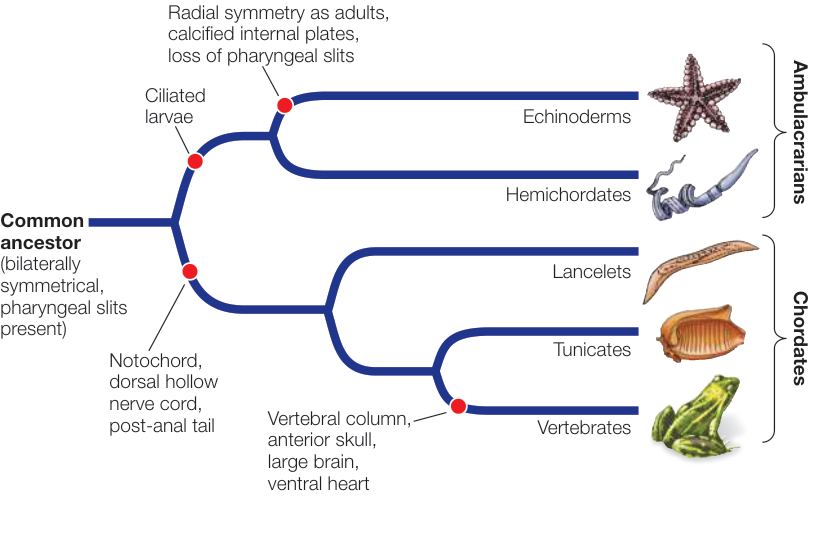
Figure 31.1
Echinoderms and Hemichordates Are Restricted to Marine Environments
- ■ Echinoderms and hemichordates both have bilaterally symmetrical, ciliated larvae.
- ■ Most adult echinoderms have pentaradial symmetry. Echinoderms have an internal skeleton of calcified plates and a unique water vascular system connected to extensions called tube feet.
- ■ Hemichordates are bilaterally symmetrical and have a three-part body divided into a proboscis, collar, and trunk.
Questions
- What evidence can you offer that the pentaradial symmetry of adult echinoderms is a derived (rather than ancestral) condition within the ambulacrarians?
- What two additional marine groups may be related to echinoderms and hemichordates (although their relationships are still debated)?
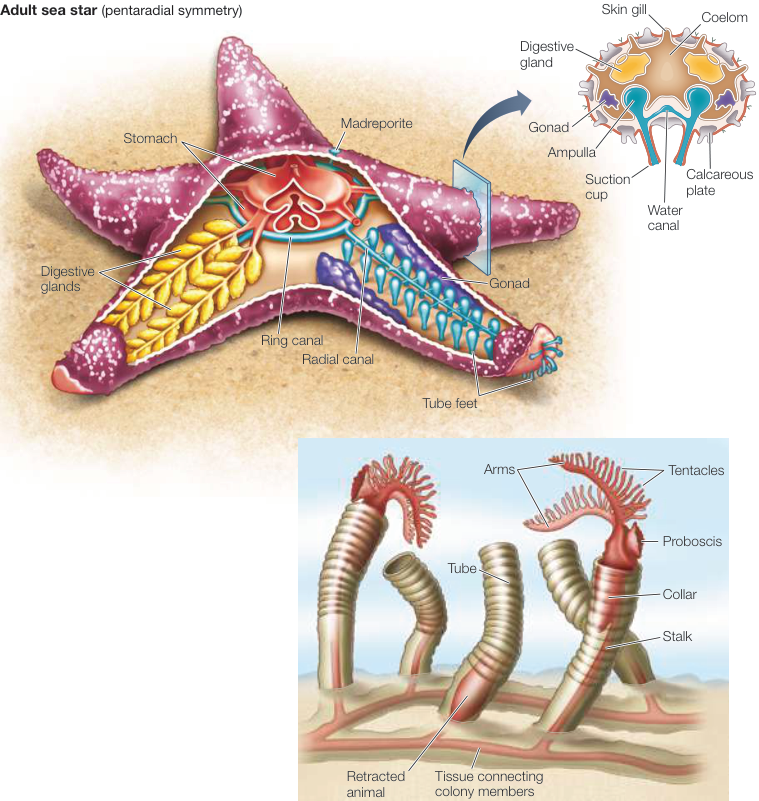
Figure 31.3
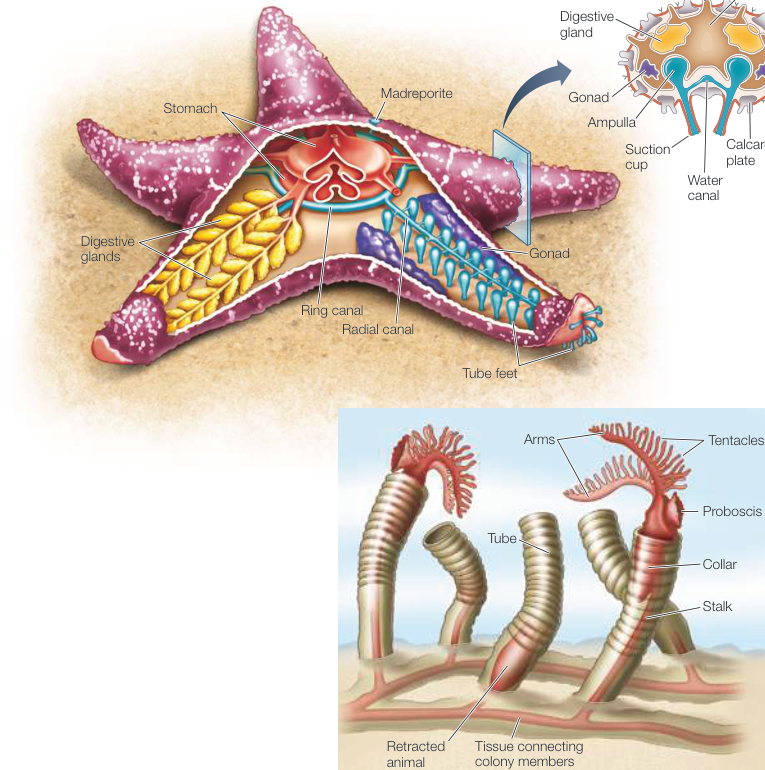
Figure 31.6
More Than Half of Chordates Are Also Aquatic
- Chordates fall into three principal subgroups: lancelets, tunicates, and vertebrates. At some stage in their development, all chordates have a dorsal hollow nerve cord, a post-anal tail, and a notochord.
- The vertebrate body is characterized by a rigid internal skeleton, which is supported by a vertebral column that replaces the notochord, internal organs suspended in a coelom, a ventral heart, and an anterior skull with a large brain.
- The evolution of jaws from gill arches enabled individuals to grasp large prey and, together with teeth, cut them into small pieces.
Questions
- Draw the phylogenetic relationships among the following animals: hagfishes, lampreys, sharks, ray-finned fishes, coelacanths, lung-fishes, frogs, and turtles.
- Name a shared morphological character that supports each of your groups in the tree from Question 1.
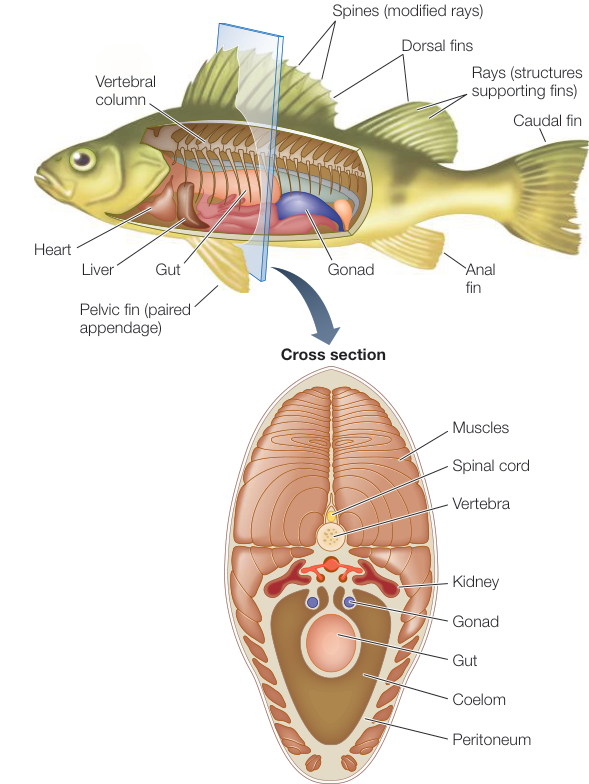
Figure 31.9
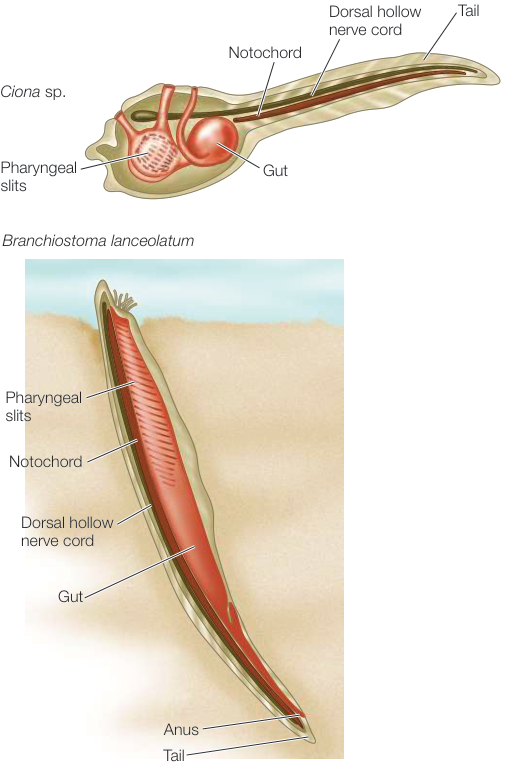
Figure 31.7
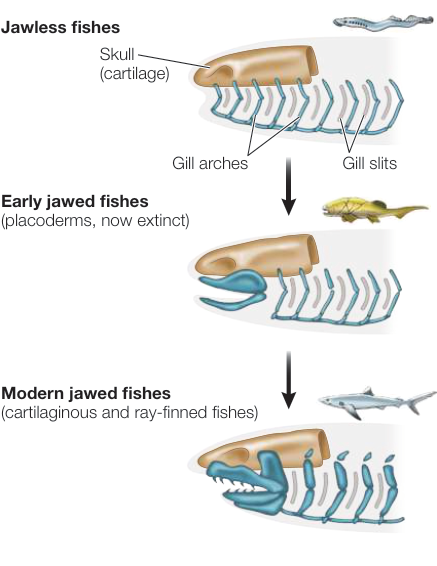
Figure 31.12
- ■ Lungs and jointed appendages enabled one lineage of lobe-limbed vertebrates to colonize the land. This lineage gave rise to the tetrapods.
- ■ The earliest split in the tetrapod tree is between the amphibians and the amniotes (reptiles and mammals).
- ■ Most modern amphibians are confined to moist environments because they and their eggs lose water rapidly.
- ■ An impermeable skin, efficient kidneys, and an egg that could resist desiccation evolved in the amniotes.
Questions
- What are two examples of aquatic lobe-limbed vertebrates that are not tetrapods?
- What are the two major groups of tetrapods that independently evolved the ability to maintain a relatively constant body temperature?
- Which group of living tetrapods is most closely related to the extinct non-avian dinosaurs?
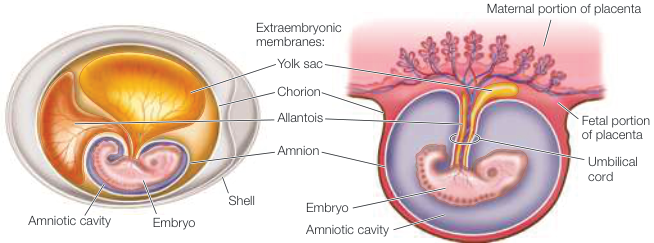
Figure 31.19
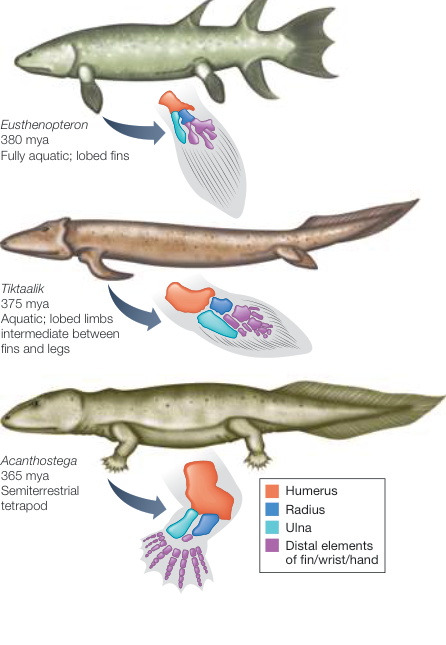
Figure 31.16
Humans Evolved among the Primates
- ■ Grasping limbs with opposable digits distinguish primates from other mammals. The wet-nosed primates include the lemurs, lorises, and galagos; the dry-nosed primates include tarsiers, New World monkeys, Old World monkeys, and apes (including humans).
- ■ Hominin ancestors developed efficient bipedal locomotion. Several species of Homo coexisted in parts of the world until recently.
- ■ Within the Homo lineage, brains became larger as jaws became smaller. The two events appear to be developmentally linked and are an example of evolution via neoteny.
Questions
- Several species of Homo are thought to have lived together on Earth until recently. Why is Homo sapiens thought to be the only species alive today?
- What evidence suggests that Homo sapiens interbred to some extent with other Homo species in the past?
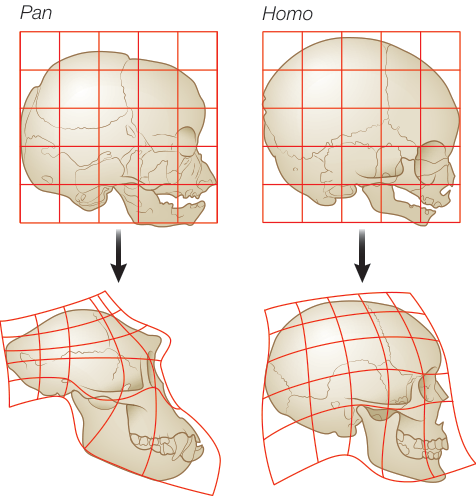
Figure 31.35